From the perspective of the 21st
Century it is difficult to imagine the
repressive atmosphere of Cromwellian
England, let alone the intense artistic
rebirth brought about by the monarchy
in 1660.
Charles II encouraged
the arts, not least music, with the
re-establishment of a thriving court
music. This not only boasted its own
orchestra, but an ensemble known as
"The Twenty-Four violins",
clearly in emulation of his French cousins
at Versailles.
Matthew Locke, a Devonian
trained at Exeter Cathedral, managed
to survive the excesses of the Civil
War to assume a prominent place at Court.
On the outbreak of hostilities he fled
to the Netherlands but returned three
years later to involve himself in what
remained of a musical scene in London.
In 1656 he collaborated with William
Davenant on the "Siege of Rhodes"
an entertainment with music. Often described
as the first English opera, it was one
of the few stage events to survive the
puritanical rigours.
Yet during the Commonwealth
the centre of musical activity had switched
to Oxford, where the emphasis was on
the intimate world of the viol consort,
recitals taking place in the privacy
of the homes of "gentlemen".
Despite the fact that Locke was handily
placed in 1660 to take advantage of
the new found activity at court, (most
of his contemporaries being too old),
he decided to retain a foothold among
the Dreaming Spires. Indeed he was inspired
to do so by a great Oxford figure, the
enthusiastic Professor Edward Lowe,
who encouraged him to write a number
of works for its music school. Moreover
it was profitable labour/ It is recorded
that in July 1672 Locke was paid the
handsome sum of £3/19s/4d for music
used in the university’s annual degree
ceremony, the work in question almost
certainly being "Descende caeol
cincta soroibus", the first track
on the present disc.
The need for new repertory
after the Civil War also resulted in
Locke writing for the Anglican liturgy
despite being an avowed catholic. "Be
thou exalted" (track 8), a fine
polytonal anthem, was performed at Whitehall
on 14 August 1666 to celebrate Albermarle’s
victory over the Dutch. One listener,
a certain Samuel Pepys, later recorded
in his diary, "(a) special good
anthem".
There is much to enjoy
then on this fine reissue, recorded
at Rosslyn Hill Chapel to accord as
closely as possible with the modest
acoustics encountered at Whitehall and
Oxford. If forced to nominate a personal
favourite it would have to be the work
which became his most popular after
his death, "Lord let me know mine
end" (track 6). The simplicity
of the opening with a solo voice I still
find breathtaking and intensely moving.
The performances are
generally admirable. Just occasionally
a slight eyebrow may be raised at the
intonation of one of the boy’s voices,
although that said I felt Oliver Johnston
excelled throughout. Good clear recording
quality too. Recommended.
Ian Bailey



 Choir of New College, Oxford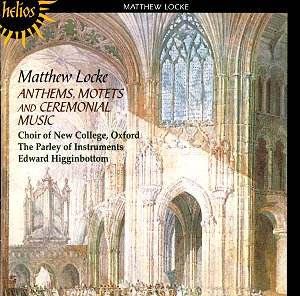
 for
details
for
details











