Schulhoff’s First String
Quartet was written in 1924 and makes
a real impression. It’s the most characteristic
work here, because the latest, and came
after the success of his earlier Five
Pieces at the International Society
for New Music festival in Salzburg the
previous year. He had only recently
returned to Prague after a prolonged
stay in Dresden and marked shifts in
his compositional direction were becoming
increasingly apparent. It’s a concise
work, no more than a quarter of an hour
in length and cast in four movements.
And yet what a punch it packs. Alternately
stormy and fleet the broadly neo-classical
argument drives over rock steady pizzicati
with plenty of dance-derived material
and well-controlled, terse lyricism.
The nocturnal life of the second movement
is explored above the viola’s melody
line with the first and second fiddles
skittering at the top like fireflies.
Some of these sonorities are reminiscent
of Janáček’s in their rapid angularity
and then cantilever lyric release,
but the older composer’s First Quartet,
though written toward the end of 1923,
wasn’t performed until October 1924;
Schulhoff’s was finished in September.
In terms of nervous tensile strength
however there is some felt influence
at least, as there is also of Bartók.
A Slovak dance courses through the third
movement full of folk fiddlery and the
finale is the longest and most intense
of the four – the slow movement. Textures
here are thinned; he uses harmonics
to especially descriptive and impressive
effect and the ambivalent heart of this
work is laid, if not bare, then at least
evident, as the tick-tocking motif flickers
to the end. This is a major example
of twentieth century, mid European quartet
writing; it has big gestures and subtle
ones, plenty of right hand fireworks
in terms of bowing colour and effects,
and an ambiguous cumulative sense of
power.
If the other two companion
works are not as distinctive they are
avowedly not lacking in incident and
colour. The 1914 Divertimento is an
example
of clean-limbed neo-classicism, written
in five movements. Songful, folk-flecked
and with a touch of late Dvořák
its larger gestures are reserved for
the fourth movement Romance where the
Schulhoff Quartets digs deeper into
its collective vibrato for maximal
expressive effect. It’s true that Schulhoff
tended, from a post-war perspective,
to disown his earlier works as immature
but though the Rondo finale is a touch
diffuse and doesn’t quite sustain its
length he’d certainly served notice
that his handling of a quartet was already
enviably proficient and that he could
spin a line melodically. The Five Pieces
explore a similar arc of proficiency
but are more humorous with a Viennese
Waltz (that will set you thinking about
Britten’s Bridge Variations of 1937)
and a Tango and Tarantella. There’s
more lithe colour in the little Serenata
and an increasingly free Iberian warmth
in the Tango Milonga, full of fillip
and fun, topped by a tensile and driving
Tarantella.
The recorded sound
has enough warmth to bring out the fine
tonal bland of the eponymous Schulhoff
Quartet but is tart enough to reflect
the acerbic neo-classicisms embedded
along the way. The venue was the Domovina
Studios – which helps. Neat and tidy
notes complete a fine disc. You may
have the Brandis’s recording of No.1
on Nimbus but that’s coupled with Hindemith
No.4 and Weill Op.8 but I think all
Schulhoff admirers will want to acquaint
themselves with this one from the Schulhoff
Quartet.
Jonathan Woolf



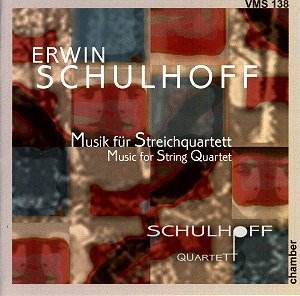
 Schulhoff Quartet











