Daniel Lippel is a
New York-based guitarist, who is intensely
committed to challenging contemporary
music. He performs both as a soloist
and in different groups so far afield
as the Zvi Migdal Tango Ensemble and
Mice Parade, an indie-rock group. He
also collaborates with many composers;
besides those who appear on this disc:
names like George Crumb and Aaron Jay
Kernis. The list of his teachers includes
David Starobin, Jason Vieaux, David
Leisner and John Holmquist, of whom
especially David Starobin has played
an important role as his mentor. Contemporary
music is unfortunately mostly relegated
to specialist festivals and minor venues.
The major record companies mostly fight
shy of anything written by composers
still alive. It is to be hoped that
this brave project will pay dividends
in the end, for although all the music
on this disc was written within the
last fifteen years it should be readily
accessible even to non-specialist listeners
or guitar freaks. What is needed is
an open mind and open ears.
Apart from using my
mind and ears I have also culled information
from the booklet notes, where in several
cases the composers are quoted. My only
regret is that the designer of the booklet,
has not – as so often is the case –
been able to withstand the temptation
to print the text in white against a
brownish background. It might look stylish
but readability is low. But there my
complaints end. The text, when I had
found my magnifying glass and a suitable
spotlight, is illuminating (sorry about
the pun), the sound is well defined
and realistic, quite closely recorded
but still without the sort of extraneous
noises that often afflict guitar recordings.
The recording engineer – and also co-producer
with Daniel Lippel – is Peter Gilbert,
who is also the composer of the music
on the last track on the disc.
Although written during
roughly the same period the music here
is nicely differentiated, each of the
composers having an individual voice.
It also seems that none of them is a
guitarist and that may be one reason
for the successful results, thinking
more in terms of music as opposed
to guitar music. The oldest of
them, the doyen of American music, Elliott
Carter, is represented by a short piece
(less than 3 minutes), composed for
David Starobin in 1997. It is filled
with pleasant surprises and rhythmic
vitality, swinging violently before,
in the end, it dissolves into thin air.
Here Carter very decisively marks the
end of the composition with a very earth-bound
full stop.
Mario Davidovsky, born
in Argentina, who has been one of the
fore-runners in the field of electronic
music, combines a pre-recorded and altered
tape with the live guitar. This piece
was also written for Starobin and the
use of unvarnished guitar sounds against
the processed guitar sounds from the
tape gives the music a feeling of unity.
The electronics do not enter until halfway
through the composition and before that
the music flows in a lyric-melodic vein
but spiced with violent outbursts of
powerful chords and percussive effects.
Fascinating!
In Nils Vigeland’s
La Folia Variants the well-known,
late Renaissance theme is used, in the
composer’s own words, "more as
a point of departure rather than a foundation".
It is a quite extended work in three
movements, where the central Sonata
is powerfully contrapuntal while the
concluding Dances are more lyrically
reflective, the dance elements appropriately
more in the line of the stylized dances
of the baroque than the more flexible
and rhythmically more intense dances
of later periods.
Seoul born Soonjung
Suh uses elements from traditional Korean
music which he dresses in modern harmonies.
Garak, meaning Melody, is partly
an introverted composition but in the
middle section also highly virtuosic.
In Judah E Ardashi’s
Meditation, loosely based on
the first three chapters of William
Styron’s Memoir, the silences
between notes sometimes seem just as
important as the notes. People of today
are very often unfamiliar with silence
but to me it seems that the moments
of afterthought occur in the silences.
Just as Davidovsky’s
Synchronisms, which start the
programme, Peter Gilbert combines the
guitar with electronics, but uses them
quite differently. In Ricochets,
a premiere recording like most of the
contents on this disc, we experience
a constant combat between the electronically-produced
sounds of the modern industrialized
society and the solo instrument, which
for its survival prepared with a pencil
stuck between the strings at the fourth
fret and tin foil being wrapped around
the neck of the instrument, which is
also differently tuned. The human mind
obviously has to adjust to the technological
surrounding and the composition seems
to end somewhere in outer space. We
don’t really know whether the instrument
gets the last word, but to my ears at
least the last chord of the guitar lingers
ever so little after the electronics
have died away. Hopefulness? Daniel
Lippel writes "resignation".
Whatever, it is the composition – and
the whole disc – is thought-provoking
and stimulating. Much of the music is
extremely demanding for the guitarist
and I can’t imagine it being better
played.
Some people I know
refuse to listen to music by other composers
than those who have been dead for at
least 100 years. This disc is not for
them. Everybody else should definitely
find this – as I said earlier – thought-provoking
and stimulating.
Göran Forsling



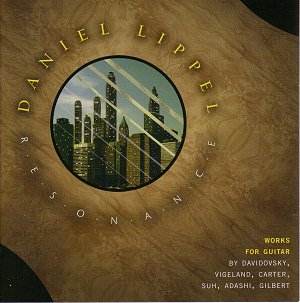
 Daniel Lippel (guitar)











