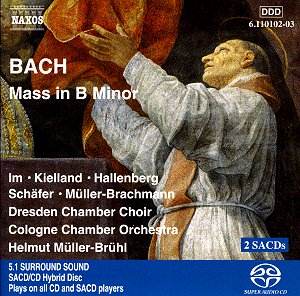
Comparison Recordings of the Mass
in b:
Hermann Scherchen, VSO & Akademie
Kammerchor. [mono ADD] Westminster/JVC
MVCW 14015/6.
Robert Shaw, his Chorale and Orchestra.
[ADD] RCA/BMG "Living Stereo"
09026-63529-2
Fritz Lehmann, Bavarian Radio Cho. &
Orch. Urania & Vanguard [mono] LP
Joshua Rifkin, The Bach Ensemble. Nonesuch
9 79036-2
Johannes Somary, Amor Artis Chorale,
ECO [only 2 channel so far] [ADD] Artemis
Classics 69967-51242-2
Eugen Jochum, Bavarian Radio Cho. &
Orch. [ADD] Philips 438 739-2.
Nicolas Harnoncourt, Wiener Sängerknaben,
Concentus Musicus [ADD] Teldec 8.35019
ZA
Also mentioned in the review:
St. Matthew Passion, Peter Schreier,
Staatskapelle Dresden. Philips 412 527-2
This work has perhaps
the most complicated composition, performance,
and recording history of any work by
Bach. It was composed in bits and pieces,
with the Crucifixus being composed
in 1714, the Qui Tollis in 1723,
the Gratias Agimus Tibi 1731,
Kyrie and Gloria in 1733,
all based on earlier sketches. The music
for the Credo, which makes it
a fully Catholic work, came to light
in 1729 as part of Cantata 171.
It is assumed that the Et resurrexit
is based on a lost concerto. At the
time of Bach’s death the work still
did not exist as a single manuscript
with the title Messe; many performances
had caused the pages to be damaged through
use and handling, so C.P.E. Bach had
to fill in a few missing bars here and
there in his father’s style.
The earliest performances
in the Nineteenth Century were naturally
by full symphony orchestra and large
chorus. The 1958 Jochum recording is
in these dimensions and for all the
outrage directed at it by the original
instrument people, the recording is
still in print after many years and
still carries off the power and excitement
of the work. The earliest recording
in high fidelity and then-state-of-the-art
original instrument/original performance
practice was by Hermann Scherchen in
1950. In this brilliant single channel
recording the chorus comes across as
a crowd of people who are very excited,
who have something very important they
want to tell you. Anton Heiller is the
organist and Anton Dermota the tenor
soloist. Later in the fifties Fritz
Lehmann’s recording gave Scherchen serious
competition with brighter sound, wavery
but authentic high natural trumpets,
and a more disciplined yet still exuberant
chorus.
The first recording
in stereo was on RCA in 1960 by the
38-year-old Robert Shaw’s touring performance
group (hopefully soon to be released
as a three-channel RCA "Living
Stereo" SACD). He thinned out the
texture by having solo voices sing the
choral lines when unaccompanied or accompanied
by only a few instruments, with the
full chorus only coming in with the
full orchestra, an innovation that paved
the way for Joshua Rifkin’s 1982 recording
with solo voices throughout, a manner
of performance we know was at least
occasionally utilised in Bach’s time.
These two recordings still stand as
among the finest ever done of the work,
as does Harnoncourt’s 1968 version,
the first to use boy sopranos exclusively.
Lest you think Müller-Brühl’s
is the first recording in surround sound,
that honour belongs to Johannes Somary,
the Amor Artis Chorale, and the ECO,
released on Vanguard SQ quadraphonic
disks in 1970, which recording has not
yet been released on a surround sound
SACD, but other performances recorded
by that conductor made at that time
have been, so it may only be a matter
of time. Müller-Brühl’s is,
however the first high resolution digital
recording to be released on surround-sound
SACD.
The classic recordings
of this work explore the frenzied, passionate
ecstasy of the contrapuntal high chorales,
and the solo arias give us a chance
to catch our breath before being once
again hurtled into galactic space. In
the notes to the classic Shaw recording
the maestro is shown drenched with sweat,
hair standing out in spikes like the
crown of the Statue of Liberty, baton
raised, head back, eyes closed, buffeted
as by a high wind by a religious ecstasy
which pours out of the music and over
him in a flood. Thirty years later,
he re-recorded the work in Atlanta,
but, like many attempts by old men to
revisit the passions of their youth,
the result is best not mentioned—more
calm dignity and precision and very
little ecstasy.
The recording of the
St. Matthew Passion by Peter
Schreier and the Staatskapelle Dresden
is amazing in that it completely ignores
the morbid, tragic aspects of this program
and treats each musical selection purely
as music, performed as lightly and joyously
as possible. This is a very unusual
approach, of course, and, due to Schreier’s
genius—and Bach’s genius—it works brilliantly.
We are led to wonder if Bach thought
of this work as he thought of his God
and his religion, entirely in terms
of joy and delight, even when contemplating
the gloomy, bloody, and gory aspects
of the Christian mythos.
So, with this in mind,
is it possible that Bach thought of
the Mass in b more lightly than
the classic recordings suggest? Clearly
that’s what Müller-Brühl thinks,
and he has made a careful study of Baroque
religious music. He treats the chorales
more the way one would perform the Fauré
Requiem, lightly and cleanly,
deliberately (one assumes) shying away
from dynamic, dramatic climaxes and
frenzied ecstasy. As a result, the arias
become the dramatic high point of the
performance, the concentration of emotion,
with the choral comments relegated to
a connecting, background role. From
the photograph of the recording session
I count 34 in the chorus, or 8½ voices
per part on the average; the contrapuntal
lines are clear without exaggeration.
The soloists are uniformly excellent
and respond to their being in a brighter
spotlight by investing their arias with
more concern and independent drama than
we’re used to. This is a soloists Mass
in b.
Further contributing
to the smallness of this recording is
that it sounds like it is recorded in
"European" or ITU775, "side
surround" sound, rather than in
Hollywood "four in the corner"
"rear surround" sound, i.e.,
there is no centre rear channel information.
As a result the acoustic of the recording
space is not vividly depicted although
the sound sources are well delineated—but
not all that much more than, say, the
Shaw two channel version when played
through a surround sound decoder.
Paul Shoemaker
see also
review by Zane Turner