What triggers our interest
in ‘serious’ music? Quite often, I guess,
it’s a film or - perish the thought
- a TV advertisement, or something overheard
on the car radio. Usually, some musical
plum or meringue, which means less and
less to us as we ‘mature’. My earliest
musical friends seemed always to follow
the same route - from the Nutcracker,
Finlandia or the Ride of the
Valkyries ‘outwards’. But not me!
My Damascus Road experience
was Beethoven’s Fourth Symphony. Not
the violin or clarinet tunes of the
slow movement, or the bustling energy
of its finale, but two transitions in
the first movement. The passage of staccato
unison minims, rising chromatically
out of the canonic second theme towards
the tutti which rounds off the
exposition. And second, the magical
transition linking the pianissimo
climax of the development to the inspired
moment of recapitulation, in which Beethoven
slips from the remote key of F sharp
into the ‘home’ key of B flat by the
divinely simple use of an enharmonic
pun, the timpani’s A sharp (the leading
note of the ‘leaving’ key) becoming
- unnoticed! - B flat, the tonic note
in the ‘arriving’ key. I guess that
tells you something about me. These
are ‘nuts and bolts’ moments of no real
melodic or even thematic significance,
but moments of wonderful drama and mystery!
Life has never been the same since,
and this sublime music has always maintained
a special place in my affections.
I’m not sure why I
burden you with this very personal recollection.
Partly, I suppose, because Classic fM
- and the modern trend towards the ‘Greatest
of This and That’ - encourage us to
indulge in moments, moods and melodies,
rather than the architecture of a piece,
or the fuller picture which is painted
when we hear a whole piece, rather than
mere bits of it. I know of people who
know the Fifth Symphony’s first movement
who reckon they know Beethoven’s
Fifth Symphony! But they’ve never experienced
the life-changing half-hour sea-crossing
from C minor darkness into C major
light (a C-crossing!) of which that
first movement is but a portion.
The best Beethoven
performances pace themselves, and take
an overview. The map is as important
as the journey. Every great moment needs
to be relative to another - no detail
assuming unjustifiable prominence, no
climax being assigned undue weight.
Vänskä’s conducting is up
there with the best. It’s true that
there are alternatives in the catalogue
which deliver more weight, more incisive
articulation, more youthful energy,
more unanimous ensemble, perhaps even
more outright beauty. But few that are
more loyal to (more revealing of) the
wholeness of Beethoven’s conception.
In the Fourth, Gardiner
(on original instruments) is explosively
dynamic. Likewise Zinman, who - on modern
instruments - is extraordinarily agile:
and he ornaments some slow movement
wind solos daringly but persuasively.
Vänskä, you could argue, is
uncontroversial, and a safer choice
for everyday listening. He is unobtrusive
without being anonymous. The slow introduction
to his first movement is superbly atmospheric,
imparting an impressive sense of forthcoming
occasion - like the overture to an opera.
And the main body of that same movement
grows compellingly, with every building
brick in its rightful place. The third
and fourth movements are not remotely
hard-pressed, providing excitement through
enhanced rhythmic clarity rather than
relentless forward drive. (Interestingly,
you may have noticed, his Fourth is
longer than his Fifth!)
I’ve been guilty of
holding the classic Kleiber Fifth (surely
one of the great recordings - of any
music - of all time?) in such high regard
as to consider it definitive. But the
notion of a ‘definitive’ performance
of such music is dangerous. Kleiber
conducts this music like a Churchillian
oration - as if our lives depend on
it, as if a message for all humanity
and all time. It’s a performance of
near-desperation - overwhelmingly weighty
and dynamic. On the other hand, Harnoncourt
- and what a wonderful cycle his is!
- asks less of his COE players, moving
from staging post to staging post, speaking
with tremendous conviction, but without
impatience. Likewise Mackerras, another
admirable cycle, whose middle-of-the-road
Liverpool readings are intelligent -
powerful, without being oppressive.
The Abbado-Berlin and
Rattle-Vienna sets are the nearest thing,
stylistically, to Vänskä -
modern instrument performances illuminated
by ‘modern’ thinking. The almost
equally impressive Davis-Dresden and
Barenboim-Berlin sets are (dare I say
it?) more old-fashioned - musical, well-considered
and well-played, but slightly ponderous
and heavyweight, in the Klemperer-Furtwängler
mould.
These Minnesota performances
are ‘zoom lens’ performances where the
conductor allows us to see the wide-angle
whole as well as the telephoto detail.
They’re as good as any in the catalogue
- as long as you don’t want your Beethoven
breaking records!
Peter J Lawson



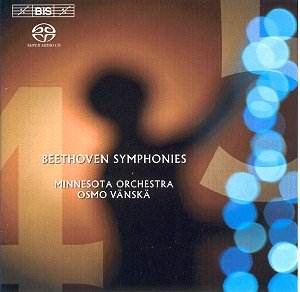
 Minnesota Orchestra/Osmo Vänskä
  BIS
SACD 1416 [67:03]
BIS
SACD 1416 [67:03]