Four works from across
the span of Sallinen's creative years.
Here is a Finnish composer whose first
successes came in operas such as The
Red Line and then in symphonies
1 and 3. All three were recorded during
the late-1970s vinyl Götterdämmerung,
the opera on Finlandia; the others on
Bis.
Sallinen’s style is
modern, definitely not a swooning post-romantic,
but amongst the stubborn, discontinuous
triumphs and terse, expressive ideas
there is a real lyrical sympathy.
Shadows is all
steely silvery awe with a wandering
Sibelian bass which transforms into
a billowing cannonade of vehemently
threatening sound.
Symphony No. 8 represents
the essence of discontinuity. It speaks
of anxiety-haunted exploration. The
opening is spattered with sparse woodblock
clatter under an awed brass-led largo.
This percussive clatter provides the
germ for rhythmic propulsion alongside
the pensive foreboding. Woodwind chirping
suggests woodland glades and moments
of rest among the green shadows and
cool forest ponds. The bell finale is
built from the notes of the name of
the orchestra ConCErtGEBouw AmstErDAm.
The title, Autumnal Fragments,
relates to the World Trade Centre tragedy
and 9/11. Any tendency towards woodland
restfulness is expelled by the violence
and nervy-jerky activity of most of
the second part of the symphony of which
this is the world premiere recording.
That sense of pastoral Sibelian benediction
returns at 15:32 and alternates with
glimpses of horror. The work ends in
a calming yet sterterously funereal
cortege that finally slides into silence.
This is the third recording
of the Violin Concerto. You can hear
one on Campion coupled with the Sibelius
and the irresistible but reactionary
Janis Ivanovs' concerto; don’t miss
it. The recording here is much more
refined and also has greater grip at
every dynamic level. This early work
predates the wonderful Sinfonia which
was his first symphony. This was originally
coupled with No. 3 on a ikonic Bis LP
which, along with Arto Noras's version
of the cello concerto, really established
Sallinen's orchestral music with me.
The concerto is an intense song for
violin and orchestra, very romantic
in a modernist sense, somehow Sibelian
without replicating the language, It
is not 12 tone but feels modern and
the zither and harpsichord encapsulate
this at the start of the second movement.
Rhythmic germs and fragments are at
serious play in the finale which displays
the excellently resonant sound-image
captured by the CPO team. I am not at
all sure that this a successful work
as a whole but it certainly fascinates
in its flood of incident and imagination.
Operas have played
a central role in Sallinen's work. These
range from his earliest celebrity: Ratsumies
(The Horseman), 1973, to
The Red Line 1976-1978, The
King Goes Forth to France 1983,
Kullervo 1986-88, The Palace
1991-93 and finally (so far) King Lear
1997. Shadows has its origin
in The King Goes Forth while
The Palace Rhapsody's operatic
sources are self-evident. This work
is scored for winds, percussion, harp
and orchestra. It has a more candidly
Sibelian accent and is a work of line
and continuity much more than the Eighth
Symphony. It is thoughtful, brooding
yet with flashes of brilliance. Sallinen
says that he has created it in much
the same way as did the arrangers of
‘harmoniemusik’ operatic potpourris
in the 18th century.
For the latest in Sallinen's
symphonic line this CD is IT. Of the
other items I make an urgent recommendation
to you for The Palace Rhapsody which
for all its operatic origins has a symphonic
weight and momentum alongside some unusually
jazzy, Malcolm Arnold asides and Ivesian
interjections towards the end. This
is a fascinating ‘confection’ not without
humour but not such as to torpedo this
impressively fantastic piece.
CPO’s second volume
in their invaluable Sallinen Edition
is as expected superbly documented and
recorded.
Rob Barnett



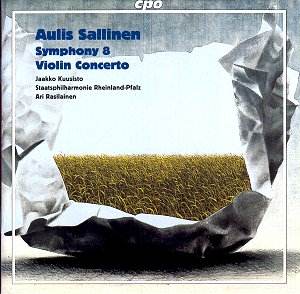
 Jaakko Kuusisto (violin)











