The Naxos tradition
of forwarding the career of competition
winners continues with Jean Dubé,
winner of the Sixth Utrecht Liszt Competition
in 2002; one competition distinction
among many, it seems. Something of a
prodigy - performing Mozart’s Piano
Concerto No. 5 with the Radio France
Philharmonic at the age of nine - he
is a pupil of John O’Conor.
Dubé is a sensitive
musician, of that there is no doubt.
It is a quality that stands him in good
stead in the music of Liszt. This is
a fascinating programme he has picked
or had picked for him. The most popular
work is the shortest, ‘Au bord d’une
source’, although the two Ballades
have swung in and out of popularity.
Jorge Bolet, I seem to remember, gave
a memorable Second at the RFH once.
The Polonaises and, especially, the
Trois Morceaux Suisses, sit more
towards the fringes of Lisztian output.
The first of the two
Polonaises, in C minor, is sometimes
known as ‘Polonaise mélancholique’,
and with good reason. Some of the filigree
is decidedly Chopinesque, veering suddenly
back to unmistakable Liszt as if to
correct itself. Dubé shows himself
as a clear talent, not intervening too
much, just allowing the music to flow.
He is particularly good at the darker
side of this composer; something that
will stand him in good stead in the
second Ballade. The piano recording
is more than acceptable without being
overly noteworthy – there have been
better sounds coaxed out of this venue
(Potton Hall).
The second Polonaise
is more heroic in nature. There is a
‘twang’ to the recording that some might
not warm to when Dubé veers towards
the fff. Nevertheless, this makes
for riveting listening, and Dubé
catches the flights of fantasy well.
The first Ballade
has a subtitle of ‘Le chant du croisé’
('The Crusader’s Song'). Dubé
coaxes a rich sound from his instrument,
his voicing is exemplary and he brings
across some sense of quasi-improvisation.
But it is in the B minor Ballade
that Dubé actually excels. The
initial left-hand exemplifies the care
here, sitting on the line between definition
of individual notes (one can hear them
all) and ominous rumbling. If Dubé
tries too hard in the chordal statements,
he elucidates the structure well by
means of mature pacing.
Au bord d’une source
emerges logically and effectively
out of the decrescendo that closed the
preceding Ballade. Surprisingly,
though, this brief piece (5’08) is given
a stilted rendition. On the stiff side,
the waters refuse to flow as in Nature
(appoggiaturas similarly sound forced).
Repertoire-wise, the
most interesting inclusion here by far
is the Trois morceaux suisses,
published as ‘Op. 10’ (later appearing
in the ‘Album d’un voyageur’). The first
is ‘Ranz des vaches: Mélodie
de Ferdinand Huber, avec variations’.
Dubé is obviously ‘thinking’
in terms of a brass instrument in the
opening ‘call-to-arms’ before the set
of free variations gets under way. Few
composers can produce Variation sets
like Liszt, and Dubé leads us
through them with an assured hand. The
second is a Nocturne (‘Un soir dans
la montagne: Mélodie d’Ernest
Knop’. It takes the form of a yodelling
song melody by Knop. Being a Nocturne
it is not quite what one might expect
of a yodelling tune. It also includes
some ‘stormy weather’ during its travels.
Finally, a Goatherder’s Song provides
the material for the third (again, Huber).
By turns turbulent, delightful, playful
and (finally) unabashedly virtuoso,
it suits Dubé’s youth to a tee.
Well worth hearing.
Dubé is a pianist to watch. His
biography paints a portrait of a well-travelled
artist, but one that has yet to reach
the shores of the UK. Maybe this can
be fixed?
Colin Clarke



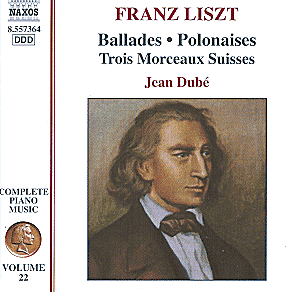
 Jean Dubé (piano)











