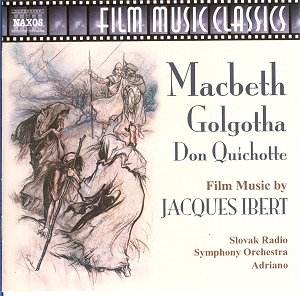
Adriano has scored
another winner with this scintillating
and thought-provoking Ibert disc. It
was recorded a full decade and a half
ago on Marco Polo and is now reissued
in Naxos’s Film Music series and joins
some luminous recordings in that series
such as Yablonsky’s Shostakovich Hamlet,
Stromberg’s recording of Steiner’s Mark
Twain and Adriano’s own exemplary release
of Honegger’s Les Misérables.
Ibert was a consummate film music composer
– subtle, tensile, avoiding cliché
and easy gesture, capable of real élan
in his orchestral or ensemble timbres
and knowing just how to screw up or
relax tension.
His music for Orson
Welles’ Macbeth (1948) uses chamber
forces and weird colours to just such
effect. The Overture to the Suite (the
meeting with the witches) is dripping
with tension and employs a piano, percussion,
celesta and violin harmonics to nerve-tingling
effect. The flirting with atonality
only increases the effect. Malign brass,
jagged string writing, muted trumpet,
and the impulse generated by the percussion
are all part of his colouristic and
rhythmic vocabulary, from those glowering
brass chords in the Murder of Duncan
to the strange muted string intimacies
in the same scene. After the murder
we can sample nasty sounding low brass
and a malign kind of dance as the original
martial music is subject – as it is
throughout – to constant permutation
and recasting. The sonorities for the
Ghost of Banquo sound almost like a
wind machine, so effective is Ibert’s
writing – brass shiver, bass clarinet
doom, off-kilter piano. And the final
transfiguration of the March theme,
heard throughout in different guises,
comes in Macduff’s victory where the
tension ratchets up incrementally until
we reach a gloriously affirmative apotheosis.
Golgotha dates from
1935 and is heard here in Ibert’s own
suite, with Adriano’s restoration of
an important eight minute cut. Bold,
vividly scored and full of brass bustle
the characterisation level throughout
is high. The opening movement, Les fêtes
de Pâques, is a particularly long
one – thirteen minutes – but very well
sustained and full of incident and drama.
The Biblical scene setting is, as one
would expect of Ibert, the obverse of
gaudy and self-satisfied; instead he
hints at mercantile bustle, inserts
a remarkable slo-mo moment for the Sellers
in the Temple scene (which acts as a
kind of Scherzo) and employs some wind
effects for the difficult scene in Calvary.
He does employ some baroque sounding
brass calls in the Crucifixion but The
Agony is not overdone; skirling strings,
eruptive little lines but most particularly
the spooky ondes martenot – which imparts
more than its fair share of the extra-human
to the later martial-noble sounding
muse.
The most well known
of this triptych is Don Quichotte, which
has retained something of a hold in
the repertoire and was most associated
with Chaliapin. Adriano has rediscovered
and orchestrated the Chanson de Sancho
with a blast of music hall vitality.
The others winnow down to five accompanying
instrumental voices or vest swathes
of cool Spanishry over the songs, well
characterised by the bass Henry Kiichli.
The most extrovert is Chanson du
duc with its harpsichord and antique
aria reflections, the most fully expressive
the mournful Chanson de la mort.
The Slovak Radio Symphony
sounds very well drilled in this repertoire;
a lot of preparation has gone toward
the success of the disc and it’s a pleasure
to welcome it back to the fold, not
least at such a tempting price.
Jonathan Woolf



 Henry Kiichli (bass) +











