Anyone wanting a copy
of Pergolesi’s Stabat Mater has
a bewildering variety of recordings
to choose from. These range from well-upholstered
performances from star singers such
as June Anderson and Cecilia Bartoli
to early music specialists.
Australians Sara Macliver
and Sally-Anne Russell have now recorded
the work. This new disc makes an attractive
follow up to the singers’ disc of Bach
duets, also with Antony Walker [review].
Macliver and Russell
both have attractive, even, well-produced
voices that blend well. Macliver has
a bright, flexible soprano that is perhaps
rather richer than is common with sopranos
recording with period instrument orchestras;
no bad thing you might say. Russell
has a rich, even contralto and has no
problems with the tessitura of a part
which is commonly taken by counter-tenors.
An added advantage
to the pairing is that Macliver and
Russell have voices which blend beautifully.
But it is not just their voices that
blend; the two seem to move as one in
the duet passages. The results make
for gorgeous listening. Pergolesi’s
suspensions in the opening movement
have never sounded spine-tinglingly
lovelier.
When I reviewed the
pair’s Bach disc, a drawback to their
approach was a certain reticence with
the words; this continues with the Pergolesi.
Whilst Pergolesi’s decoratively operatic
movements may not need the attention
to textual detail that Bach’s arias
do, the Stabat Mater is a seriously
heavy text and does need projection,
something that Macliver and Russell
do not give. As their voices are so
richly beautiful, we seem to be being
encouraged to sit back and enjoy the
music without worrying too much about
the exact meaning. This is not entirely
true and some movements are suitably
dramatic, but in a very generalised
way without an attention to verbal detail.
They are supported
by the Orchestra of the Antipodes, though
perhaps ‘orchestra’ is a misnomer as
for the Pergolesi, only eight players
are used with strings playing one to
a part. The playing has an uncompromising
directness which makes the most of Pergolesi’s
harmonic and chromatic score, but contrasts
oddly with the rather rich voices. After
all, Pergolesi lived in Naples and wrote
for rich, Italian operatic voices. Having
cast the Stabat Mater with two
singers possessed of lovely, vibrant
young voices, it seems a shame that
the orchestral accompaniment could not
have been made more sympathetic, either
by increasing the number of strings
or having the string players modify
their style by using just a little vibrato
to warm the rather bare tone.
The Stabat Mater
is accompanied by pairs of duets from
other baroque masters. The well known
Laudamus te from Vivaldi’s Gloria
is paired with the Virgam virtutis
tuae from the Dixit Dominus.
I am always a bit dubious about pulling
stray movements from such sacred works,
but the two singers are undeniably attractive
in both works. It was a pity that something
a little more unusual could not have
been found though. For the movement
from the Dixit Dominus the
size of the instrumental ensemble was
increased, with a resulting improvement
in the warmth of the string tone.
The two Handel duets
are charming revelations. Handel wrote
quite a number of Italian duets, quite
often as recreation; they were not published
in his lifetime and were probably used
at aristocratic soirees when he put
his Italian singers through their paces
for the benefit of his patrons. These
duets are lovely pieces and I wish that
we could hear more of them. Both the
pieces here are in three movement format,
fast-slow-fast; the novelty is that
the fast movements were all quarried
by Handel for choruses from Messiah
so that whilst we are listening to Italian
amorous duets, we hear his sacred oratorio
in the background. Both singers are
ideal in this repertoire, accompanied
just by harpsichord; I would have liked
more.
The disc concludes
with a pair of Monteverdi pieces. The
madrigal, Chiome d’oro from the
Seventh Book of Madrigals, is
not a complete success because you need
to perform this repertoire with more
than beauty of tone; greater attention
to the words would have helped enormously.
But the final item is all about gorgeous
tone, the stunning closing duet from
Monteverdi’s L’Incoronazione di Poppea.
Almost certainly not by Monteverdi but
by one of his pupils, it nonetheless
makes a lovely conclusion to a charming
disc.
Robert Hugill



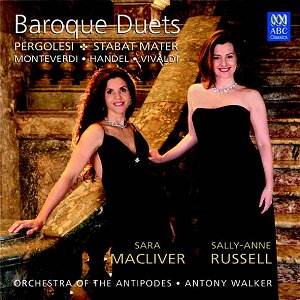
 Sara Macliver (soprano)











