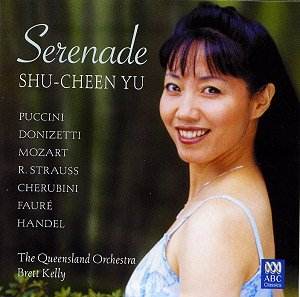
ABC Classics seem to
have a wholly commendable policy of
giving recording opportunity to performers
making their professional way in Australia.
I recently
reviewed an ABC disc by the New
Zealand baritone Teddy Tahu Rhodes,
albeit under the rather pretentious
title ‘The Voice’.
The present wide-ranging
collection of soprano arias and songs
has a more pleasant and realistic title.
As with the baritone, the singer here
has worked and developed her skills
with Opera Australia. No date of birth
or age is given for Shu-Cheen Yu. The
booklet, which gives all words with
English translation, merely states that
she was twenty years of age when she
first encountered Western music. Prior
to that she was involved, and totally
immersed, in Chinese folk music. This
is her third album for ABC Classics.
The first, ‘Lotus Moon’, featured a
combination of Eastern and Western repertoire.
The second, ‘Willow Spirit’, was exclusively
Oriental in style. In this disc she
sings her personal choice of a broad
spectrum of the Western classical and
operatic repertoire. The selection represents
significant and diverse challenges for
any singer. Shu-Cheen Yu has a light
soprano voice with a fair degree of
flexibility. In arias such as that from
Mozart’s Zaide she exhibits a
promising palette of colour at the start
of the aria whilst her high notes are
well taken on the breath at the conclusion
(tr. 1). What is lacking is even transition
between the two whilst sustaining the
tonal colour. She succeeds better in
this respect with Richard Strauss’s
Wiegenlied (tr. 2). On the down
side her depth of feeling and understanding
of the song is not on a par with say
the rich-voiced Jessye Norman, or the
lighter-toned Lucia Popp, both of whom
have developed as singers whilst totally
immersed in the European tradition.
Shu-Cheen Yu puts her vocal agility
fully to the test in Bach’s Cantata
No. 51 (tr. 3). Perhaps stimulated
by the well-played trumpet obbligato,
she makes an acceptable shot at this,
getting expression, coloratura and clarity
of diction in nice balance. This higher
part of the singer’s voice is well suited
to Pie Jesu from Faure’s Requiem
where she soars above the stave very
affectingly (tr. 9). Likewise in Rachmaninov’s
Vocalise (tr. 8) and Bishop’s
well known Lo! here the gentle lark.
Problems for her come when she needs
to put more pressure on the voice, particularly
in the middle and lower regions where
an intrusive flutter is evident and
also a tendency to chop phrases. These
weaknesses tend to restrict full enjoyment
of the operatic items in particular,
even in Quel guardo, il cavaliere
from Don Pasquale which I would
have expected to have suited her strengths.
The recording is set
in a clear, slightly warm, airy acoustic
with a nice balance between singer and
orchestra. The orchestral accompaniment
is ideally paced by the conductor and
wholly supportive of the singer. The
booklet gives all the words with English
translation as well as a paragraph on
each of the works sung; well done ABC
Classics! Without knowing Shu-Cheen
Yu’s age, it is difficult to say whether
further study in the European operatic
idiom would facilitate her career in
that field. In the immediate future
the wide repertoire on this disc should
appeal to her admirers. It may also
extend their musical horizons as she
is obviously doing.
Robert J Farr