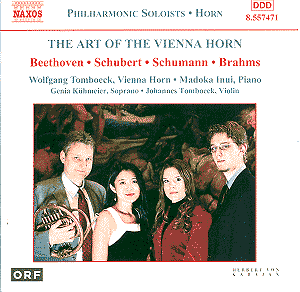
Wolfgang Tomboeck’s
extensive notes to this release provide
not only an overview of the evolution
of the horn in general but an explanation
of the precocious nature of the F horn
or Vienna horn, with its close harmonics
bringing the player into dangerous territory.
The nearer the harmonics on any particular
fingering, the more chance of the player
‘missing’ – i.e. splitting the note.
The Vienna horn (still
in use in said city) remains a noble
beast, its tone mellower than the more
open B flat/F double. In the wrong hands
this tone-quality can be woolly or even
cumbersome, seeming to inhibit mobility.
Not in the hands, lips, more accurately,
of Wolfgang Tomboeck, however, a member
of the Wiener Philharmoniker since 1978
and first horn since 1980. Tomboeck’s
tone is simply lovely. He combines all
the necessary agility with this, plus
no mean musicality.
The recital, travelling
from Classical through Romantic in stages
through to Brahms, begins with Beethoven’s
Horn Sonata. Known, I would imagine
almost exclusively, to horn players,
it is a thoroughly attractive work.
Its opening, an unaccompanied, fanfare-like
figure based on an F major triad (or
C major for a player playing on horn
in F) proves just how difficult the
most elementary constituents of music
can be in exposed circumstances. Actually
here it also contains in embryo the
seeds of Tomboeck’s playing. Eminently
musical, though without losing its annunciatory
function, immediately we know this is
a player of musicality and focus. Every
note is bang in the middle. The players
take the exposition repeat, correctly.
Pianist Madoka Inui copes well with
the tricky piano part, although Naxos’s
recording makes the piano sound rather
tinny, not doing justice, I am sure,
to Ms Inui’s tone.
The tiny slip of a
slow movement has both players tiptoeing
on egg-shells before the joy that is
the concluding Rondo. Suave and witty,
there is a nice spring in the step.
Auf dem Strom
is one of Schubert’s most inspired Lieder.
Less often heard than some of the finest
Lieder, it is a work of great beauty.
Written for horn in E it has a text
by Rellstab. This is helpfully reproduced
in the booklet, unhelpfully only in
the midst of the German text and even
more unhelpfully without translation.
Perhaps print out this page: http://www.recmusic.org/lieder/get_text.html?TextId=13382.
The text is an archetype of parting,
longing and death. As Tomboeck says
in his notes, ‘A piece about dying and
beauty, a very Austrian idea’. Indeed.
This performance is marked by a freshness
that comes from the pure, pristine voice
of soprano Genia Kühmeier. The
intertwining of voice and horn lines
is miraculous, a seeming free-flow of
Schubertian spur-of-the-moment invention.
If you don’t already know this Lied,
here is as good a place as any to start.
Schumann’s Adagio
and Allegro poses real perils for
the player. The long line of the Adagio
requires real legato and velvet tone;
here no problem. However it is the top
C (1’34, reached by octave slur) that
instils the real fear. Obviously not
in Tomboeck. There is a little ‘air’
around his sound that is most appealing,
and both players achieve real repose.
There is fine cantabile playing from
Inui and superbly warm ‘pedal’ notes
from Tomboeck. This contrasts with the
gritty, confident (nay, swaggering)
beginning of the Allegro. The ‘Eusebius’
moments are savoured. Tomboeck, in addition,
seems to be able to project just the
right amount of strain around his high
(played) B flats.
Brahms’ Trio, Op. 40
is a magnificent work. Aubrey Brain
(father of Dennis) remains a clear historic
recommendation (Pearl GEMMCD0007), yet
for a modern version this one ranks
with the very best. Brahms’ warm, autumnal
voice resonates well with the Vienna
horn; the timbre is totally appropriate.
Johannes Tomboeck, son of Wolfgang and
a violinist with the Vienna State Opera,
matches Wolfgang in terms of both warmth
and conviction. There is throughout
the first movement a sense of a smouldering
passion underneath the surface, a passion
that should surface in the Scherzo.
Here the scherzo is a little under-powered
to fully realise this. Better is the
Adagio mesto with Inui at her best here.
This really does manage to hypnotise
the listener. If the finale could be
more exciting towards the very end,
its hunting origins are nevertheless
well preserved.
A triumph; a real disc
to be savoured. And most emphatically
not limited in its appeal to horn players!
Colin Clarke
see also review
by Peter Lawson



 Wolfgang Tomboeck (Vienna horn); Genia Kühlmeier
(soprano); Johannes Tomboeck (violin); Madoka
Inui (piano).
Wolfgang Tomboeck (Vienna horn); Genia Kühlmeier
(soprano); Johannes Tomboeck (violin); Madoka
Inui (piano).