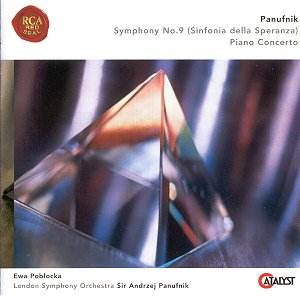
Early days perhaps
but since the composer's death Panufnik's
music does seem to have slackened its
grip on the concert-hall repertoire.
Performances were never that numerous
but my impression is that they are now
fewer than during his lifetime. Some
works such as the Heroic and
Tragic overtures and the Sinfonia
Sacra (all three well worth exploring)
are still played ... but not as often.
Recordings live on in various reissues
but whatever happened to the Decca Headline
LP of the Sinfonia di Sfere and
the Sinfonia Mistica? The Unicorn-Kanchana
CDs of his orchestral music have disappeared
from the catalogue. John Kehoe’s Conifer
did valuable work for Panufnik but when
they folded their CDs also vanished.
This is the first reappearance and I
hope that the launch of the BMG Catalyst
series will be the cue for many other
Conifer reissues.
Panufnik's music is
spare and whispered for long expanses
of time and then explodes into tempests
of protest or violence or both. It is
not merely irate but furious. The quiet
music is marked not just by low volume
but by its meditative quality. It has
minimalist repetitive aspects but I
would not term Panufnik a minimalist
composer in the patterns of Nyman, Glass,
Reich or Adams. With Panufnik it is
less a matter of repetition; more a
steady unhurried progression. Often
as in the Sinfonia Elegiaca long
expanses of prayer-like material are
separated by episodes of almost manic
fury. The fury is clear-eyed and lucidly
presented - different and somehow less
complex than the vituperative power
of Mennin in his piano concerto and
Seventh Symphony. The symphonic tension
of Panufnik is between peace and war.
He had seen too much of war and its
aftermath in Poland both under the Nazis
and the Communists. His move to England
in 1954 turned out to be a happy decision.
It is hope (Speranza)
that forms the subject of the Ninth
Symphony. At forty minutes this
is the longest of his nine symphonic
works. Throughout the harpsichord subtly
tints the crystalline progression of
the music which deploys a noticeably
hymnal melody typical of Panufnik whether
in the 1940s or the 1990s. The ideas
develop across a single continuous movement
which passes through anger as well as
a great deal of prayerful music. Panufnik
finds a grippingly majestic iterative
momentum and symphonic triumph over
an extended timescale at 36.03 onwards.
And the punched out rhythmic emphatics
of the last few minutes deliver a finality
which is exciting and awe-inducing.
The Piano Concerto
was first written in 1962 and uses
splintering dissonance. The first of
the three movements is very demonstrative,
full of loud full-on dramatic material
with plenty of writing for drums. Those
thudding taut timpani (as heard at the
end of the first movement) are so much
a Panufnik hallmark. The long and glacially
slow middle larghetto croons
consolingly and that archetype of a
Panufnik melody rises wraith-like at
8:43. The second movement has the piano
rattling and hunting along in Bartókian
splinters and flying smithereens while
timpani and xylophone add texture to
the piano commentary.
These two recordings
were made at Panufnik's last recording
sessions. He died in October 1991.
A distinguished contribution
to the catalogue and one with many rewards.
If you are a Panufnik tyro do try to
find a Unicorn-Kanchana CD of the Sacra,
Heroic and Tragic as your
initiation into the work of this undervalued
but valuable music.
Rob Barnett



 London Symphony Orchestra/Andrzej Panufnik