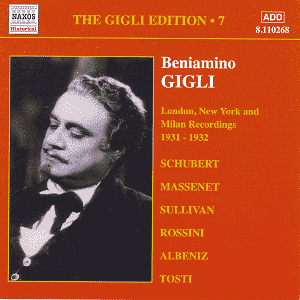
Francesco Paolo
TOSTI (1846-1916)
Goodbye. (Sung in English); Addio
Jules MASSENET
(1842-1912)
Manon, Instant charmant
... En ferment les yeux (Sung in Italian)
Sir Arthur SULLIVAN
(1842-1900)
The Lost Chord. (Sung in English)
Giacomo PUCCINI
(1858-1924)
La Bohème, Che
gelida manina
Georges Charles
GOUNOD (1818-1893)
Faust, Quel trouble inconnu...
Salut, demeure (Sung in Italian)
Georges BIZET
(1838-1870)
Les Pecheurs de perles,
Je crois entendre encore. (Sung in Italian)
SIMONS.
Marta
Issac ALBÉNIZ
(1860-1909). Quisiera olvidar tus
ojos
SANDOVAL.
Eres tu
DE CRESCENZO.
Triste maggio
Nikolai RIMSKY-KORSAKOV
(1844-1908)
Sadko, Chanson Hindoue.
(Sung in French)
Pietro MASCAGNI
(1863-1945)
Cavalleria rusticana,
Tu qui, santuzza?,, No, no Turiddu,
(with Dusolina Giannini, sop)
Franz SCHUBERT
(1797-1828). Ständchen
Louis NIEDERMEYER
(1802-1861) (attributed)
Pieta, Signore
Gioachino ROSSINI
(1792-1868)
Stabat Mater, Cujus animan
Ernesto DE CURTIS
(1875-1937)
I’m’arricordi ‘e te (Lucia, Luci) (Sung
in Neapolitan dialect)
‘A canzona ‘e Napule.(Sung in Neapolitan
dialect)
As I noted in my review
of Volume 6 in this series (Reviews:
R Farr
J Woolf),
Gigli’s time at the Met was drawing
to a close. The circumstances of his
somewhat acrimonious departure are outlined
in Graeme Kay’s admirable four CD ‘A
Life in Words and Music’ which draws
extensively Gigli’s own perceptive autobiography.
Gatti Casazza, the manager of the Met,
proposed a pay cut to all artists as
the theatre shared the world’s economic
downturn after the Wall Street Crash
of 1929. Gigli (1890-1957) rather impetuously
refused to accept and was summarily
dismissed. Alan Blyth’s booklet note
suggests Gigli had already lost enthusiasm
for the house and had decided to leave
and work more in Europe. As a consequence
he began to record in London for HMV
although he had to fulfil the remainder
of his Victor contract. The five items
of that contract are the rather inconsequential
pieces contained on tracks 8-11 in music
by Simons, Albeniz, Sandoval and De
Crescendo’s Triste maggio (tr. 11).
Of more substance is the Chanson Hindoue
(tr. 12) that Gigli sings in French
with good tone and legato. The RCA recordings
have the singer’s voice more forward
than the HMV London recordings. Perhaps
more to the interpretive point is that
the London producers allow him much
greater self-indulgence in respect of
his use of that honeyed head voice and
soft pianissimos that were his hallmark.
This is particularly evident in Instant
charmant ... En ferment les yeux from
Manon (tr. 2) and the Faust (tr. 6).
I must not let that sound condemnatory
because I, like all listeners to the
78s, used to glory in the beauty of
the singing and not worry too much about
the characterisation. His singing, in
English, of Tosti’s Goodbye and Sullivan’s
Lost Chord (trs. 1 and 3) has rather
drawn-out vowels. The Tosti song sounds
much better, and the singer more comfortable,
in the Italian version (tr. 4). Incidentally,
in a producer’s note, Mark Obert-Thorn,
who is also the excellent restorer,
states that the Italian version is making
its first appearance. On the track details
it is stated as being previously unpublished.
The remaining London recordings include
Gigli’s bestseller, Che gelida manina
from La Boheme (tr. 5). At the peak
of his career and popularity he opens
the aria with classic gentle phrasing,
softly on the breath, and then lets
his voice open out into the lyric tones
that thrilled in the opera house. What
Mimi would not be tempted by these deeply-felt
and ardently expressed words? The concluding
notes are sung beautifully sotto voce.
That track is the highlight of this
issue.
The remaining tracks
(trs. 14-19), including the two duets
from Cavalleria Rusticana, were recorded
in Milan. The first thing to say is
that the recording characteristics of
these tracks is not of the clarity of
those recorded in London or New York.
The sound is more recessed generally
and particularly that of the accompanying
orchestra. In summary they lack something
of the impact that is present from the
other venues. Gigli sings the two Mascagni
duets (trs. 14 and 15) with full-throated
passion with the American-Italian soprano
Dusolina Giannini matching him note
for note. Although not well known in
the UK Giannini had a considerable career
in the theatre and on disc. More of
her singing can be heard on a Naxos
CD devoted to her. Gigli’s Ständchen,
sung in Italian, (tr. 15) is not one
that would readily be recognised by
the composer but the singer’s expressiveness
shines through. I found Gigli’s Cujus
animam from Rossini’s Stabat Mater disappointing
(tr. 17). He enjoys the rhythm of the
piece and sings with open voice and
elegant phrasing without seeming to
be involved. Nor does the high note
ring out in the way I had expected.
The final two tracks of Tosti songs
(trs. 18 and 19) are sung in Neapolitan
dialect which Italian speakers will
find interesting. Gigli does sing these
two songs with particular feeling. I
wonder how well they sold as 78s.
This period marked
a turning point in Gigli’s career and
so it is for this series. Those following
that career and this series need not
hesitate in purchasing this disc. They
will find much singing of the quality
that made the singer world famous in
the concert hall, the opera house and
on record.
Robert J Farr



 Beniamino Gigli (tenor)