Other Links
Editorial Board
-
Editor - Bill Kenny
Assistant Webmaster - Stan Metzger - Founder - Len Mullenger
Google Site Search
SEEN AND HEARD UK OPERA REVIEW
Puccini, Tosca:
Soloists, Chorus and Orchestra of Welsh National
Opera/Lothar Koenigs (conductor) Wales Millennium Centre, Cardiff 26.2.2010 (BK)
Co-production between Welsh National Opera and the State Opera of South
Australia (1992)
Direction: Michael Blakemore (original) Benjamin Davis (revival)
Sets and
Costumes: Ashley Martin-Davis.
Lighting Design: Mark Henderson.
Lighting realised by Paul Woodfield
Conductor: Lothat Koenigs.
Cast:
Angelotti: Julian Close.
Sacristan: Henry Waddington.
Cavaradossi: Geraint Dodd.
Scarpia: Robert Hayward.
Tosca: Elisabete Matos.
Spoletta: Cárthaigh Quill.
Sciarrone: George Newton-Fitzgerald.
Shepherd Boy: Paula Bradbury.
Gaoler: Jack O'Kelly.
Children from local schools.
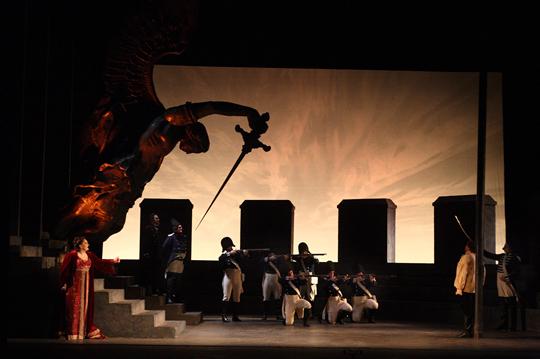
The Act III Set © Brian Tarr
It must be quite difficult to make Tosca
dull, but this revival managed that and more: here and there, it was
positively embarrassing. Much of the problem seemed to stem from revival
director Benjamin Davis' vision of the work, particularly his
characterisation of Scarpia, which apparently attempted to turn melodrama
into something more meaningful. The result was a new twist to Joseph
Kerman's famous description of the opera as a 'shabby little shocker.'
The point about melodrama - indeed its entire point - is that the characters
in its blood and thunder plots are deliberate stereotypes. Tosca is
the madly jealous but vulnerable diva, passionate about her art and
idealised romance in equal measure and Cavaradossi is the hero figure
standing for everything noble in political idealism, spiritual
expressiveness and life-long commitment to love. Scarpia on the other hand,
is the arch-villain who stops at nothing in his pursuit of power over other
people, full of hatred and vengefulness sure enough, but also supremely
self-confident in his dealings with both men and women. He rules with
complete authority to get exactly what he wants and knows every trick in the
book for achieving his (obviously) evil ends.
Not so for Mr. Davis apparently. His Scarpia is no more than a bully
fixated with psychoneurotic fantasies about sadism and sex, who writhes with
orgasmic lust during Cavaradossi's torture and fumbles anxiously with his
trouser buttons when attempting Tosca's seduction. He's less manly
than the flasher on the common.
Small wonder then that baritone Robert Hayward sang this Scarpia almost
hesitantly - fiddling desperately with your trousers in Act II, or indeed
knowing that you will be doing this later during Act I - is enough to make anyone low
on menace, even such a seasoned singer. It does nothing for vocal authority
either: troupers can only do so much after all.
On paper, the performance should have been fine. Michael Blakemore's 1992
production has traditional sets and no surprises, WNO's Musical Director Lothar Koenigs
is a talented conductor who turned in a
remarkable Wozzeck last autumn (see
review) and the Tosca, the Portuguese soprano Elisabete Matos,
has a string of notable credits to her name, especially in Spain.
In January this year, my colleague José Irurzun rated Ms Matos a more than decent Senta in
Madrid, she sang a praiseworthy
Turandot in Valencia last April and
later made a fine Gutrune in the remarkable Valencia
Götterdämmerung. For that
performance, JMI said of her:
Elisabete
Matos
proved again with Gutrune that she is a most
competent soprano, worthy of much more attention from the great opera
houses. Hers was an excellent interpretation.
But something was seriously amiss here which seemed to have disturbed
almost all the singers. Ms Matos sang an ear-splitting Tosca,
certainly every inch the diva but rarely at anything less than ff
even in 'Vissi D'arte' - an unusual experience to
say the least. Excessive volume in fact, was pretty well the order
of the evening except perhaps for Geraint
Dodd's Cavaradossi. While at his best with his rejoicing at the
rumours of Bonaparte's victory, when his 'Vittoria, Vittoria!' rang out
strongly and clearly, he seemed to struggle with placing his voice in
'Recondita Armonia' and even with his 'E lucevan...' in Act III.
As it happens, apart from his ideas about Scarpia, Mr. Davis's directorial hand was
otherwise
almost invisible, with no apparent impact even at the most
dramatic moments - surely Cavaradossi ought to look just the teensiest bit
emotional when Tosca turns up at his execution? Not
here he didn't. And it's a very unusual Tosca indeed
where the most impressive performances come from the Sacristan and Angelotti,
both sung and acted ably by Henry Waddington and Julian Close.
These really were the only highlights.
While the usually persuasive Lothar Koenigs did what he could with the
score, even that failed to take flight as Puccini intended, as
if the general misguidedness of what was - or wasn't - happening
on stage had somehow sapped the life out of it. The music won on points as
always of course, thanks to the orchestra's sheer professionalism.
Bill Kenny