Other Links
Editorial Board
-
Editor - Bill Kenny
Assistant Webmaster - Stan Metzger - Founder - Len Mullenger
Google Site Search
SEEN AND HEARD INTERNATIONAL OPERA REVIEW
Mozart -
Le nozze di Figaro at the Stockholm Royal Opera: (Premiere)
27.3.2010 (GF)
Costumes: Maria Geber
Lighting: Ellen Ruge
Choreography: Anna Koch
Sets and Direction: Ole Anders Tandberg
Cast
Count Almaviva – Ola Eliasson
Countess Almaviva- Maria Fontosh
Susanna – Elin Rombo
Figaro – Johan Edholm
Cherubino – Katija Dragojevic
Marcellina – Marianne Eklöf
Doctor Bartolo – Lennart Forsén
Basilio/Don Curzio – Ulrik Quale
Barbarina – Vivianne Holmberg
Antonio – Anton Ljungqvist
Two girls – Monika Mannertröm, Kristina Hanson
The Royal Opera Chorus and Orchestra / Stefan Klingele
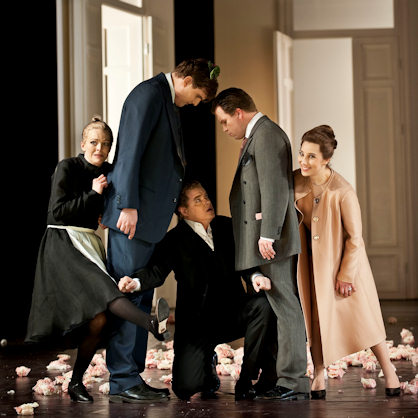
Photo © Carl Thorborg
Three years ago Ole Anders Tandberg directed a fresh and fanciful Così fan tutte at the Royal Opera. It was not devoid of burlesque episodes, even some absurdities. Generally speaking it was however a highly enjoyable production, full of surprises, well balanced and cogent (see review). In this Le nozze di Figaro he goes not one but several steps further and presents an absurdist, even surrealist reading of the text, spiced with gags, slapsticks and other ingredients, more at home in vaudeville farce. Some of it is fun, it is cleverly thought out and realized, the timing with the music often striking and the actors are uninhibitedly committed to the ideas – but it is too much. All right, there are many opera lovers who have difficulties stomaching parts of this comedy and see it as something to be laughed at for the wrong reason, but Figaro is also filled with the most marvellous music and, sad to say, this is in many instances relegated to the background with this treatment. The feudal rights of the count, which is the ordinary backdrop to this crazy day, is toned down. Instead everyone seems to be sexually attracted to everyone, the story thus being over-sexualized. Of course there is an erotic undercurrent running through the story but is it really necessary to be so over-explicit? I think Tandberg mistrusts the intelligence and the musical sensitivity of his audience. After more than three hours of candid erotic pointmaking one is heartily tired of the lack of sophistication and when Susanna, disguised as the Countess, in the last act finale drops her panties the cup is full to the brim. Others may think that this is fun and trendy – I find it vulgar and tasteless.
There was a time, not long ago, when suitcases were a common ingredient in many opera productions – now it’s hotels. Stockholm’s Traviata a few years ago was partly set in a hotel, the first act of Xerxes last year played in a hotal lobby, this year’s Fledermaus took us to Carlton Hotel in Cannes and now the Almavivas reside in a hotel. Interesting idea, no doubt, but haven’t we seen it once too many already? The last act’s garden scene is however beautiful, even though the size of the trees leads the thought more to some Nordic national park.
Musically this production has many merits, though there are some question-marks here too. The most questionable novelty is no doubt the insertion of unwritten pauses in the score. For dramatic reasons, to underline a charged situation or to give the actors time to move – there are always theatrical reason. And there is nothing wrong in that as long as it appears in the secco recitatives, which are not really of musical importance – notated speech rather. But it also happens a few times in throughcomposed scenes, where the flow of the music is broken. There are also some extremely heavy ritardandi that feel at odds with Mozartean style. Elsewhere Stefan Klingele adopts sensible tempos, sometimes brisker than usual. No criticism here – Mozart’s music can stand this.
While I have expressed objections concerning the basic concept of this production I have nothing but praise when it comes to the singing. Maria Fontosh may have been slightly under par a few times in her first aria but during the rest of the performance she was a wonderful Countess. Elin Rombo proved once again that she is one of the best lyric sopranos around and besides stupendous singing – her aria was marvellous and the letter duet with Maria Fontosh a wonder of matching voices – she is a superb actress. Even more sensational was Katija Dragojevic as Cherubino, a notoriously difficult role to cast, since women so often seem uncomfortable in boys’ outfits. Ms Dragojevic was however cut out for the role and her impersonation of the nervy teenage boy was magical.
Johan Edholm’s marrowy bass-baritone made him an uncommonly strong and virile Figaro, singing with a bite in the tone that reminded me that he was a great Scarpia a few years ago. Ola Eliasson’s lighter baritone was suitably well contrasted to his valet and his tenoral high register allowed him to sing Mozart’s later reworking of the last section of the Count’s aria, where he is required to sing fifteen high Gs! Marianne Eklöf and Lennart Forsén, two stalwarts at the Royal Opera, were good, as expected, as Marcellina and Bartolo, Ulrik Qvale made a somewhat over-the-top Basilio, gigantic shawl around his neck, and doubled as a stuttering Don Curzio, and Anton Ljungqvist’s imposing Antonio promised well for a career in bigger bass roles, while the cute and mercurial Vivianne Holmberg was an ideal Barbarina. Both are still students at the University College of Opera.
To my mind this production is an ideal radio opera and those who heard the live broadcast must have had a real treat. The vocal standards at the Royal Opera are today on a very high level.
Göran Forsling