Other Links
Editorial Board
-
Editor - Bill Kenny
Assistant Webmaster - Stan Metzger - Founder - Len Mullenger
Google Site Search

SEEN AND HEARD INTERNATIONAL OPERA REVIEW
Wagner, Parsifal:
Soloists, chorus and orchestra of the Vienna State Opera. Conductor: Peter Schneider. Wiener Staatsoper, Vienna, 4.4.10. (JPr)
Parsifal at Easter is a tradition in Vienna and I have seen it there off and on now for over thirty years. I was there last time in 2006 for the seventeenth outing of Christine Mielitz’s 2004 production which by this year had reached its 28th performance. The previous Vienna Parsifal production was a memorable one by the late August Everding, classical in its simplicity and magical in its use of the Vienna State Opera’s stage technology during the transformation scenes which never distracted from the drama of Wagner’s music. To be successful of course, Parsifal need not have all the overt religious symbolism that Everding included and indeed we get little or none of that from Christine Mielitz. She seems to have been inspired by Vienna, as the home of Sigmund Freud, to analyse the work from the gender inequality perspective. We are shown a closed community of men, strictly regimented, as evidenced by the fencing training that we see at the opening of the opera, who are probably somewhat ideologically fanatical. There is no role at all for women here and when Kundry first appears in her Burkha she is set upon by the ‘grail knights’ as an unpleasant expression of gender suspicion or hatred. Significantly, when the women’s voices sing out in the Hall of the Grail they are also dressed in Burkhas and somewhat segregated, below the stage. The depth of depravity this society has descended into is hinted at by the suggestion of the sacrifice of a child during the Act I transformation scene. The focus is on Amfortas’s intense suffering and the lack of feminine insight in the knights’ lives. The ‘pure fool’ Parsifal gets the latter from Kundry and is able to use it to release (purify?) the closed order’s fanaticism and prejudices. When the body of Titurel is removed from its shroud in Act III, it clearly shown to be a woman. Strangely at this Easter time in Vienna, there were two exhibitions on in the city which coincidentally gave some insight into Mielitz’s approach. At the Wien Museum there was a fascinating exploration called ‘Madness and Modernity’ developed by London’s Wellcome Collection. It illustrates the relationships between early twentieth century psychiatry and the fine arts, including architecture and design. The Act I derelict building in Stefan Mayer’s designs for the Mielitz Parsifal could easily be an asylum, as much of the fencing knights’ clothing looked liked straightjackets. Vienna’s famous Secession building has been turned - for a few months at the start of 2010 - into a ‘Swingers Club’ with rooms (and saunas) anticipating much late night sexual activity. During the day visitors just look around and use their imaginations but its ‘delights’ are fully open to school children: imagine the protests in prudish Britain if there was such an ‘installation’ at the Tate Modern. In Parsifal, the ambience of the ‘Swingers Club’ was evoked by the red leather furniture, shimmering curtain, large glitter ball and the use of video in Act II. Kundry is shown in a negligee and the extremely alluring Flowermaidens readily strip to their underwear on Parsifal’s arrival. The Flowermaidens are soon dismissed by Kundry who sets about seducing the innocent Parsifal who finds all this female attention irresistible. Eventually he pulls himself together with the remembrance of Amfortas’s plight. His ‘spear’ - actually a white neon tube - brings about the destruction of Klingsor’s ‘magic castle’ to a background of images of warfare and mass destruction. Act III moves from a wasteland back to the Grail Knights’ realm. Amfortas is shadowed by a figure who looks a little like Jacob Marley from Dickens’s A Christmas Carol carrying the grail in a box. When Parsifal demands that the grail is revealed, the golden casket opens and the relic topples out and breaks into pieces. Parsifal remains a spiritual opera of course, and sometimes this fact is taken to demand a leaden-footed approach. Not so with Peter Schneider however, a former member of the Vienna Boys’ Choir and honorary conductor of the Vienna State Opera: his reading eschews any over -bloated devotion or reverence. Instead, he concentrates on the work’s core which perfectly underpins Mielitz’s non-romantic approach to the opera. There were any number of impressive moments but it was clear that Schneider’s restrained tempi were always keeping a firm grasp on the arc of the drama. The orchestral playing was virtually faultless, the chorus well-drilled and the choral effects perfectly balanced, as were the temple bells. The cumulative effect was persuasive, though not as radiant as I would have liked. Not as fast as Boulez, or as slow as Knappertsbusch whose Act I once took nearly two hours, the music lasted – for those interested in such things - a little less than four hours. Although I had these minor doubts about the orchestral accompaniment, what was very clear is that this was as fine a cast as I can remember from all the Parsifals I have seen. There was not a single weak link. Falk Struckmann was outstanding as Amfortas; he acted with great dramatic fervour and I felt every grimace on his tortured face. His voice was rich, nuanced and perfectly characterised his despair. Wolfgang Bankl sang a fine, suitably malevolent, Klingsor - though it would be better if he kept his shirt on and we were spared his corpulent physique. Christopher Ventris as Parsifal sang very well too. His fluid, focussed, voice is nearly perfect for the role and it rings out cleanly and effortlessly. In the first two acts the staging gives him little chance to make much of the character. He spends most of Act I with an uncomprehending look on his face lolling about at the front of the stage. In Act II he puts up little resistance (who would?) to the womanly-wiles of the Flowermaidens and Kundry. However, from the moment he arrives in the forest at the start of Act III his world-weary Parsifal was very emotional and effective and the performance grew in stature from then on. Two jarring issues were to do with his costumes: the boots he wore for the first two Acts were of a quality that no one spending time in a forest would wear and they were matched by an Act II suit that looked as if it was designed by Giorgio Armani. That leaves me to report on two further performances in a near-perfect ensemble. It is usual to hear Kundry sung with too much over-the-top wailing and shrieking but here the ever-reliable Petra Lang gave a mightily impressive expressionist performance which was purposely quite subdued until her pursuit of Parsifal in Act II, all with controlled lyricism and never an ugly sound. This made her outcry on the final word of the phrase ‘Ich sah ... Ihn ... Ihn ... und ... lachte!’ - as she recalled Christ on the Cross - so much more chilling. Ms Lang is quite possibly the best Kundry (and Ortrud) anywhere among the current generation of singers. How great it was too, to hear Sir John Tomlinson in top form as Gurnemanz. He is a seasoned professional of course, making up for any diminishing tone or control brought on by the passage of time with incomparable stage presence, sheer gravitas and undiminished vocal power. He remains a peerless communicator, making his monologues much more riveting than they can sometimes be because of his crisp diction and expressive word-colouring. Look out for his Gurnemanz next season at the London Coliseum when he sings the role for the first time in English: it should make for unmissable Wagner. Finally, this performance was put together with only a few days’ rehearsals for the principals, yet it was brought completely to life by the committed cast. It lacked nothing in terms of dramatic intensity at any point, proving that over-rehearsing opera is both possible and sometimes counter-productive. Jim Pritchard
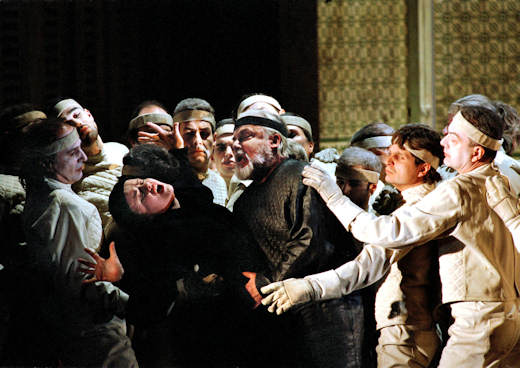
Petra Lang as Kundry and John Tomlinson as Gurnemanz
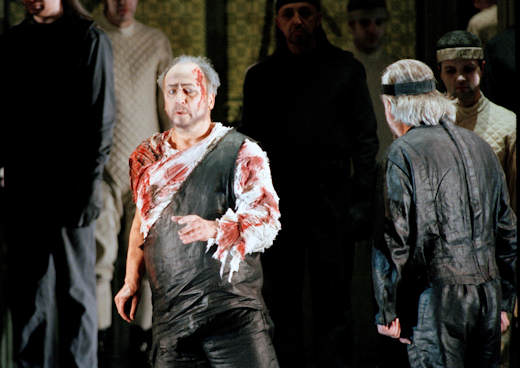
Falk Struckmann as Amfortas
Pictures © Wiener Staatsoper GmbH / Axel Zeininger