Other Links
Editorial Board
- Editor - Bill Kenny
- Deputy Editor - Bob Briggs
- Founder - Len Mullenger
Google Site Search

SEEN AND HEARD UK OPERA REVIEW
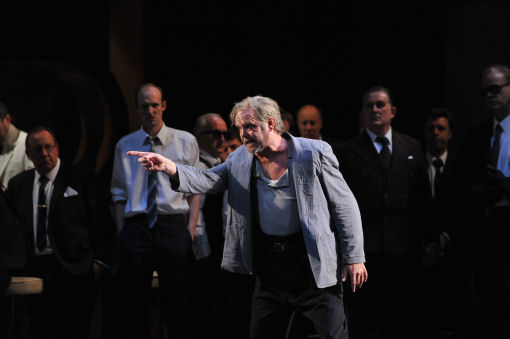
Anthony Michaels-Moore as Rigoletto
One of the free newspapers that litter London every evening had this advert with the quote from a review - ‘Mafia, Betrayal, Love, Revenge. GO SEE IT’. This didn’t refer to Jonathan Miller’s 1982 production of Rigoletto but the current musical Jersey Boys. But on coming back to see ENO’s iconic production after a gap of more than 20 years, it is clear the Cosa Nostra world of the New York Mafia in the 1950s has become the setting for many other things. According to the libretto of course, we should be sometime in the Renaissance watching the hunch-backed and mentally scarred court jester Rigoletto hurling bitter and continuous jibes at his employer’s party guests. Rigoletto’s only joy in life is his innocent daughter Gilda and when the jester finally goes too far, a curse from one of his victims sets a trail of events in motion that ends with Gilda’s murder.
In my review of Royal Opera’s current David McVicar production in February (here) I noted how
it had been staged five times now,
but this revival brings the twelfth time round for Jonathan Miller’s celebrated ENO staging. At Covent Garden an internationally-renowned Rigoletto was parachuted in and brought his own costume to give his regular performance (and very good it was too). At ENO Dr Miller returned to direct this revival himself, dispelling perhaps any advance concerns about over-familiarity - or a sense of routine – affecting the performances.
And indeed everything does return at the very high standard that we are beginning to expect now at English National Opera for the most part. It is not Dr Miller’s fault that the production has lost the shock-value of the relocated setting which seemed such a bold step when I was there in 1982 to see the first night and or its first revivals in the 1980s – Oh, where have those intervening years gone? There is a certain smoothness to the production now that made me think of other West End Musicals that could be staged in the three-dimensionality of Patrick Robertson and Rosemary Vercoe sets. The cocktail lounge scenes reminded me of High Society or The Rat Pack Show, the tenement building where Gilda is somewhat implausibly closeted away is straight out of West Side Story and the Edward Hopper-inspired bar for Act III would grace Guys and Dolls or any other production with a 1950s’ theme.
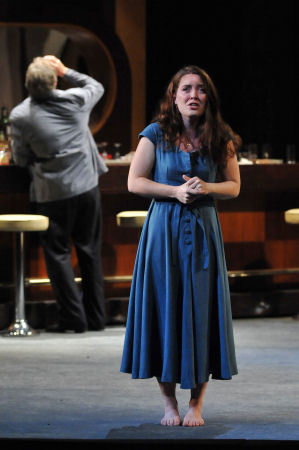
Katherine Whyte as Gilda
But there is no doubt at all that Jonathan Miller’s return has had a wonderful effect on the personenregie; from Katherine Whyte’s awkwardly shy Gilda who is constantly toying with her hair during her Act I aria through to telling little vignettes from the well-directed members of the chorus. Sadly there is also a lot of evidence of pandering to the PC-brigade - for Little Italy of the 1950s there is very little smoking to be seen and there is relatively little evidence of Rigoletto’s disability. Indeed Dr Miller’s eye for detail may just have wandered a touch because Anthony Michaels-Moore appeared to limp on one leg when going in one direction and on the other leg when going the opposite way!
Thinking about this through the mists of time, I have a vague residual memory of puddles of water on the stage for Rigoletto’s first encounter with Sparafucile in a rundown street. At times in the opera bad weather is mentioned - or is heard in the music - but everything is dry as a bone now. If I am wrong and there wasn’t any water, then perhaps there should be to make these scenes more atmospheric.
The original ‘Duke’ in 1982 was to have been Graham Clark before he decided to give up these kind of roles and begin his conquest of character parts in, most notably, the German repertoire. He did a straight swap with Arthur Davies and a role in Janáček’s From the House of the Dead at Welsh National Opera. Looking back, this fact made me wonder where the opportunities are for British tenors these days. In the current revival the ‘Duke’ is the young American tenor, Michael Fabiano, and he is very good but is possibly another singer whose long-term career may not be in Italian opera either. He has a virile voice yet it’s lacking the brightness and the Italianate ‘ping’ needed for Verdi. These comments must be tempered, of course, by the fact that he is singing in English here but even so, that shouldn’t really affect the brightness of his voice. He brings out the louche side of his character very well and had the look of the young Montgomery Clift about him. The poster of From Here to Eternity in which Clift starred, hangs above the old jukebox which amusingly gives him the tune for La donna è mobile or, as here in James Fenton’s English version, ‘Women abandon us’.
The Canadian soprano, Katherine Whyte, sings Gilda and she began nervously but improved as the evening went on. ‘Caro nome’ or ‘Dearest name’ was sung with bell-like precision and a poignant reflectiveness. Ms Whyte does make Gilda a credible character whose infatuation leads to her self-sacrifice, but at the moment her voice seems to be on the smallish side for the Coliseum and it failed to ride the ensembles. Similarly, the conductor Stephen Lord, another compatriot from across the Atlantic, although very sensitive to his leading singers allowed his tempos tended to sag just enough to make his accompaniment to these showstopping arias rather like what might be expected at an opera gala.
This is a very good cast however, dominated by Anthony Michaels-Moore’s experienced Rigoletto making a welcome return to ENO after too long an absence. He acts frustration, resentment and obsession for his daughter very well but does not play up the jester’s sardonic humour sufficiently. He enunciates the text very cleanly – as do most of the cast – and for the most part the English surtitles are redundant. However his baritone, though full-throated, is a little lacking in lyricism and warm Italianate tone – though again singing in English may not help him.
Fine expressive singing comes from the supporting cast including Iain Paterson’s vengeful Monterone, Brindley Sherratt’s sepulchral bass as the menacing Sparafucile (sounding so much like the young John Tomlinson in 1982) and some most idiomatic singing from Madeleine Shaw’s sultry and compelling Maddalena.
After a long association with Boston Lyric Opera and now music director of the Music Theatre of St Louis, Stephen Lord is making his UK opera debut with this production. His was a generally forthright performance and he took a number of moments as quite a fast pace, only slowing down sensitively as mentioned previously for the operatic highlights. The orchestra played splendidly for him but it was little more – for me – than a creditable accompaniment to the singers and rarely viscerally exciting. The impending foreboding storm, thunder and lightning was there in the music for Act III for example but the chorus’s wimpy moaning and Lord’s slightly perversely restrained conducting at this point was underwhelming.
But you do get Mafia, Betrayal, Love, Revenge. GO SEE IT!
Jim Pritchard
Pictures© Chris Christodoulou
For further details of the remaining Rigoletto performances please see the English National Opera website (http://www.eno.org)