Other Links
Editorial Board
- Editor - Bill Kenny
- London Editor-Melanie Eskenazi
- Founder - Len Mullenger
Google Site Search
SEEN
AND HEARD ART REVIEW
Tutankhamun and the Golden Age of the
Pharaohs: The O2 / Millennium Dome, Greenwich,
London15th November 2007 – 30 August 2008 (AVE)
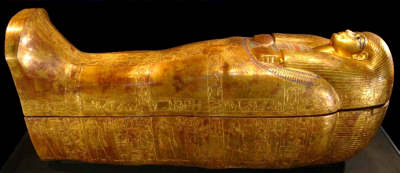
Minus his mummy and famous funerary mask,
Tutankhamun is back in town for the first time since his solo
appearance at the British Museum 35 years ago, and now making a come
back with family in tow at the O2 Millennium Dome, London. The
exhibition is billed as Tutankhamun and the Golden Age of the
Pharaohs and displays 130 artefacts, many which have never
been seen before in the UK. They are presented in 11 low-lit
galleries each focusing on a theme such as Daily Life in
Ancient Egypt, Traditional Religion and Death,
Burial and the Afterlife : after leaving them we come into the
awful exhibition shop selling vulgar Tutankhamun trash like the
meretricious Mummy CD rack and a grotesque sarcophagus tissue box
that dispenses through its snout!
The surrounding soundscape of eerie Egyptian
muzak seemed to coalesce well with the subdued and sinister
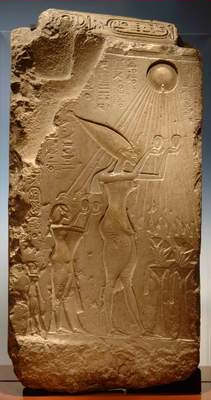
lighting, which worked wonderfully for the Balustrade Showing
Akhenaten and Family Under the Aten (crystalline limestone)
where light and shadow danced with delight in unison. The royal
couple look like aliens making magical offerings to a solar
spaceship, with its beaming rays of light bestowing the ankh
(symbol of life) upon them.
Standing before the colossal Head of the
Akhenaten (Amenhotep IV) - the assumed father of Tutankhamun -
one is stuck by his elongated and aquiline alien features and some
people today believe (à la Stargate) that Akhenaten was
actually an alien from out of space. Orthodox science of course,
suggests that he suffered from Froehlich’s Syndrome, a
glandular-hormonal disorder, or more likely from Marfan’s
Syndrome, caused by an abnormal gene.
The most hypnotic work was Statue of
Herwer (gilded wood) where the head of a hawk belongs
ontologically to the body of man without looking out of place or
merely attached afterwards. Nietzsche, Bataille, Bacon and Deleuze
instinctively knew that the human is the animal in disguise and
that there is no real distinction between being-human and
being-animal. Thus the Brazilian Bororo tribesman's assertion: "I
am a parrot" is no more absurd and arbitrary than asserting: "I am
a man" - as Lacan argued. (Le Bororo dit "je suis un perroquet",
nous disons "je suis moi" Jacques Lacan, 1978). According
to this thinking, the human-being as being-animal was a
logical and rational form of identification for ancient Egyptian
mythology and ontology.
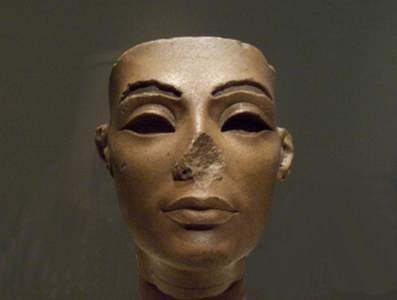
The most perfect portrait was the Face from
a Composite Statue of Nefertiti (brown quartzite): the
serenely sculptured mouth made me realise that Egyptian ‘art’ has
never been surpassed. Her empty eyes see your death that has
already come and her dry lips seem to make you freeze with their
wet warmth; her eradicated ears still have a curious sense of
being complete for even fragmented Egyptian sculpture has a sense
of completeness and wholeness in which the very where
fragmentation gives a sensation of fullness. Nefertiti's no-nose,
empty eyebrows and hair that is not there are , paradoxically,
still present - as ‘negative spaces’ breeding and becoming
‘positive forces’: we always fill in what is not there.
(Dr. Hawass mentioned that his team were still searching for the
burial site of Nefertiti as well as for Anthony and Cleopatra.) Tutankhamun and the Golden Age of the Pharaohs
by Zahi Hawass (National Geographic: June 2005), a 287-page
catalogue in full colour, accompanies the exhibition. Produced in
conjunction with National Geographic, the catalogue includes
images of each of the exhibition artefacts, accompanying photos,
and full text. £19.99.
“Welcome
to the greatest comeback tour in 3000 years!” Tutankhamun
Press Conference, 13.11.2007
“This time, when Tutankhamun returns to London, he also brings
his family with him. Not only will people learn about the life and
magic of the most famous boy king, but they will also have the
opportunity to learn firsthand about this important period of time
in ancient Egyptian history.” Dr. Zahi Hawass, secretary
general of Egypt's Supreme Council of Antiquities.
“No other race has since been so incessantly
obsessed with death as the Egyptians, or has so absurdly-wishfully
accepted it as the true life. None lavished so much preparation on
the art of dying, none paid so much attention to provision for the
dead in the other world… A culture of death was thus completely
sounded out in Egypt, by deep immersion in death."
Ernst Bloch, 'Hopeful Images Against Death';
The Principle of Hope Vo 3, The MIT Press, 1995.
“Only when death is conceived in its full ontological essence
can we have any methodological assurance in even asking
what may be after death; only then can we do so with
meaning and justification.” Martin Heidegger, Being & Time,
1927.
While many have criticised the reasonably priced £20 ticket
entrance, Dr. Zahi Hawass, secretary general of Egypt's Supreme
Council of Antiquities, rightly defended it: "If you go to the
cinema you pay £15, and maybe you go to sleep. Here you see
beautiful artefacts, you learn…Egypt gave you a lot of free meals.
When the Tutankhamun exhibition came to London 35 years ago, Egypt
got zero money ... We didn't get a penny and the British Museum
are still making money." Hawass also added: "There are no more
free meals... This exhibition, and the next in five years' time,
will make $140 million (67.5 million pounds) for Egypt," which
will be invested straight back into the urgent excavation,
restoration and conservation of Egyptian burial sites and
monuments - and ticket sales have already topped 325,000 for the
London show alone.
I was rather apprehensive about
reviewing an exhibition on Tutankhamun since
translated his name reads: In the Image of Amun – and Amun
translated is: The Hidden One. To my mind Tutankhamun – being In
the Image of the Hidden One should have remained hidden and
buried. We have no right to disturb the dead and should allow them
to rest in peace - not in pieces.
For on 26 November 1922, the
raider Howard Carter burgled Tutankhamun's tomb and plundered and
pillaged everything in sight, badly damaging the pharaoh’s body in
the process as his greedy colonialist hands wrenched at the
jewellery and relics covering the mummy. Even though the majority
of the objects ended up in the Cairo Museum this was still blatant
theft, grave robbing.
At the press conference Hawass also attacked the British Museum
for stalling on its decision on whether to ‘lend’ the Rosetta
Stone for the opening of Egypt's £300m Grand Museum in 2012: "The
answer is not a straightforward yes or no from the British Museum.
They say they must see the museum; but they know it is not
finished until 2012 ... We are not trying to keep these artefacts
forever. I am disappointed." Yet we tend to forget that Nelson’s
troops plundered the Rosetta Stone in the first place so it is not
‘ours’ to ‘lend’ and it should now be returned back home.
.jpg)
.jpg)
Today, we cannot turn stone into spirit like
the Egyptians could because the Egyptian’s ‘art’ was not a
representation of being but rather being-in-itself as pure
presentation where art is being and being is art. Of
course, the ancient Egyptians had no concept of ‘art’ as such -
nor did they need one: what we nominate as ‘Egyptian Art’ now was
for them simply ‘Egyptian Being.’ This is one reason why ‘Egyptian
art’ still looks so fresh and new and, ironically, much more
modern than so-called ‘contemporary art’ which paradoxically
always looks dated, dull and dreary. ‘Egyptian art’ has a
frisson of freshness and newness because it shines the presence of
being – as being-there - whilst ‘contemporary art’ is the absence
of being – the absence of art - as nothing-there.
At the press conference nearly everyone was
photographing and filming and I really wondered if such uncanny
artefacts could really be recorded by our modern means of
reproduction. Would we all be cursed for pillaging and plundering
their ancient stolen images through such vile things as
mobile phone cameras?
I also felt that many were recording simply as
a strategy to avoid having to confront the artefacts
face-to-face, many of which make us confront ourselves as our own
death to come This is not a Heideggerian being-towards-death but
an ancient Egyptian being-after-death as the afterlife that
today we no longer know. The artefacts seemed to be saying:
'We do not want you taking images of us – we want to go back
home." I realised there and then that it was essentially
impossible to write about such enigmatic and elusive artefacts:
they may remain but have a desire to be hidden and buried out of
sight. So-called ‘Egyptian art’ does not require interpretation
but contemplation for it has nothing to say: remaining silent, it
wants only to shine ahead and protect the dead. The golden gleam
of Egyptian art’s invisible shining, somehow blinds our sight like
the sun, and we stand dazzled and dazed, shaken and stirred:
‘Egyptian art’ shimmers constantly with vacillating vibration,
shuddering between life and death and becoming the afterlife. This
'art’ is the flux of being – the vibration of being - hovering
between being-alive and being-dead.
As I left this rather eerie exhibition,
bedazzled and dazed I came out into the clinical coldness of the
tacky and tawdry O2 Millennium Dome, akin to a miserable American
shopping mall full of ugly emptiness and a sign of our culture in
decline. Displaying Tutankhamun's adorable artefacts in an
abomination such as the O2 Dome is antithetical to the sacred and
secret function of Egyptian burial – and the Dome was cursed
before the exhibition arrived!
Alex Verney-Elliott
Tutankhamun and the Golden Age of the Pharaohs
is at The O2 Millennium Dome, London, until August 30, 2008.
Details: 0844 844 0003.