1. I Fall in Love Too Easily
2. Go Down Moses
3. Desolation Sound
4. La Llorona
5. Caroline, No
6. Monk's Mood
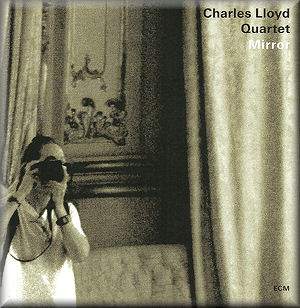
7. Mirror
8. Ruby, My Dear
9. The Water is Wide
10. Lift every Voice and Sing
11. Being and Becoming
12. Tagi
Charles Lloyd - Tenor sax, alto sax, voice
Jason Moran - Piano
Reuben Rogers - Bass
Eric Harland - Drums, voice
Basically, Charles Lloyd is the same saxophonist who so impressed me when I heard him in the late 1960s with his famous quartet which included Keith Jarrett and Jack DeJohnette. He still has that distinctively trembling legato sound, sometimes gravelly and swooping up and down in trademark arpeggios. Yet he has become more introverted since the 1960s, when he wrote catchy tunes like Forest Flower and Sombrero Sam (I see the latter is in Grade Two of the Associated Board exams).
In those days, he was popular enough to appeal to the hippies at Fillmore. Nowadays his playing has become more abstract, and few tracks on this new CD can boast memorable melodies. Even well-known tunes like Thelonious Monk's Ruby, My Dear and Brian Wilson's Caroline, No are barely recognisable because of the group's sidelong approach. And the CD ends with a rambling piece, Tagi, which is overlaid by Lloyd mumbling words virtually inaudibly.
The album opens with a familiar jazz standard - I Fall in Love Too Easily - but Lloyd disguises the melody in lyrical flurries, and the tune of Go Down Moses is hinted at rather than played directly. Lloyd's composition Desolation Sound actually has a singable melody, and his version of the traditional Mexican song La Llorona has a comprehensible shape, although Charles's saxophone sounds wheezy in places.
The obliqueness with which some tunes are approached is one of the drawbacks of this album. The other is the fact that most tracks are in a slow tempo. This makes for a meditative album, but without much variety, except when the quartet gets bluesy with The Water is Wide, whose groovy introduction by Reuben Rogers' bass evokes cries of appreciation from the other musicians. Jason Moran's piano solo and Rogers' bass solo are also funky here - and in general Moran provides a clearer sense of some tunes than Lloyd does. Drummer Eric Harland is content to click or clatter in the background of most numbers.
The quartet seems to be unified in its approach - dedicated to introspection rather than extroversion. So the music succeeds in conveying Charles Lloyd's inner vision. This will appeal to many listeners but make it less accessible to others. I hover somewhere between the two.
Tony Augarde
 CD Reviews

 ECM 274 0499