|
|
|
|
|
|
|
|
|
|
 |
 |
 |
|
||||||
 |
 |
 |
 |
 |
 |
|
|||
 |
 |
|
|||||||
 |
|
||||||||
 |
|
||||||||
Classical Editor: Rob Barnett
Music Webmaster
Len Mullenger:
Len@musicweb-international.com
|
Classical Editor: Rob Barnett
|
||||||||||||||||||||||||||||||||||||||||||||
February 1999 |
||
© Music on the Web(UK) 1999. All rights retained. Reviewers retain copyright on their reviews. Disclaimer
 COMPETITION WIN
a CD of your Choice from Crotchet
COMPETITION WIN
a CD of your Choice from Crotchet
OSKAR NEDBAL (1874-1930) Orchestral Music Carlsbad SO/Douglas Bostock
Nedbal may not be all that well known to you. Certainly until I auditioned this disc I had not heard anything by him. I had noticed a Supraphon disc some years ago but had not bothered to explore it. On this showing he is to be recognised and appreciated as a fine light music composer to be spoken of in the same breath as the British composers Eric Coates, Coleridge Taylor, Montague Phillips and Albert Ketèlbey.
Nedbal is remembered as the Czech Johann Strauss. He was born in Tabor in South Bohemia and wrote seven operettas, five ballets, marches, polkas and waltzes. He studied under Dvorak and his fellow pupils included Vitezlav Novak and Josef Suk. Like Suk, Nedbal joined the Bohemian Quartet and remained with them from 1891 to 1906. He also conducted the mainstream as well as Fibich, Novak and Suk. His last years were spent in Bratislava as conductor of the Slovakian city's radio orchestra and the National Theatre.
The first two works are for violin and orchestra. Romance sings over a rocking rhythm in the nature of a serenade rather like Tchaikovsky's Souvenir d'un Lieu Cher. The soloist, Vladislav Linetzky, continues with a Serenade which is more of the same but a littleless languid. This is much more attractive as an essay similar to the Havanaise by Saint-Saens. This is all done with great poise. and accompanied with restraint and poetic insight by Bostock and the Carlsbaders. Both works date from 1893.
The waltz Forest Bells is winningly faltering and yet sumptuous with romantic aspiration: all lanterns and perpetual twilight. A Tchaikovskian wallow.
The Scherzo Capriccioso (1892) is very Dvorakian but with dramatic moments out of Schumann. The string tone of the orchestra is not all it should be though I have heard far worse. It is Dvorak's Symphonic Variations rather than his identically named 1883 work. which are recalled by the Nedbal work. This is Nedbal's most ambitious 'serious' orchestral composition.
With a title like Suite Mignonne Nedbal's 1902-3 work it will come as no surprise to you to hear that this work belongs to the cavernously deep heritage of salon music. It began life as Aus dem Kinderleben for solo piano. This is very Viennese hesitant dance music.
Czech Polka is and unnervingly unison Scottish string music.
The soulful Romance for cello and orchestra (1899) has the impassioned inner qualities of Frank Bridge's suite for cello and orchestra -
Die Keutsche Barbara (The Chaste Barbara), apparently one of Nedbal's best operettas, was premiered in Vienna in 1911. The music is light, charming, relaxed - Brahmsian like something from the Hungarian Dances. However here the intonation of the strings began to show up as deficient under pressure. There is a thin quality to the string sound which is out of keeping with music which was clearly written for the sumptuous plush of a great string section. Nevertheless the spirit is well caught by the orchestra. Bostock's great eloquence sweeps away small reservations about string sound. (4:53).
Die Winzerbraut Overture (1916) (The Winegrower's Bride) sounds very southern (Italian or Spanish perhaps). The operetta was premiered in Vienna in 1916.
These two overtures whet the appetite for a CD entirely devoted to Nedbal's operetta overtures. On this evidence they are sparkling examples of the genre. Good sleeve notes by Mogens Wenzel Andreason. Suitable art-deco style cover art. I wish the font chosen for the text had been one which was easier to read.
The disc claims to include world premiere recordings but does not say which of the 12 pieces featured fall into this category.
In summary a fine collection but with some of the gloss taken off by the occasional orchestral shortcomings. Bostock however seems utterly committed to the music and it lacks nothing in lively poetry. The sole problem is the orchestra or parts of it - notably the violins. Perhaps more rehearsal time would have helped.
Orchestral blemishes notwithstanding this seems a good introduction to the composer's music. Recommended for those whose palates have become jaded by the waltzing Strausses but who would like to explore other composers active in that field.
Reviewer
Rob Barnett
VITEZSLAV NOVAK (1870-1949) South Bohemian Suite (1937) 29:57 Eight Nocturnes (sop & orch) (1907) 29:25
In the league of Czech composers, Novak, if known at all, is definitely ranked in the third division. Is this fair? While everything that Dvorak wrote is legitimate for recording the best of Fibich and Novak is still seen as unusual and risky for concerts and disc. Fibich has made something of a come-back with Neeme Jarvi's Detroit SO recordings on Chandos. Novak still has some headway to make up.
So what is Novak's music like? He is a late romantic paralleling Szymanowski, Atterberg, Karlowicz, Bax and de Boeck. What we know of the music is largely down to Supraphon. Their Karel Sejna-conducted recordings of the two tone poems About the Eternal Longing and In the Tatras were long a staple of the LP catalogue. The Sejnas and the earlier (1960) Bohumil Gregor recordings remain in the Supraphon catalogue and are definitely well worth collecting.
The suite dates from 1937 but its idiom is locked into the flourishing crop of impressionistic/Dvorakian works written during the 1900s. The first movement blends Delian luxuriance with Dvorak's naive romantic and sprightly nationalism. It ends in exalted magic floated on high violins at the top of their register.
The second movement is of a similar atmosphere - gently rounded themes conjure up a woodland in summer and Delius seems not far away. The third movement (Hussite March) is turbulent and shadowy rising to a dread march of doomed heroes. The harp swirls, the side-drum hammers with militaristic remorselessness and brass call out. This is a most ambiguous movement superficially triumphant but who has won? It has a very satisfying emotional symmetry.
The extremely brief Epilogue: To My Homeland is positive but seems oddly out of place alongside the powerful, albeit negative, 'punch' of the Hussite March.
The suite represents relaxed picture painting, like Bax's Spring Fire, though the intensity of inspiration in the first two movements burns a micron or two lower with Novak. It can more closely be compared with Bantock's Hebridean Symphony of nine years later. The titles of the movements suggest an inconsistent line of inspiration with movements 1 and 2 being rural and woodland idylls. The other two movements are patriotic in their origin; the sort of inspiration you might expect from Smetana or Dvorak.
At the end of the disc I was left thinking that Novak was a Czech counterpart for Bantock (Sappho Fragments), Schoeck (Elegie), Szymanowski (Songs of the Infatuated Muezzin), Zemlinsky, Mahler, Delius or Bax.
These range from the glistening Stars in the Water [1] to the deep plangent sea-currents of Waldnacht [2] which ends in elfin bells and dances. The Notturno [3] is followed by the fourth song which has a comforting and memorable tune. The sixth song is Night Journey - full of dark and disruptive currents and the dreamy atmosphere of some Bohemian nightride and sunrise. Christchild's Lullaby has the innocent wonder of Canteloube's Songs of Auvergne. This is the kind of song which would have a popular success if only it were featured on Classic FM or was taken up at an international singing competition. Utterly treasurable.
Strakova creamily floats the long vocal lines with the an engaged and engaging sense of joyous discovery.
Strakova's lovely voice is comparable with that of Heather Harper (in another register) but the recording balance not ideal and when she sings quietly she can be over-run by the orchestra. Notes are only in English by Mogens Wenzel Andreasen. Regrettably none of the song texts are provided. The photograph of Novak which adorns the booklet cover and the insert main text has been textured in a way which does not enhance the clarity of the portrait. I wish this design feature had not been used.
Douglas Bostock assures me that there are other Novak orchestral song cycles to come. I hope to hear them soon. This one is extremely impressive. It is rumoured that another Bostock Novak song CD is to be released soon. I look forward to hearing it.
This disc is very well worth getting and is too easily lost in the welter of 'big name' releases. The orchestra is in excellent heart.
The enterprise of ClassicO is to be congratulated. Do get this disc, made a compulsive purchase by the song cycle.
I hope that the same forces will soon tackle the other song cycles and the 1941 St Wenceslas Triptych plus the unrecorded May Symphony (1943, curiously dedicated to Marshal Stalin). The symphony, Triptych and De Profundis are all orchestral works dating from the early 1940s and Czechoslovakia's occupation by the Nazis.
Recommended.
Reviewer
Rob Barnett
tar.gif)
ALLAN PETTERSSON (1911-80) Symphonies 10 (1970-72) and 11 (1973)
My initiation into Pettersson's world was not an encouraging one. In 1979, scanning the stacks of Scandinavian LPs in Harold Moores, I bought the Swedish Society Discofil LP of the second symphony. I am afraid that to this day I cannot gain much from this work. I must be at fault because, of all the symphonies, it was No 2 which Paul Rapoport chose in his valuable 'signposts' book Opus Est (Kahn & Averill, 1981?). Later I was completely won over by the seventh symphony which I commend strongly to everyone for what I can only describe as its sustained despairing beauty.
CPO have methodically been recording the complete cycle using a variety of conductors and orchestras. No 10 is a whirlwind of despair and violence spanning 27 minutes. It could not have been written without Tchaikovsky's Francesca da Rimini, Scriabin's wilder extremes, nor without Shostakovich's bleaker symphonies but really the sound is very much Pettersson's own. It is not atonal and great themes do rear up constantly through the hammering, screaming agonised brass and certainly the crippled humanity and broken splendour of the music is accessible. An almost Bach-like theme winds in and out of the last half of the symphony.
The eleventh symphony runs for 25 minutes. It opens in gentle spirit but soon feels the call of Gehenna. It is turbulent music but without the sustained drive of its predecessor. Once again great striding themes claw heavenwards through oceans of strident clamorous sound. One of these themes closes the symphony which ends as if cut off in mid-step: not for Pettersson any conventional finishing flourish.
How can one judge performance of this music? How much of a performance history is there? In any event all seems as it should be. Alun Francis's dedication to the cause is clear. He has recorded for CPO Pettersson 2 3 4 5 9 13 and 16! I wish the BBC had made more use of him and indeed other conductors like Stanley Pope. As it is he has recorded Casella, Dohnanyi, Searle, Toch and Wolf-Ferrari for CPO along with much else. His radio tape of Hovhaness Concerto No 7 is well worth finding. These CPO recordings (1993 and 1994 respectively) are rich and fully three-dimensional. I stress this because some may worry about the presumed radio provenance of the tapes. CPO have been humane in both the symphonies providing scrupulously subdivided tracks linked to particular bars in the score: five for each of the symphonies.
Excellent notes by Andreas Meyer plus a chronology and the composer's marginalia from the 10th symphony.
Fine recordings. Short value I suppose but these are accessible short single movement introductions to the man. If neither has the blasted splendour of the seventh symphony they are nevertheless deeply impressing pieces.
Reviewer
Robert Barnett
Maurice RAVEL (1875-1937) Piano Concerto in G major. Piano Concerto for the Left Hand in D major*. Valse nobles et sentimentales
This recording has received rapturous reviews and, indeed, the idea of combining the talents of the virtuoso Zimerman and the one time enfant-terrible composer/conductor, Boulez is intriguing. The result is, as one might expect, electrifying. The sound is first class adding further lustre to a most exciting listening experience.
Ravel's G Major Concerto was first performed in 1932. It is a brilliant cocktail of varied influences: jazz, in the outer movements, mixed with Saint-Saëns, Liszt and Mozart. In the outer movements Zimerman brings his usual rhythmic verve and lucidity; thrilling power balanced by a fluid limpid beauty in the quieter sections. Boulez provides a brilliant accompaniment coaxing virtuoso playing and immaculate phrasing rounded by telling little nuances. Notice how well the exquisite harp passage in the first movement is realised (with the aid of clearly captured ppp sound from the DG engineers). I always tense up before the start of any performance of the ravishingly beautiful Mozart-like Adagio expecting much and hoping not to be disappointed. Although Zimerman's phrasing and shading is lovely enough, I felt he was a little detached, lacking that expressive poignancy that Michelangeli brought to this most beautiful of Ravel's creations and Boulez's accompaniment might have been that shade warmer.
The Concerto for the Left Hand dates from the same period, 1930-31. It was commissioned by the one-handed pianist Paul Wittgenstein. Again the Jazz elements are prominent but this score is much darker more sardonic than its companion G Major Concerto. It is cast in one continuous movement with the Spanish influences of the G Major Concerto much more pronounced. Its more sinister rhythms have been likened to Nazi jackboots but this is essentially a shifting and brilliantly coloured Kaleidoscopic work, by turn quirky, swaggering, brooding and sentimental recalling many of Ravel's previous compositions. This is a supremely confident and bravura performance, powerful and sensitive by turn. Just listen, for instance, to Zimerman's polished and supremely articulate concluding cadenza and the devastating effect of Boulez's crushingly heavy main climax.
I would not hesitate to say that Boulez's reading of the notoriously difficult-to-bring-off-well Valses nobles and sentimentales is the best I have ever heard. The brilliant colours of the more vivacious waltzes are nicely contrasted with the paler pastel shades of the more dreamily romantic dances. Boulez judges the pacing, weighting and lilting rhythms with consummate skill; the Cleveland players responding with playing of great sensitivity and immaculate phrasing. Boulez lingers over a phrase just enough to emphasise romance but never long enough to make sentimentality cloy. His Assez animé is featherweight dainty and delicately feminine; his ebullient Moderé irresistibly inviting. The subtly haunting Epilogue:Lent that mistily recalls preceding themes and both sums up and, in a way, bids a fond farewell to the era of the elegant ballrooms is a triumph.
Reviewer
Ian Lace
tar.gif)
Nicholas SACKMAN String Quartet No. 2 George NICHOLSON String Quartet No.3
I had wondered what might have happened to Nicholas Sackman. His impressive A Pair of Wings for three sopranos and ensemble of 1973 made a lasting impact upon me and for many reasons. One was that it was amazing mature work for someone in their early twenties. Now Metier have this quartet and his Piano Sonata (MSV CD92008) available and they are to be highly commended for their welcome enterprise.
His String Quartet no 2 is an exceptional work. The first performance was part of a Mozart: Preconstruction and Deconstruction concert in 1991 and, as the composer writes, the work contains "memories of Mozart some of which are fairly explicit." Frankly, I do not think this to be vitally important. I listened to it as an original piece, which it is.
The opening movement is full of varied sounds, energy and joyful enthusiasm. It is rich, engaging, exciting and it is music that has to be listened to, such is the power and conviction of the work. The slow movement is also remarkable having an obvious coherence that makes it wholly and logically satisfying and it has moments of genuine beauty. The finale is equally well-constructed and it is so refreshing to find a composer of real allegros, music that is quick and lively. There is no sensationalism here but honest, captivating and real music. This is a genuine string quartet and, therefore, a rarity. A truly memorable work. One hesitates to say it but it is almost a perfect work.
George Nicholson’s String Quartet no 3 is in one movement and is in five continuous sections. It has a different sound world than Sackman’s piece with its natural harmonies and tremolando figures. It is an introspective work and it has within its pages a rich variety, and yet the music is not brief episodes stuck together but, rather, the complete material is well-integrated. As with the Sackman there is a rich lyricism but, perhaps, Nicholson’s quartet is the more profound in statement whereas the Sackman is more immediate.
But both quartets are works of a rare and distinctive quality and the Bochmann Quartet’s performances are convincing.
I would not want to be without this disc.
Reviewer
David Wright
Performances

Recording
John SCOTT A Colchester Symphony
Bristol born John Scott has built an enviable reputation for himself as a composer of dramatic and evocative scores for documentaries (as well as feature films), such as the Cousteau adventures, so it is appropriate that he was commissioned to write this celebration of Britain's oldest recorded town.
The Colchester Symphony, at 66:30 minutes duration is huge and sprawling; and, it has to be said, of uneven inspiration. Bold, exciting material is let down by more ponderous elements. Try as I may, in the absence of really memorable themes, I sometimes found my attention wandering particularly in 16 minute first movement - or first tableau as the CD booklet calls it - the work is divided into five tableaux each with its own title and programme.
Tableau one entitled "Before Camulodunum" suggests the area of Colchester at the dawn of history: softly focussed and distant heraldic fanfares evoking "primordial elements drifting in the ether" and then more substantial symphonic material developing as the land forms. A sonorous celli theme is announced which is to become the motif for Colchester and
from which the whole work will develop and proceed. For the first ten minutes or so we have music that represents the early dawn of civilisation and it strongly reminded me of the first movement, "Danses of des Temps primitifs" from Tournemire's Symphony No 7 , "Les Danses de la Vie" dealing with very similar subject matter. The music proceeds slowly and ponderously and might have benefited from some judicious editing; but at about 10:00 the rhythms grow increasingly urgent; there are softly touched cymbal strokes as if one hears the breath of some stirring beast, saxophone
wailings, percussion beats, winding woodwinds, slithering strings, and then slight syncopations and faintly exotically Arabic inflections - all adding interest and colour as the mysticism of the Druids is invoked.Tableau two is called, "The Romans" and it is much more arresting. It is a powerful alla marcia statement - a Respighi-like sound-portrait of advancing, mighty Roman legions. Proud and confident brass fanfares call out across the sound stage and their colour is enhanced by very authentic-sounding musical phrases evoking Latin and exotic cultures. Quieter passages suggest Celtic resignation and the verdant landscapes around the town, before an impressive fugal section evokes the building of the Roman temple.
Tableau three represents the uprising and temporary victory of Boudica against Roman tyranny. The music harks back to some of the material in the opening movement to portray the less sophisticated rebel army drawn together by the fiery female warrior. As her forces gather the music swirls around like some swelling cloud of angry bees until at the hight of their rage they are released to on their prey. After the climax of the conflict the music decrescendos to mourn Boudica's many casualties.
The fourth tableaux takes us forward to the Civil War with Colchester in a state of siege with Roundheads encircling the town and forcing depravation on the Royalists within its walls. Desolate tonalities comment on the hardship of the citizens. Martial music underscores armed conflict and then there is poignancy for the deaths of the Royalists who are handed over to the Roundheads as the price of the safety of the majority.
The final movement, "Celebration", is a portrait of modern Colchester. The music has all the sweep and pomp that goes with great civic pride. It is joyful and breezy, and both the everyday hurry and bustle of the town, and the contrasting serenity of its leafy green spaces and quieter paths are evoked. An attractive, Romantic, broad-flowing melody is introduced which builds up to an imposing and sustained climax which is rather let down by an anti-climactic and rather perfunctory ending after earlier material is briefly recapitulated.
An interesting if flawed work enthusiastically performed by the Colchester players.
Reviewer
Ian Lace
Dmitri SHOSTAKOVICH (1906-1975) The Film Album
This is the third of Decca's forays into the "lighter" Shostakovich. Earlier albums were: Shostakovich: The Jazz Album (CD 433 702) and Shostakovich: The Dance Album (CD 452 597). This new collection comprises music for films dating from 1930 to 1967.
The best known composition, here, is the Romance from The Gadfly (1955), which was made famous in the TV series, Reilly, Ace of Spies. Chailly opts for a more understated, but no less beautiful, reading of this captivating melody than many of the other, more fulsome recorded renditions.
In Alone (1930), a school teacher goes to the remote Altai where she meets hostility from the locals who leave her to die of frostbite. The original intention was that she should commit suicide but the directors changed the end so that the villagers, recognising the benefits of socialism, rescue her while she then comes to value her work. The suite opens with a rousing patriotic march followed by a high-spirited Galop recalling silent film comedy music as does the cue "Altai" with its comically stealthy bassoon treads. But those treads become sinister in "In Kuzmina's hut" before a plaintive clarinet lightens the mood and the music returns perky and boisterous. "Barrel Organ" is a vivid evocation with a lovely wheezy sound produced by the brass. "School children" is a sad but tender string study while the children's excitement at the prospect of frolics on the snow and ice is made very clear in Shostakovich's animated "Storm Scene". The following cue "Storm Breaks" is a most impressive and exciting picture of howling gales and driving snow with the composer using the theremin to brilliant effect. "Calm after the storm" is another wonderful evocation - chill and crystalline.
The Counterplan (1932) was about the thwarting of a band of wreckers' plans to disrupt a factory. The score is surprisingly warm and human and not without humour The Presto movement is an exuberant study of the factory and, presumably, its heroic workers. The Andante contains some of Shostakovich's most appealingly romantic writing with a meltingly beautiful violin solo (played by Alexander Kerr) clouded only briefly by the threat from the saboteurs. "The Song of the Counterplan" - jolly and heroic, by turn - proved to be one of Shostakovich's most popular compositions. It even became fashionable in the USA when Harold Burns added lyrics to the tune and called it "The United Nations". A slightly altered version became the hit song in the MGM musical, Thousands Cheer.
The Tale of the Silly Little Mouse (1939) is great fun. A baby mouse just will not go to sleep. An assortment of animals try to lull him off, after mother mouse has failed. The cat succeeds but greedily runs off with the poor little mouse. However, all ends happily when he is rescued by the dog. In this version, Chailly uses an arrangement by Andrew Cornall who transposes the animal noises from percussion instruments so that mother mouse becomes a flute, the pig a bassoon, the horse a trombone, the toad a double bass and the cat a violin (what else?). It goes without saying that Shostakovich brilliantly captures character, narrative and atmosphere. A minor gem.
Bernard Herrmann made a memorable recording of Shostakovich's music from the 1964 Russian film of Shakespeare's Hamlet for Decca Phase 4. Chailly's reading is no less arresting. The heavy emphatic staccato chords, snare drum rolls, swirling strings and long low cymbal strokes of the "Introduction" set the mood of dark tragedy. The vivacious and striking "Palace Music" brings some light relief in perky woodwind figures while "Ball at the castle" has hurrying, scurrying string figures and proud and pompous brass motifs. "Ball" has a hard masculine tune that reminds one of the parade ground (like the more aptly named "Military Music" cue) more than the ballroom. "In the Garden" might have been more appropriately termed ballroom music for this is much more relaxed and elegant. But the most impressive and imaginative cue is "Scene of the poisoning" using wooden block, snare drums and bass drum, pizzicato strings and harp, grotesque woodwind figures and percussive piano and tambourine in an explosive mix. This has to be some of the most flesh-creeping music ever written.
"The Funeral March" from The Great Citizen (1934) is hugely impressive. Heroic, compassionate and poignant, this is a powerfully moving elegy. The "Waltz" from Sofia Perovskaya is, at first a muscular and masculine creation until the woodwinds allow some feminine grace. From Pirogov,(1947) a film portrait of a surgeon best known for his work in the Crimea, comes the fast, quicksilver Scherzo while another excerpt from the film, "Finale", brings the programme to a thrilling conclusion.
John Riley's excellent and informed notes sets details of these compositions against the often harrowing politics of the times and the consequent demands made upon Shostakovich and his fellow artists. Chailly and the Concertgebouw are absolutely first rate; a brilliant collection.
Reviewer
Ian Lace

RUDI STEPHAN (1887-1915) Liebeszauber (Magic of Love) for baritone and orchestra (1911) 10:22 Music for Orchestra (1913) 16:38 Music for violin and orchestra (1911) 17:30 Music for seven stringed instruments (1911) 24:27
While it is politically correct to identify genius among allied servicemen who died during two world wars any attention paid to those who fell fighting for the aggressors who lost is considered suspect.
George Butterworth was the archetype of the young officer class British composer cut down in the Great War slaughter in the trenches of the Somme. Quite properly his reputation stands secure on the basis of the handful of works he completed.
In a later conflict two German composers who sided with the Nazis included Von Trapp and Hessenburg. Both reputedly wrote fine music which we do not hear because of their objectionable political alignment. Yet what has that to do with their music?
Rudi Stephan died at the age of 28 in the service of the German Imperial Army in the Galician Eastern front campaign during the Great War.
Stephan's music comes from a world of saturated early 20th century romanticism.
The Magic of Love is a narrative monologue for baritone and orchestra. It inhabits a world similar to that of Zemlinsky and Schrecker with a touch of Mahler. His textures are quite luminous and the vocal part is smoothly curvaceous. A dramatic rictus at 3:10 leads into a dreamy recitative. Fischer-Dieskau is in good voice, sounding more youthful than his years. The singer has to switch from singing to speech and back. The lightness of his serenading suggests that Stephan was influenced by the burgeoning operetta world of the time as well as by early Schoenberg.
Music for Orchestra floats spectrally in and out of the miasma of a dream. At 2:48 a more positive, almost heroic and demonstrative interlude bursts in. The harp cuts a swathe through the strata of sound. The music is somewhat Straussian but with some of Korngold's epic wash and a grand victorious stride. The vainglory subsides and we return to the mournful reflection of the opening but with the enchanter solo violin to spin the silk of this unusual fantasy. A jolly fugue sets in (11:23) and gallops into a climax of exalted high ideals in a Romantic Hansonian language with the odd hint of Sibelius. This is a most intriguing and pleasurable discovery.
After too short a silence the Music for violin and orchestra starts. This at first muses in a Hollywood haze - part Lark Ascending, part Finzi Introit, part Delius Violin Concerto. This is intensified in a display of fireworks which becomes increasingly warm and nostalgic. A rapid scudding from the violin (reminiscent of Sheherazade) bridges into calm and back at (10:30) to flights of fancy and again to Korngoldian whooping horns. Gallic accents are never far away and strangely enough neither is the Elgar violin concerto! The final 'meltdown' sunset is very Delian.
Finally we move to a surgingly romantic two-movement chamber work. The movements are of unequal length with a sprawling quarter hour Sehr ruhig followed by a ten minute Nachspiel. The work is laid out for string quartet, double bass, harp and piano. John Ireland, Fauré, Howells, Ravel and Schumann are the names which spring to mind as reference points. In addition to the intense sea-swell swing of the opening, Stephan also explores more ghostly and magically still moods. Towards the end of the first movement he attains a swinging confident life-enhancing theme although the movement ends conventionally.
The second and last movement makes the two-movement work enigmatic. The first movement feels complete and of a piece. It is a parallel with one of the single movement constructs featured on the first three tracks. Perhaps we have misunderstood and Stephan simply intended to group together two independent pieces which are simply published together because otherwise they might become lost in the flood of music. The two pieces play quite independently. Together it is like listening in sequence to two tone poems which share the same instrumental specification.
The second movement 'Nachspiel' is a throatily romantic piece with a lifting free-floating dance theme which suggests a dream ballroom. The work seems to rake over and revive intense and painfully beautiful memories. It promises to end in resolute energy but instead fades to a high held violin note and the gently trilling piano.
This music reminds us that German music of this century is not simply preoccupied with the trendy, massive, colossal or impenetrable.
I rather hope that this disc will launch a series of recordings of music by German composers killed in or forgotten because of the Great War or the Second World War.
The present Koch disc is the single most generous (probably only) compendium of Stephan's music, taking in four works. I seem to remember that this collection or at least some of these recordings have been issued previously.
The collection is distinguished by the presence of Fischer-Dieskau. Interesting to see that he was prepared to associate his name and standing with Stephan's music.
Reasonable notes in German, French and English although I would have appreciated more biographical background.
The texts of Liebeszauber are also presented trilingually but unfortunately the different language versions are not side by side making it difficult to follow the singing.
Reviewer
Rob Barnett
Michael TIPPETT Sonata no 2; Nicholas SACKMAN Sonata; Robert SAXTON, Chacony for the left hand; Justin CONNOLLY, Sonatina in five studies Op 1
Steven Neugarten is a multi-talented pianist whom I first encountered when he was a prize winner in the British Music Society’s piano awards. He played the Humphrey Searle which is a contender for the finest of all British piano sonatas. It is exceptionally difficult and demands a pianist with a cool head and steel fingers. Ronald Smith once said, "If I could play that sonata, I could play anything."
Therefore we have in Neugarten a master pianist.
Tippett’s Sonata no 2 was first performed by Margaret Kitchen at the 1962 Edinburgh Festival. She was a fine artiste who was the courageous and leading exponent of modern British piano music. She bravely undertook many first performances and I remember a disgraceful audience’s insulting response to her faithful reading of Roger Session’s Piano Concerto.
There is far too much prejudice about modern music. The sleeve note about the Tippett is wonderfully honest and astutely written by Michael Finnissy. He writes of this sonata ... "it can and should confuse and irritate." It is the contrast changes of tempo and the pointless comings and goings that I find disconcerting and the repetition of a seven note figure becomes wearisome. Yet Tippett’s skill cannot be doubted and the work has some great moments.
Nicholas Sackman’s Sonata of 1984 is far more coherent in its form and structure in three sections - fast, slow, fast. It is decidedly pianistic and is often fascinating. The work requires a highly accomplished player and has a fine advocate in Neugarten. The quick passages are exhilarating; the slow movement has a melody but some may find it a little overlong; the finale is unquestionably impressive although its end may appear to be a little strange.
The Chacony by Robert Saxton dates from 1988. It takes a while to get going and by then some listeners may have lost interest. The lively passages are very rewarding and it is generally a good piece for a difficult medium.
Any recording of music by Justin Connolly is always welcome. I am not convinced that these five studies (the third of which is a chaconne by the way) make up a successful sonatina since the movements do not appear to be related. The best of the five pieces have an energy and onward motion and I believe the composer is being far too modest in claiming this to be a sonatina.
It is a welcome disc although the music is rather like the curate’s egg ... good in parts. But let me not deter you. Lovers of British music should buy it.
Reviewer
David Wright
Performances
Recording
VAUGHAN WILLIAMS Symphony No. 5; Valiant-for-truth; The Pilgrim Pavement; Hymn-tune Preludeon Song 13; Psalm 23; Prelude and Fugue in C minor.
Much of the tranquil, mystical material of RVW's 5th Symphony is taken from his opera based on Bunyan's The Pilgrim's Progress which also influenced most of the other sublime liturgical works on this CD. Hickox delivers a glorious, ecstatic performance of the Symphony, its ebb and flow beautifully directed - the music often seeming to float ethereally. The scherzo has great finesse and the lovely Romanza movement is deeply affecting. Although not quite eclipsing the classic Barbirolli and the much admired Handley performances (both EMI), this is a front-ranking reading. The radiant, gently rippling setting for soprano and mixed chorus of The Twenty Third Psalm shares the same serene quality of the Symphony. It is an arrangement from The Pilgrim's Progress made by John Churchill in 1953. It is this work, I guess, and the other items in this enterprising and intelligent programme that will inevitably decide a purchase rather than the Symphony which must figure in most people's collections.
The first work in the programme is an a capella version of Valiant-for-truth, a motet dating from 1940 composed for mixed voices with organ. Bunyan's memorable words for Mr Valiant-for-truth did not fit into the opera The Pilgrim's Progress and so it stands alone as a considerable and moving composition in its own right; the final "trumpets sounding" here ringing out splendidly. The Pilgrim's Pavement is a processional-style hymn for soprano, chorus and organ to words by Margaret Ridgeley Partridge with voices mostly in unison, the organ part echoes the Symphony and The Pilgrim's Progress.
The serene, luminous beauty of Vaughan Williams arrangement for strings of the Hymn-tune Prelude on Song 13 by Orlando Gibbons is contrasted with the magnificence of the Prelude and Fugue in C minor for organ and orchestra. It is a powerful work with links to Job and the Fourth Symphony as well as references to the Fifth Symphony.
A most impressive album
Reviewer
Ian Lace
VAUGHAN WILLIAMS Symphony No. 6; In the Fen Country; On Wenlock Edge.
Vaughan Williams's violent and pessimistic 6th Symphony is in stark contrast to his preceding Fifth Symphony. Haitink, continuing his impressive RVW symphonies cycle, gives a truly impressive reading in superb sound. His opening Allegro has swagger and bravado aplenty and the glorious big tune, great nobility. The Moderato builds wonderfully up to a shattering climax while the scherzo sounds really demonic and the Epilogue is chill and mysterious enough. Haitink closely approaches Andrew Davis' blistering reading, with the BBC SO, on Teldec.
But this is now the recording of the orchestral version of On Wenlock Edge, Vaughan Williams's wonderful settings of A.E. Housman's memorable verses. Never have RVW's bells rung so evocatively over Bredon Hill depicting summer warmth and love and life, and winter chill with the cold hand of death. The gales shriek realistically around "On Wenlock Edge" as Ian Bostridge trenchantly compares the ancient Roman's troubles with his own. "From far, from eve and morning" glows,and the ghostly exchange between the dead and living is full of character and conviction in "Is my team ploughing" - Is my friend hearty? - Yes, lad, I lie easy, I lie as lads would choose; I cheer a dead man's sweetheart, Never ask me whose.
Haitink gives us an affectionate and very evocative reading of Vaughan Williams's tone poem, In The Fen Country (1904 rev. 1905 and 1907). The work is a musical depiction of the skies and flat landscape around Cambridge and in Lincolnshire.
Another fine release
Reviewer
Ian Lace
GERARD VICTORY (1921-95) Ultima Rerum (1975-83)
It is a pleasure to review this splendid work. Gerard Victory was born in Dublin at Chritmas in 1921. Although he had lessons from A. J. Potter, John F. Larchett and Alan Rawsthorne he was largely self-taught. Throughout his comparatively short life (he died in 1995) he received numerous awards for several compositions which are noted for their originality and effortless flow. Even his light music is of superior quality. He wrote four symphonies and Eblana, a history of Dublin, and this massive Ultima Rerum which is in ten movements.
Ultima Rerum is a global symphony. It is not an eclectic work since throughout all his work Gerry’s very individual style is evident whatever material he uses. In many conversations with the composer, he made it clear that this was not a religious work as such but a humanitarian one. While he hoped that religious thought could unite the world, his view was that honesty, morality and simple kindness in all things was the remedy. He passionately believed in the equality of all men of whatever culture. He was a thoroughly likeable and good man.
The Kyrie is not tonal but based on a twelve note row F Bb A G# F# E D Eb B C C# B. The contralto, the excellent Bernadette Greevy, sings a telling line over exquisite instrumental colour. The entrance of the choir leads rapidly to a stunning climax and we know that we are ‘in for’ one of those rare and unequalled music experiences. The joy of Gerry’s music is that it is never crude or out of control but reasoned and expertly crafted. There is some stirring music here along with an earthy beauty. The baritone (Alan Opie) introduces an excerpt from Lames Elroy Flecker’s Hassan. The vocal lines are clear, unaffected by any vocal technique. The orchestration is exquisite. The doomed lovers, the soprano (Virginia Kerr) and tenor (Adrian Thomson), have some impassioned music. It is almost too beautiful; the choral writing is often ethereal. This is very special music indeed. The return of the Kyrie is very well judged.
The Canzone funebre is for tenor, male chorus and orchestra and is taken from the writings of Leopardi. Again, the vocal line is highly melodic. It is introspective lamenting the absurdity of death which makes life somewhat meaningless. The entry of the male choir is profoundly moving and Victory’s highly original harmonies are both a joy and exceptionally beautiful.
I suppose every Dies irae is compared to Verdi’s. This setting is splendidly realised and has a tremendous impact without being pompous or self-indulgent. Again the music is not tonal but returns to the tone row of the Kyrie. There is a spine-chilling exchange between the tenor and bass soloists and there is an electrifying tension. Simply stunning. The inclusion of sections from William Blake’s Vision of the Last Judgement reintroduces the futility and despair of life. The quieter sections are of a cold, serene beauty. The opening Dies irae returns heralded by a clever medieval technique and with the anguished cries of the lost.
The De Profundis leads us out of the dark into the radiant light. It is pastoral in mood and set for mezzo-soprano, small choir and orchestra. It teems with melody and lovely pastel colours in that strange beauty which is a hallmark of Victory’s originality.
The Offertorium has many interesting features including mediaeval polyphony, the Lydian scale, the fascinating rhythm of Navajo chant, the children’s choir who sing from the Koran, fanfares, a fugato and a triumphant climax. The use of all these texts and the employment of all ages of people to sing makes this world symphony unique. Mahler’s Eighth Symphony is the nearest comparison but does not encompass all creeds and cultures as this masterpiece does. The Dominie Jesus Christie refrain complete with the mighty tones of the organ is very exciting.
The sixth movement, Carizone a sè Stesso is a solo for mezzo-soprano and uses a text by Leopardi. It is particularly beautiful as is the Lydian melody played on the saxophone who is as lonely as the song. Some of the melismata is extraordinarily fine as are the shifting harmonies.
The Sanctus follows and includes Tennyson’s Ring Out Wild Bells in the tenor part which recalls Victory’s splendid Chamber Music from James Joyce. The tenor here is at his best with a clear lyrical tone and his vocal line is very taxing. I can tell you that several tenors turned down this part because of its difficulty. Tension builds up and after a tranquil section, a violent climax leads to an elegiac conclusion.
In Paradisum is set for unaccompanied choir following a short orchestral introduction. It is largely a reflective piece with those original Victory harmonies and is exquisitely sung.
The penultimate movement is the Benedictus and it makes an interesting contrast to the preceding movement. The Hosannas come in turn from various sections of the choir in quick repetition, a device liked by Irish composers as Seoirse Bodley who does it in his gloriously nationalistic Symphony no 3 with the words ‘whatever you want’.
And so to the final Agnus Die which employs all the forces and is a major movement recalling many of the features of the previous movements. The quote from the opening Kyrie gives the work a cyclic effect. The passage from the Old Irish Lebor na hUidre is a reminder that Victory was Irish and loved his country. He took no sides in the political divide but valued Irish culture and was a man of compassion. He told me that this work was not yet another protest at the futility of war but a call to peace, something that he believed in.
The soloists are all good. Virginia Kerr is especially fine with wonderfully secure high notes. There are a few minor flaws in the recording but Coleman Pearce is faithful to the score.
Gerry’s writing for voices, whether as soloists or as a choir, is always impeccable and often sensuous. His orchestration is equally fine. His operas and symphonies are indestructible monuments to his incredible skills. If I can, I plead for a recording of his Symphony no 2. I have yet to hear a more exciting, colourful and highly entertaining score.
As for Ultima Rerum if you want a hell-for-leather, noisy, grandiose work you might be disappointed for here we have music of maturity and the very highest quality. It is music not for effect but music for music’s sake ... a masterpiece.
Reviewer
David Wright
Performance
Recording
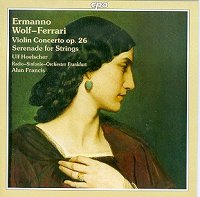
ERMANNO WOLF-FERRARI (1876-1948) Violin Concerto (1943) Serenade for strings (1894)
Right, let's get our bearings. The composer is a German conservative who was born in Venice and who died there but who spent most of his life in Germany. The music is tuneful and romantic with elements of Beethoven, Brahms, Dvorak and Rossini. You could loosely group him with Reger, Pfitzner, Marx, Korngold and Schoeck.
Wolf-Ferrari had German and Italian parents. The Italian element shows in various of the works, especially the symphony and the last movement of the violin concerto. If he is known at all by the general music lover it is for an orchestral bob-bon from his opera The Jewels of the Madonna. He made his reputation both in Germany and beyond from 1900 to 1914 with a succession of operas. The Great War stopped or re-set many clocks. For Wolf-Ferrari, as for the British composer Joseph Holbrooke (another fashion-devastated romantic), the 1920s saw a decline he was never able to see reversed. Under a composer's compulsion he continued to write, secured his premières, but his music was not striking roots into the day-to-day repertoire. The artistic preferences of NSDAP Germany of the 1930s and 1940s, together with his impeccable Axis blood-line, might have spelt renewed attention. For whatever reason, this never happened. Instead, although the three 1940s works here were premièred in Germany, these were largely isolated events. The composer continued an impoverished existence surviving the war by only three years.
The Violin Concerto was written for the Wisconsin-born American violinist Guila Bustabò "con ammirazione". The excellent notes by Herbert Rosendorfer suggest that the composer was in love with Bustabò but details seem sketchy.
The first movement opens in hushed magic with the violin quietly intoning a Hungarian-inflected tune over whisper-rustling strings. The second movement has (Richard) Straussian moments. The final Beethovenian movement is the longest of the four at 13 minutes. This is a most attractive, fresh and rounded work. Ulf Hoelscher is excellent, his playing full of fantasy, brilliance and poetry.
A performance tape by Bustabò of the concerto survives from a radio broadcast by the Munich PO conducted by Rudolf Kempe.
The Serenade for strings is an early work dating from his student years. Apparently influenced by Eine Kleine Nachtmusik, I more often thought of Dvorak's and Tchaikovsky's Serenades for Strings. In any event, it is charming, lively and fresh - well worth hearing and performing.
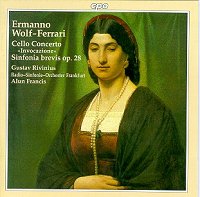
The Cello Concerto is an earnest, lyrically flowing, work in the grand 19th century manner, rather like the contemporary Pfitzner concerto. The tunes are clear and whistleable. The music seems to flow effortlessly so no doubt it was hard to write. The themes have a Bach-like grandeur. There are touches of Brahms, Bruckner and even Beethoven but none of the Hungarian or Italian element to be found in some of his other works. The odd shape of the work, with a 13 minute first movement followed by two 4-5 minute movements, does not, in fact, cause any problems. The playing of Gustav Rivinius is sonorous, unapologetic, convinced and convincing.
Sinfonia Brevis is not particularly short at 35 minutes: four movements alternately 11 mins and 6 mins. The first movement is Beethovenian. The second movement, Capriccio, is a serenade-like stroll. A real sense of theatre is apparent in the closing measures of the movement. The following adagio is confident with a Bachian stamp. This is the sort of big-band Bach we might have got even as late as the 1950s from Beecham and Goossens without the Philadelphian glitz of Stokowski. The music also has a Mozartian demeanour. The last movement allegro is definitely Beethovenian but this is not Beethoven of the beetling brow but serenade-like with more in common with the first two symphonies. Rossini and the tarantella put in an appearance towards the end. Ultimately this has the look and feel of a divertimento, suite or serenade rather than a barn-storming symphony. There is no "sturm und drang" .Regard the symphony as a blood-brother of the very early Serenade for strings or the contemporary Schoeck Suite for Strings (also on CPO see review).
Some may, perhaps, feel like condemning Wolf-Ferrari for writing such conservative music despite the Nazi regime and a world seething with death and horror. It however seems clear from the notes that Wolf-Ferrari wrote music under a composer's self-compulsion to create. His style was a natural part of his make-up. Nothing is fabricated or artificial. Here is a genuine romantic who would have written this music whatever was happening around him whether the tragedy of his own neglect or the wider tragedy of a world at war.
These two discs may well have become lost in the torrent of new releases. If so this is a great pity. Neither is recent. Both were recorded in 1994 and released in 1996. They have not received much critical attention.
It is fifty years since Wolf-Ferrari's death. This conservative and joyful music deserves more playing time. If you want only one of the two discs opt for the violin concerto. Both are enthusiastically recommended.
Reviewer
Robert Barnett
The following is a newsgroup exchange which may be of interest in reading these reviews.
Rob Barnett wrote:
Having recently reviewed the CPO recording of the Wolf-Ferrari violin concerto I am curious about this Wisconsin-born violinist. The W-F violin concerto was written for her and dedicated to her con ammirazione. It was premiered by her in war-time Germany (1944?).
How on earth did Bustabò get to do this? This was a première by a US citizen (?) with an Italian name in Nazi Germany. It seems incredible. The concerto BTW is very attractive and fresh in its ideas though the essential language is Brahmsian. Can anyone shed light on Bustabò, her other recordings, her biography and her relationship with Wolf-Ferrari. There is an off-air tape of Bustabò playing the W-F with the Munich PO and Kempe. This dates (I believe) from early 1970s. W-F died in 1948.
Guila Bustabò (with accent grave on the final o, suggesting a pronunciation [g(h)ila Bustabò]) (so given in the 1948 Gramophone Shop Encyclopedia of Recorded Music) remains a mysterious figure in the history of musical performance in the 20th century. I don't have the New Grove to consult, but I can report that neither Baker's 8th Edition nor (incredibly!) MGG (Die Musik in Geschichte und Gegenwart) has an entry for her. She did make a handful of 78s, mostly in Germany, where her base of operations appears to have been, even before WWII. Among these is a recording of the Sibelius Violin Concerto (C-LWX 372/5), with Fritz Zaun conducting the Berlin Staatskapelle. Since in the 78rpm era all recordings of this work were up against the stunning Heifetz/Beecham recording, there were understandably few reviews, and I was unable to turn up any, even in the books by David Hall. There is also a live performance of Max Bruch's Violin con. #1 in G-min. with Bustabò and the Royal Concertgebouw Orch., cond. Willem Mengelberg (rec. 27 Oct. 1940) in Music & Arts CD-780 (four CDs, a set of live concert recordings by Mengelberg and his orchestra).
Does anyone know how W-F was viewed in Nazi Germany. The notes imply that he was not encouraged or very much supported.
The book, Die Musik und Musikpolitik im faschistischen Deutschland, ed. H-W Heister and H-G Klein (Fischer Taschenbuch 6902), 1984, reports, p.149, that W-F's opera Der Campiello, which received 100 performances during the Third Reich, was one of the successes of that era. Joseph Wulf's Musik im Dritten Reich (rororo 818-819-820), 1966, includes, pp.51-52, some correspondence (all in the most bristling bureaucratic Reichsbeamtendeutsch) with a certain Dr. Achim Gercke, whose title was "Der Sachverständige für Rasseforschung beim Reichsministerium des Innern" ["the authority (literally: the one who understands the matter) on racial research in the Imperial Interior Ministry"], this concerning W-F's racial heritage. Dr. Gercke replies that, as far as the accessible documents indicate (NB, there was a specific request, for reasons not given, not to extend the research onto Italian soil), W-F's ancestors were "arisch und frei von jüdischem und farbigem Bluteinschlag" ["aryan and free of Jewish and colored strain"]. (FWIW: The same pages in the Wulf contain reports on the ancestry of Alban Berg, and the report correctly states that Berg was not Jewish.)
Hope this helps... --E.A.C.
Brian Kay's BRITISH LIGHT MUSIC Classics
Sir Malcolm Arnold: Overture - The Roots of Heaven; William Alwyn: Suite of Scottish Dances; Sir Malcolm Sargent: An Impression on a Windy Day; Clifton Parker: Overture - The Glass Slipper; James Langley: The Coloured Counties; Gordon Jacob: The Barber of Seville Goes to the Devil; Maurice Johnstone: Tarn Hows - A Cumbrian Rhapsody; Alan Langford: Overture - Two Worlds; Sir Richard Rodney Bennett: Little Suite; David Lyon: Overture - Joie de vivre.
This is an enterprising and entertaining programme of light music by British composers many of whom have written for the screen.
Arnold's Overture: The Roots of Heaven is directly linked to the film of the same name starring Errol Flynn in his penultimate role, with Orson Welles, Trevor Howard and Juliette Greco. It was set in Africa and this Overture, written for the film's London premiere, responds to all the elements of the screenplay: elephants, the Americans and the love interest. Arnold, as usual, juxtaposes an imposing fanfare and highly evocative African sound landscape-painting with quirky, jazzy rhythms and a broad, sweeping romantic melody; a minor tour de force.
William Alwyn, of course, scored many British films, but he is represented here by his jolly Suite of Scottish dances strongly based on traditional Scottish tunes. I was especially intrigued by the second dance entitled A Trip to Italy it is as though the Cock of the North is meeting Respighi's The Birds; and by Carleton House which seems to transport the dancing to the Tyrol.
Sir Malcolm Sargent is remembered as a distinguished conductor especially by older British Promenade Concert enthusiasts, yet his An Impression on a Windy Day shows that he had considerable skills as a composer. This is highly pictorial music, supremely evocative; Sargent vividly captures the atmosphere of a wild, blustery day with music that reminds one of Mendelssohn while the more romantic elements recall Eric Coates. (Has the work a hidden programme about a pair of lovers' sometimes stormy relationship?) This is a perfect little gem that makes one wonder what Sargent might have accomplished if he had chosen to develop this facet of his talents.
Clifton Parker wrote the music for the film Sink the Bismark. His Overture to his children's operetta, The Glass Slipper, based on the Cinderella story, is included here. It is an appealing, jolly, Mendelssohnian-quick-silver, yet dainty scherzo. Gordon Jacob well known as a master arranger and orchestrator is represented by his wickedly funny The Barber of Seville Goes to the Devil a brilliant parody on the famous Rossini Overture. Considering the pathetic nag that the Barber rides, no wonder such a fate befalls him! This item is a riot and worth the price of the CD alone!
James Langley's The Coloured Counties takes its name from a quotation from a line in Bredon Hill from A.E. Housman's A Shropshire Lad: "Here of a Sunday morning, My love and I would lie, And see the coloured counties, And here the larks so high, About us in the sky." The music is nicely, hazily, evocative and lightly romantic with some rather odd Celtic inflections. But the highlight of this CD, for me, is Tarn Hows, Maurice Johnstone's Cumbrian rhapsody celebrating the loveliness of this stretch of water lying between Coniston and Hawkshead in the English Lake District. Johnstone's music magically paints Tarn Hows slowly shrugging off early morning mists, then resplendent, glistening under the midday sun to the admiration of its many visitors and then bathed in serene, spectral, moonlit beauty.
Alan Langford wrote his Two Worlds to a BBC commission. The intriguing Overture is perky and full of good humour; it is a neat combination of the elegantly classical and colourful Latin American rhythms. Sir Richard Rodney Bennett has notched up many celebrated film scores but her we have a charming set of little pieces comprising his enchanting Little Suite, its movements, for the most part, named after birds. This magical little work with its gentle waltz rhythms is comfortably and charmingly redolent of a children's world of long ago - a nice romantic nostalgic wallow. Finally there is another work principally for younger audiences - David Lyon's colourful Overture - Joie de vivre which is full of just that.
Gavin Sutherland and the Royal Ballet Sinfonia deliver sparkling and sympathetic performances of all these little gems.
Reviewer
Ian Lace
ENGLISH ORGAN MUSIC
William H HARRIS (1883-1973) Flourish for an Occasion
John STANLEY (1718-86) Voluntary VII
Thomas ARNE (1710-78) Concerto No 1 - Introduction and fugue
William RUSSELL (1777-1813) Voluntary XV
C Hubert H PARRY (1848-1918) Fantasia and Fugue in G
Herbert HOWELLS (1892-1983) Rhapsody No 17 Nos 1-3
Patrick GOWERS (1936- ) Toccata
Peter Maxwell DAVIES (1938- ) Three organ voluntaries
The multi-faceted stone reflectors of Gothic Cathedrals blend organ tones together: street-organ pipes come at you like newsvendors. Parish church acoustics offer all stations in between; and I revelled in the strong colour contrasts of Matthew Morley's varied programme on the new Tickell organ at St. Barnabas, Dulwich.
If Harris's "Flourish" is a trifle tame harmonically the chorus reeds make its impact telling: enjoyable too is this fine player's easing into the softer foundation tones of Choir and Swell. Back to Stanley, where a fine diapason and cornet stop come into focus, followed by scampering flutes in an Arne Concerto.
Well-written sleeve notes mark the progress of this well-designed and finely played recital. We learn that William Russell's Voluntary XV hints at some of the vulgarities to come in Victorian England. Personally, I loved his operatic twitterings, especially as enunciated by a Swell reed and the Cremona. Certainly Victorian solidity still hangs around Parry's impressive Fantasia and Fugue in G.
How then would the crepuscular opening of Howells' first Rhapsody sound on this instrument? Movingly beautiful! "Do not forget me quite, O Severn meadows" I mused, probably misquoting Gurney. If the third Rhapsody lacks rhythmic and melodic definition, the lesser known Second really figures. How had I neglected it so long?
Festive fireworks in the Patrick Gowers Toccata lead to three slow pieces by Maxwell Davies. An anticlimax? Not at all. The startling entry of the solo stop in Psalm 124 put me in mind of Betjeman's couplet:
"Praise ye the Lord! and in another key the Lord's name by harmonium be praised''.
A strange but effective end to the 70-minute programme.
Organ buffs will love to learn from the notes of the constituent in each rank of pipes etc: and, following current TV credits, everyone gets a mention, including the tea-maker. Altogether a joyous enterprise, well carried through. Not a habitual listener to organ recordings, I shall come back to this one with great pleasure.
Reviewer
Andrew Seivewright
O SPRITE HEROIC: The life, love and death of Sir Philip Sidney explored
William BYRD (1543-1623)
O you that hear this voice
O dear life
John WARD (1571-1638)
O my thoughts surcease
William BYRD
Constant Penelope
Weeping full sore
Penelope that longed
John MUNDY (1555-1630)
Penelope that longed
Alfonso FERRABOSCO I (1543-1588)
Penelope was ever praised
Francis PILKINGTON (1570-1638)
Come, shepherd's weedsThomas VAUTOR (1590-1620)
Lock up, fair lids
And yet, O dream
John WARD
How long shall I?
A satyr once did run away
My true love hath heart
Henry YOULL (15xx-16xx)
Only joy, now here you are
William BYRD (1543-1623)
Come to me grief for ever
O that most rare breast
'To enchant' according to my 'Oxford Dictionary of English Etymology' is to charm or to lay under a spell. I certainly found enchantment in listening to the sweet tones of the Trinity Consort and if you too are equally jaded by the threadbare tones of some choirs and the barnstorming vibrato of soloists making pitch as uncertain as the English clImate then buy this CD. True, there may not yet be the consistent professionalism of the King's Singers or the Anonymous 4; but there is a beguiling quality about the singing that has to be heard. If sopranos Rachel Bennett and Clare Wilkinson are the icing on the cake, the effect of the complete five--voiced ensemble is beautifully blended and well-tuned.
Some may think that madrigals are for performing rather than listening to. (Rather like Noel Coward's "TV is something to appear on, not to watch"). And long ago I remember sitting on the river bank at King's as the madrigalists went punting past with Wilbye's "Draw on sweet night" in full flow. A somewhat blasé organ scholar turned to me and said 'They all sound the same to me'.
Byrd, Ward, Vautor, Ferrabosco and others - they all show their individual accents in this well-chosen programme. The only common factor is librettist Sir Philip Sidney (1554-1586). You can learn a lot about him in the copious scholarly sleeve notes by Gavin Alexander of Christ's College whose forthcoming book "Writing after Sidney" promises much.
Maybe, like me, you know "My true love hath my heart" (here in a setting by John Ward) and not too much else. I certainly was unaware for instance that 'Sidney writes the first feminine ending in English poetry'. He also strove for 'a harmonious marriage of poetry and music in song'. Good news for composers; and a nice change from such reluctant librettists as A.E. Housman!
I look forward to hearing this group again. Perhaps they might turn their well-tuned talents to close harmony.
Reviewer
Andrew Seivewright
TWENTY-SIX DANISH VIOLIN CONCERTOS - PLAYED BY KAI LAURSEN (1924-1996)
INTRODUCTION
I have been fascinated by this issue ever since I heard of its release. I now have the opportunity to review this 10 CD set and I am grateful to Discovery Records and Danacord for providing a review copy.
It is a tribute to the enthusiasm, dedication and artistry of Kai Laursen (the soloist in all these concertos) that this set exists at all. We must also not forget Jesper Buhl and Danacord for making these riches available nor the willing co-operation of the Danish Broadcasting Corporation. Would that similar sets existed for Swedish, British or USA violin concertos.
For all those who complain that the record companies are always recording the same repertoire again and again this set is a wonderful antidote. The adventurous listener will be able to save up to get the set (which is at mid-price working out to less than £8 sterling per disc) and enjoy many evenings of rewarding discovery, making lifelong friends along the way.
Although his name is completely unknown here, Kai Laursen's achievement is to be compared with that of the late Ralph Holmes or the still very much active Raphael Wallfisch who has recorded many of the British cello concertos. However in terms of sheer numbers of concertos tackled none of these artists approaches Laursen in breadth and depth of territory pioneered.
Here we have more than ten hours of music. The tapes are from Danmarks Radio supplemented by two private amateur tape recordings: the Nielsen and Grondahl concertos. The booklet points out that many of these recordings were done in a single take. The recordings span the years 1966-1978. The clean recording practices of Danmarks Radio and the sensitive production and re-mastering work of Jesper Buhl and his production team make these CDs a joy to hear. The results are natural and clear.
The set comes in a flimsy cardboard slipcase cradling five volumes, each volume with 2 CDs. Each volume is of the thickness of a single standard CD jewel-case. There are full notes for all ten in the first volume. The notes by Mogens Wenzel Andreasen are in Danish and English and run to 40 pages. To complete the span, the oil paintings on the slip-case cover and each volume are by Kai Laursen himself. The paintings are of rural or garden scenes with flowers predominating.
If you would like more information about Danacord's catalogue they have a website.
EXECUTIVE SUMMARY
Rare repertoire. Largely romantic and certainly tonal. Many gems here. Good solid natural sound. Don't worry about the fact that some of these are mono recordings. Convincing performances. Sick of the latest round of celebrity career launch and relaunch recordings of the top ten 'great' concertos continually recycled? Buy these. Given the sheer heart of the performances and the great beauty of most of this music I'd recommend this set strongly to both the beginner and the experienced listener.
Anyway - to the task at hand:-
THE MUSIC
DACOCD 461
CLAUS SCHALL (1757-1835)
Concerto No. 4 for violin and orchestra in D major (May-July, 1790) 26:15
Aalborg Symphony Orchestra Alf Sjoen, conductor
Studio recording, Aalborg Handvaerkerforening,
May 3, 1970. MONO
This a lyrical Mozartian concerto. The first movement is in constant song with recollections, wittingly or unwittingly, of Mozart's Sinfonia Concertante for violin and viola. The mono recording presents no problem. The sound has great immediacy. The second movement is quiet and ethereal and the playing conveys a sense of intense concentration. The last movement is an urbane and charming stroll evolving into an explosive chivalrous theme. There is perhaps some roughness at this point in the sound of the soloist but this is far from obvious and does not detract from the enjoyment of the piece.
NIELS W. GADE (1817-1890)
Capriccio for violin and orchestra in A minor (1878) 8:00
Southern Jutland Symphony Orchestra Carl von Garaguly, conductor
Studio recording, Musikhuset, Sonderborg, December 21, 1976. STEREO
This is a much more modern recording of a romantic work by an early romantic composer. The music is quite brilliant as befits a caprice. Mendelssohn is the main influence but there is even the occasional forward look towards Nielsen and sideways glances at the Beethoven concerto. The work offers a nice balance of display and melody. This work pioneered by Joachim is an excellent alternative to the Mendelssohn violin concerto.
LAUNY GRONDAHL (1886-1960)
Concerto for violin and orchestra in D major, op 6 (1917) 22:11
Aalborg Symphony Orchestra Jens Schroder, conductor
Studio recording, Aalborg Handvaerkerforening, June 6, 1967. MONO (This release is based on a private amateur tape recording)
Grondahl is well known as a conductor. To collectors his reputation rests on his pioneering recordings for radio (reissued by Danacord) and Decca of a number of the Nielsen symphonies. His Danish Radio recordings of romantic Danish symphonies (including Simonsen, Borresen, Sandby and Glass) have been a valuable staple of the Danacord catalogue on both LP and CD. Grondahl was also a composer. This concerto dates from 1917 while slaughter was raging hundreds of miles away to the south in mainland Europe. There is little or no tragedy to be heard in this escapist music. The music is Elgarian and certainly if you enjoy the British composer's violin concerto you should listen to this one. There is a moment of Korngoldian melting lyricism at 2:10 in the first incident-packed movement. The second movement has its soft Delian passages all of which remind us of Delius' links with Denmark and Danish composers, notably Sandby. The third movement has plenty of attack after a walking -pace introduction with a theme and treatment which has a counterpart in Frankel's famous piece Carriage and Pair. The music gives in to schmaltz, occasionally going slightly over the top. There is a charming accelerating theme towards the end. The convincing ending is marred slightly by the sudden cut off in the recording presumably to remove well-deserved applause. This does however create a jarring transition from concert-hall ambience to silence.
DACOCD 462
JOHANNES FREDERICK FROHLICH (1806-1860)
Concertino for violin and orchestra in D major, op 14 (1826) 15:53
Southern Jutland Symphony Orchestra Carl von Garaguly, conductor Studio recording, Musikhuset, Sonderborg. April 18,1978. STEREO
Frohlich came from a German family as did Kuhlau. This little concerto is of a Beethovenian stamp but this is the charming Beethoven of the septet and early symphonies rather than the imposingly earnest composer of the later years. There is a gentility about the first movement which avoids the commonplace. The very brief and quiet andante middle movement is followed by an explosive finale of Paganinian fireworks.
EMIL HARTMANN (1836-1898)
23:46 Concerto for violin and orchestra in G minor. op 19 (before 1880) 23:19
Aalborg Symfoni Orkester Jens Schroder, conductor
Studio recording, Aalborg Handvaerkerforening. April 10,1968. MONO
Hartmann's three movement concerto looks to Germany again. The 'hero' is the Mendelssohn concerto which makes a quite striking parallel. The middle movement is based around a charming birdsong-like 'chaffing' theme. The finale is a busy-as-a-bee flurry of activity. The work is not especially nationalist in flavour but is quite charming and full of character. If you enjoy the Mendelssohn then try this work. I would now like to hear Hartmann's Symphony No. 2 'From the Days of Knighthood'. The Concerto is quite a discovery!
HENNING WELLEJUS (b. 1919)
Concerto for violin and orchestra in A minor (1948, revised 1968) 22:21
Aalborg Symfoni Orkester Jens Schroder, conductor
Studio recording, Aalborghallen, Aalborg,
February 6, 1975. STEREO (first performance of rev. version)
Again this is a three movement work by a composer who was a pupil of Tarp. The atmosphere asserted strongly in the first movement suggests the film scores of the 1940s. Nielsen is also an influential voice. The sound is somewhat unnatural with the violin very close to the microphone. This makes for a tiring and unremitting feeling; to the first movement especially. The second movement is lighter and explores a quieter more contented mood with a contemplative approach which occasionally suggests Rózsa. The galloping finale is a light-hearted display vehicle. The notes claim that it is a neo-classical work. Certainly this is not dry neo-classicism. An entertaining concerto. Wellejus has three symphonies to his name and after hearing this concerto I would very much like to hear them.
DACOCD463
JOHAN SVENDSEN (1840-1911)
Concerto for violin and orchestra in A major, op 6 (1869-70) 28:56
Southern Jutland Symphony Orchestra Carl von Garaguly, conductor
Studio recording, Sonderjyllandshallen, Aabenraa, June 19,1968. MONO
The age of this recording is beginning to show but it is a more comfortable listening experience than the Wellejus with its close-range recording. This concerto is better known and this is by no means its first recording. Svendsen was Norwegian-born but from the age of 43 until his death he lived and worked in Denmark. Laursen plays the concerto with a communicative, loving tenderness. The first movement, almost as long as the other two put together, is full of Mendelssohnian faerie-romance and Laursen lights up this music with husky tone and brilliant fantasy. The second movement is prayer-like and strongly poetic. The last movement is dashing and virtuosic. Why on earth players do not take up this concerto I do not know. It would make a happy, satisfying coupling for the famous Bruch or the Mendelssohn.
LUDWIG HOLM (1858-1928)
Concerto for violin and orchestra in G major (1916) 36:00
Southern Jutland Symphony Orchestra Carl von Garaguly, conductor
Studio recording, Sonderjyllandshallen, Aabenraa,
December 16, 1970. MONO
This work (probably Holm's only orchestral work), like the Grondahl, dates from the Great War years. There is something of Richard Strauss about it. It would be good to compare Strauss's own early violin concerto with this work. The work arose from a competition between Holm and Axel Gade as to who could write the most difficult concerto. The first movement is strong and imaginative with Brahmsian moments though this influence is far from oppressive. The mysterious opening of the first movement in fact suggests a much more modern approach. At 10:30 there is an extraordinarily beautiful passage and this is one amongst many. The orchestration strikes one as wonderfully well-judged. There is a bright and breezy close to the first movement. The second movement sustains the magic. This really is a superb modern romantic concerto and contrary to the occasional echoes in the first movement it is far from being a Roneo-copy of anyone else's work. The final movement has a Hungarian atmosphere rich with incident and completely unlike Nielsen. The music has a dramatic-oriental sound. This a major discovery and is well worth the time of any world class violinist. Its melodies and orchestration sound well beyond its 1916 vintage. The 1970s sound is very good indeed.
DACO464
AXEL GADE (1860-1921)
Concerto No. 2 for violin and orchestra in F major, op 10 (1899) 28:47
Southern Jutland Symphony Orchestra Jens Schroder, conductor
Studio recording, Sonderjyllandshallen, Aabenraa, June 14,1972. STEREO
Axel was the son of the more famous Neils Gade. The first movement offers up a long Mendelssohnian allegro with more than a dash of Tchaikovskian vitality. The second movement has its Rimskian moments and a deal of whistling romanticism. The third movement is a Polacca - all scintillating brilliance. Sparks fly but with a great deal more musical substance than for example the Paganini concertos.
PEDER GRAM (1881-1956)
Concerto for violin and orchestra in D major, op 20 (1919) 25:56
Southern Jutland Symphony Orchestra Carl von Garaguly, conductor Studio recording, Frihedshallen, Sonderborg, June 13, 1967. MONO
Gram was a Leipzig-trained musician unlike many of the composers on this set. He was resolutely opposed to Mahler's music and according to the notes abominated late romantic music. For many years he was Music Director of Danish Radio and during that time not a single work of his was played. For all his declared opposition to the late romantics this concerto has many marks of that school. The first movement at 5:40 has a lovely chirruping clarinet theme and the work as a whole is despite the suspicion that it will be academic or desiccated is in fact very accessible without being a particularly riveting listen.
RUED LANGGAARD (1893-1952)
Concerto in one movement for violin and orchestra (August, 1943) BVN 289 8:47
Odense Symphony Orchestra Aksel Wellejus, conductor
Studio recording (first performance), Fyns Forsamlingshus.
Odense, January 10, 1968. MONO
This is a one-movement concerto with the duration of an overture. It is laid out Allegro vivace - Finale Scherzoso. The presence of a piano in the orchestra adds a piquant flavour to the proceedings. For a work written in 1943 the Mendelssohnian style is very anachronistic; not that anachronism is itself any reason to condemn music. The music is bright and buoyed up by birdsong. The world of the Mozart piano concertos colliding with the charm and romance of Mendelssohn. Entertaining music again from a composer always worth hearing.
DACOCD 465
AUGUST ENNA (1859-1939)
Concerto for violin and orchestra in D major (1897) 22:57
Southern Jutland Symphony Orchestra Carl von Garaguly, conductor
Studio recording, Sonderjyllandshallen, Aabenraa,
December 20, 1966. MONO
Out of the Gade and Mendelssohn school, this is another singing display piece but with the emphasis on heart rather than obviously flashy pyrotechnics. Once or twice the first movement seems to pre-echo Sibelius's Humoresques (a desperately undervalued set of pieces). The second movement makes much of Laursen's hooded tone and muses amidst birdsong and woodland rustlings. The last movement glitters and bubbles with energy.
HAKON BORRESEN (1876-1954)
Concerto for violin and orchestra in G major, Op. 11 (1904) 28:24
Southern Jutland Symphony Orchestra Carl von Garaguly, conductor
Studio recording, Sonderjyllandshallen, Aabenraa,
August 20, 1975
Borresen did not write a great deal of music. There are three symphonies (all available on CD from Da Capo and CPO), this concerto and several operas, the most famous of which is The Royal Guest and the most intriguing is the Iceland-set opera Kaddara which deserves revival if the aria Ujarak's Farewell is anything to go by. This is an early work with strong Brahmsian overtones and a dash of Wagner. Brilliance aplenty is required but again this is no vapid display vehicle. The poetry displayed at 10:05 of the first movement is just one example of Borresen's heartfelt inspiration. The violin is in constantly ardent song through the second movement: try 5:30 for some distinctly Elgarian poetry. Laursen's concentration and identification with the music is total. The final molto vivace has the violin dancing out of the wispy opening chords but for some time the high inspirational charge of the first two movements escapes Borresen only to be recaptured in the joyous and explosive final two minutes. Captivating and treasurable indeed. There is a competing performance from (Da Capo/Marco Polo 8.224059) played by Rebecca Hirsch. Hirsch though giving what seems to be a strong and enjoyable performance however does not have quite the involving fleetness and mercurial brilliance of Laursen.
P. E. LANGE-MULLER (1850-1926)
Concerto for violin and orchestra in C major, op 69 (1904) 21:21
Southern Jutland Symphony Orchestra Peter Ernst Lassen, conductor Studio recording, Sonderjyllandshallen, Aabenraa, May 31,1966. MONO
A confidence and Straussian exuberance positively bursts out of this music. At 4:00 in the first movement there is a remarkable jerky little march and at 7:30 aspiring and hyper-romantic passage work for the solo violin. The second movement is largely quiet and reflective. The last movement strolls away charmingly with eagerly darting music. At 4:05 there is a chirruping theme briefly recalling one of Sibelius's Humoresques. The spiccato display at 7:10 and through to the end brings the concerto to a convincing close. This is an extremely attractive work.
SIEGFRIED SALOMON (1885-1962)
Concerto for violin and orchestra in G minor, op 26 (1916) 21:52
Southern Jutland Symphony Orchestra Alf Sjoen, conductor Studio recording, Sonderjyllandshallen, Aabenraa, May 13,1970. MONO
The Salomon was premiered by Peder Moller who also gave the first performance of the Nielsen. This concerto did not however impress me all that favourably. It has its moments as at 6:51 in the first movement with some delightfully musing passage work for the soloist. The second movement sounds a little like early Bax or perhaps Macdowell and there is even a shade of Wagner's Siegfried Idyll. The final, movement strikes me as somewhat conventional.
GUSTAV HELSTED (1857-1924)
Concerto for violin and orchestra in B minor, op 27 (1909) 21:45
Southern Jutland Symphony Orchestra Carl von Garaguly, conductor Studio recording, Sonderjyllandshallen, Aabenraa, June 13,1974. STEREO
The Helsted is a very busy concerto with plenty of colourful and attractive activity for the soloist. It is not however all that compelling. The one exception is the lengthy passage beginning around 2:20 where Nielsen-like music is carried by the soloist who is accompanied entrancingly by a solo french horn. This is quite magical. The festive music of the third movement finale perhaps calls to mind the Tchaikovsky Concerto but not sufficiently to grab and hold the attention.
DACOCD467
NIELS W. GADE (1817-1890)
Concerto for violin and orchestra in D minor, op 56 (1880) 26:10
Southern Jutland Symphony Orchestra Ole Schmidt, conductor
Concert recording from Sonderjyllandshallen, Aabenraa, February 3, 1966. MONO
Gade conducted the Mendelssohn violin concerto while he was the conductor of the Gewandhaus concerts. It is Mendelssohn's concerto which yet again gives a reference point for this one. The first movement is dramatic and tender with leanings towards the Bruch (no.1) and Brahms. In fact there is more here in common with Brahms than Mendelssohn. It is no wonder that Joachim liked it well enough to play it several times. There is an almost constant flow of melody which is very attractive. While not, in the last analysis, a tremendously compelling work, it is certainly diverting and makes for a relaxing listening experience. The middle movement has a lower level of inspiration though pleasant enough. The last movement is much better. It has a heart-in-throat pastoral quality which stands strongly in the company of works like the Arensky, Glazunov (strong pre-echoes of that work!) and Tchaikovsky. There is very little here which I recognise as overtly Danish. It is however a work which packs great charm and glittering technique. The warm appreciation of the audience is reflected in a long segment of applause included at the end of the concerto.
CARL NIELSEN (1865-1931)
Concerto for violin and orchestra, op 33 (1911) 34:21
Southern Jutland Symphony Orchestra Mariss Jansons, conductor Concert from Sonderjyllandshallen, Aabenraa, given on the occasion of Kai Laursen's 25th anniversary as first violinist, January 24, 1978. MONO (This release is based on a private amateur tape recording)
Unlike the other 25 concertos in this set the Nielsen is comparatively well known. The inclusion of Kai Laursen's performance from a private amateur tape recording is nevertheless welcome and not only as a document of an anniversary. There are, of course, a few performances of the Nielsen Concerto in the catalogue and there has been a steady though hardly overpowering flow of these over the years. I can recall Menuhin's on an old Classics for Pleasure LP from the 1960s. The ones by Cho Liang-Lin and Dong Suk-Kang on Sony and BIS respectively have been warmly welcomed. I rather liked Kim Sjogren's performance on Chandos and before that Arve Tellefsen's 1970 performance once available in a major LP box from EMI. With Laursen everything is brilliantly, lovingly and deliberately detailed. I am not sure I could recommend this over the Sony, BIS and Chandos versions but it will, due to its intensity and passion, take the same place in collections as that occupied by Jacqueline Dupre's live performance of the Elgar Cello Concerto on Sony by comparison with the much-lauded EMI/Barbirolli studio version.
DACOCD468
OTTO MALLING (1848-1915)
Fantasia for violin and orchestra in F major, op 20 (c. 1885) 13:35
Aarhus Symphony Orchestra Jorma Panula, conductor
Studio recording, Aarhushallen, February 20, 1975. STEREO
This is a three movement concerto written by a composer clearly tutored and impressed by the works of Massenet, Saint-Saens, Tchaikovsky and Glazunov. There are even anticipations of Sibelius's concerto. Perhaps Sibelius heard the Malling Fantasia? The first movement opens with a wave figure crashing against the crags but soon evolves into a carefree joyous celebration. The solo part is flighty and displays itself in dazzling fashion without ever losing touch with the emotional kernel. Tchaikovsky is certainly an influence but the ideas are fresh and flow and change continually. The musical ideas seem well constructed and hold the attention. Everything is presented with great clarity and you get the impression that everyone including the orchestra enjoys the experience. The finale is bright and returns to the mood of the first movement. If only Malling had called it a concerto he might have had more performances.
AXEL GADE (1860-1921)
Concerto No. 1 for violin and orchestra in D major (1889) 23:41
Aarhus Symphony Orchestra Aksel Wellejus, conductor
Studio recording, Aarhushallen, March 13, 1978. STEREO
This predates the other Axel Gade concerto in the set. Atypically this is in four brief movements. This is ripely romantic music with a Brahmsian accent. At 6:00 the horns make for a magical presence. The second movement - a restful Romanza is only 3 minutes long, similar in duration to the third. The third movement is a Canzonetta with a purposeful, sharply-etched tune underpinned by a deliberately paced contribution from the orchestra. There is a sunlit, chuckling brightness about this music. The last movement is flashily melodious with distinctive tunes. Fanciers of the Glazunov and Tchaikovsky concertos will enjoy this enormously. If you know and enjoy the concertos by De Boeck and Karlowicz you should fall instantly in love with this piece.
KNUDAAGE RIISAGER (1897-1974)
Concerto for violin and orchestra in A minor, op 54 (1950-51) 23:29
Aarhus Symphony Orchestra Aksel Wellejus, conductor
Studio recording, Aarhushallen, May, 1973. STEREO
From a mysterious calm opening unwinds the first of the two movements of this modern sounding concerto. Riisager was a pupil of Roussel and Leflem and perhaps this does account for the different 'feel' of this piece. The melodic element is very strong but the music has more in common with say the Walton concerto than Riisager's Danish forebears. Oddly enough a Hungarian skirl is occasionally to be heard. At 4:20 there are some remarkable discordant trumpet fanfares. The concerto sometimes leans into the language of Roy Harris, Samuel Barber and Berg. The second movement opens with Straussian leaping brass. William Schuman and perhaps Alan Rawsthorne are also suggested. At 4:00 Riisager unleashes a touchingly lyrical idea and another emerges at 5:16. The movement and the work close with two pizzicato notes from the orchestra. I am strongly interested in Riisager. He intrigues me and I would very much like to hear the three symphonies. This Concerto however did not impress me strongly.
DACOCD 469
EYVIN ANDERSEN (1914-1968)
Concerto for violin and orchestra (1964) 30:38
Southern Jutland Symphony Orchestra Alf Sjoen, conductor
Studio recording, Sonderjyllandshallen, Aabenraa, May 10, 1975 (first performance) STEREO
It is interesting to note the premiere of this work written four years before the composer's death taking place 11 years after Andersen's death. Andersen was born in Colorado, USA but graduated as an organist from the Royal Academy of Music in Copenhagen. He made his career in Denmark with the Danish Radio SO and as Head of the School of Ancient Music.
The Concerto was written for and dedicated to his son, Jan. This is a spiky, modernistic work without being wildly atonal. Honegger is mentioned in the booklet as an influence but I doubt this hearing the influences as being more Slav than Gallic/Helvetian but all filtered through an atonal gauze.
The first movement pitches in with a Shostakovich-like petulance and it is this Russian composer and Prokofiev who often come to mind. The edges of the music are jagged though there is tense on-the-edge lyricism here but it is the slightly stressed world of the Rawsthorne and Frankel violin concertos that comes most readily to mind when listening to this movement.
The second movement wanders through a desolate landscape. There is a certain all-purpose, threnody-like, early Penderecki feeling to the string writing. The last movement is athletically challenging and clearly a technical tour-de-force for any soloist. Overall I am far from sure that this work is marked out for an international future but those in sympathy with the composer references I have mentioned should try it out. I would be interested in hearing the impressions of others.
NIELS VIGGO BENTZON (b. 1919)
Concerto No. 2 for violin and orchestra (1961) 28:04
Southern Jutland Symphony Orchestra Alf Sjoen, conductor
Studio recording, Sonderjyllandshallen, Aabenraa, May 26, 1975. STEREO
DACOCD 470
Bentzon is one of those composers awaiting wider discovery. His reputation teeters on the edge of celebrity. People know in a general way that there is some extremely impressive music there but its awesome quantity and its inaccessibility are an obstacle to all but the most intrepid explorer. His symphonies have had broadcasts in the UK during the late 1970s and early 1980s with the BBC Welsh SO conducted by Ole Schmidt and created a finger-hold impression at the time.
This concerto was premiered by Andre Gertler in November 1963. If anything this is even spikier than the Andersen work. Often a difficult nut to crack, it is a step onwards from works such as the William Schuman Violin Concerto. It is a work of contrasts though. For illustration, try the closing minutes of the first movement which have a particularly ethereal beauty paralleled by the closing measures of the second movement. The last movement has a buzzing purposeful activity but is ultimately episodic and ends because it does rather than with any sense of fulfilment. The booklet speaks of Bentzon proving that the music of the last century has not been exhausted yet and says that he seems like an Arch-Romantic. Well, I have heard impressive works by Bentzon (among the symphonies and piano concertos) but I did not find this one in that category.
JENS LAURSEN EMBORG (1876-1957)
Concerto for violin and orchestra, op 48 (1926) 17:50
Southern Jutland Symphony Orchestra Carl von Garaguly, conductor
Studio recording, Sonderjyllandshallen, Aabenraa, June 12, 1969. MONO
This is a great rarity - full of Christmas-like atmosphere and the chiming of miniature bells. The carolling tunes are rather out of the Nielsen school although Emborg is said to be of the Hindemith camp and according to the booklet he had some success in Germany. He was extremely prolific with three operas, a ballet, various short orchestral works, songs and piano and chamber music to his name.
As the concerto unfolds it is revealed as a florid work of no great tuneful distinction in three short movements. These total 17 minutes: another 'pocket concerto.' The central adagio muses quietly with a hint of Gerald Finzi's Introit (now when is the whole of Finzi's violin concerto going to be reconstructed and revived). The violinist catches an attractive husky tone for this movement. The last movement is lively and leans back into Nielsen's sound-world. It ends with jubilant work for the bells.
LEIF THYBO (b. 1922)
Concerto for violin and orchestra (1969) 28:34
Southern Jutland Symphony Orchestra Carl-August Vogt, conductor
Concert recording from Frihedshallen, Sonderborg, February 10,1971. MONO
Leif Thybo may be known to some as the arranger (for organ) of Stravinsky's Dumbarton Oaks. His concertos for cello and piano date from the 1960s and are said to be worth exploring. The violin concerto belongs to the end of that decade. It did not have to wait long for this first and only recording. This is not the premiere although Lauren was the soloist who presented it in 1969 with Miltiades Caridis conducting the Danish RSO. This is another thorny concerto; which for all that inspiration catches fire from time to time (e.g. in the wonderful barbarous march at 8:10 Track 4) does not move me.
VAGN HOLMBOE (1909-1996)
Concerto 9 per violino, viola et orchestra, op 39 (1968) 19:15
Erik Spillemose, viola, Southern Jutland Symphony Orchestra Carl von Garaguly, conductor Studio recording, Sonderjyllandshallen, Aabenraa, June 19, 1969. MONO
This concerto begins in typical Holmboe fashion with an arresting punchy attack. This motor-like energy is never far away from then on. The two soloists carol away beautifully. The music has hints of Sibelius and Copland and once or twice perhaps wanders into the world of Vaughan Williams' Violin Concerto or Holst's Double Violin Concerto. In the second movement the solo viola opens proceedings unaccompanied and is soon joined by the violin. The mood is slightly bleak and the exploring contemplative tune has Holstian overtones (Egdon Heath or the more obvious parallel of the Lyric Movement). If we did not know we were dealing with Denmark we might think that the last movement was influenced by square dance music and the fiddle tunes of Appalachia. At least that is the first impression. It is not long before distinctively Scandinavian elements assert themselves. The violin sings high and happy - ably partnered by the viola. Vigorous dance interludes are interspersed with music which seems to reach into E.J. Moeran territory.
We should hear this work as frequently as say the Mozart Sinfonia Concertante. This music is utterly delectable while being completely different from the softer-edged warmly romantic music of most of the rest of the music in the set. Holmboe's music is a Danish national treasure - a world international treasure - and a highpoint on which to close the set.
THE FUTURE
I would like to think that the next similar set from Denmark will give us never before recorded symphonies from the Danish repertoire. The symphonies of Louis Glass (1-4 as yet unrecorded), Victor Bendix, Sandby, Hamerik, Simonsen, Gram, Tarp, Bentzon and many others are very much due this sort of attention. Now imagine … if only the BBC would catch the same bug - we could have a set comprising all of Vernon Handley's Bax symphony (3, 5, 6, 7) radio broadcasts; Rootham Symphony No. 2, Arthur Butterworth 1-4, Moeran Del Mar, Arnell 5 and 6, Brian, Somervell and so many others! RB
SET AVAILABLE FROM
Discovery Records
The Old Church Mission Room
5 Kings Corner
PEWSEY
WILTS SN9 5BS
ENGLAND-UK
Phone 01672 563931
Fax 01672 563934
Price: £79.40 pounds sterling or US dollars $129.40 post free
Visa and Mastercard accepted.
Reviewer
Rob Barnett
RUSSIAN VIOLIN CONCERTOS Knipper, Khrennikov, Karayev, Rakov There may be a supply problem with this disc
This is a very varied catch with a different soloist and conductor for each concerto. Oistrakh and Kremer devotees will not want to miss these recordings. Sound quality is never very sophisticated. These are radio tapes rescued from Russian Radio archives. The sound is probably mono throughout. The notes do not tell me. The Karayev is possibly in stereo.
Two very different concertos from the very late 1950s are sandwiched between two from the years of the Great Patriotic War against Nazi Germany. Overall the bread comes over far more successfully than the filling. Both the Nicolai Rakov (1908-90) and Lev Knipper (1898-1974) works, dating from 1943 and 1944 respectively, are sweetly and meatily melodious. They are not specially original and are none the worse for that. The Knipper (played by Arkady Futer rec 1966) is called 'Little Concerto' and so it is, running circa 11 minutes across three pocket movements. The language is a rather touching blend of Delius, Glazunov, Korngold and Dvorak. The only criticism is an unconvincing finish.
The Rakov (David Oistrakh rec 1947) is quite a find too and deserves more exposure. It is another ripely romantic work but here struggles with crumbly fragile sound. It is written in much the same language as the Knipper but with a dash of Walton - odd since there is presumably no way Rakov could have heard the Walton while writing it. The Khrennikov (Yako Sato rec 1967) and Karayev (Gidon Kremer rec 1989) are written in very different language. The latter is atonal and only becomes engaging in the final sardonic march movement which shows signs of Shostakovich's tutelage. The Khrennikov is, to my ears, a rather empty exercise. The language is certainly approachable and the violinist's skills are tested or showcased as is expected but little stays in the memory afterwards except perhaps a rather Eastern caste to the first movement which also uses material which seems to have escaped from Rosenkavalier.
Good notes from John Kehoe though I would have liked to know more about the featured composers' other works. Perhaps their music will appear in future releases. Good discographic information but no indication of stereo or mono.
Reviewer
Robert Barnett
RARE RUSSIAN SYMPHONIES Vol. 2.Rostislav BOIKO (1931-) No 2 [21] Revol BUNIN (1924-1976) No 6 [22] Revaz GABICHVADZE (1913-) for strings, piano & timps [22] Revelation Records RV10105 [66:20]
Revelation continue to do good service in issuing recordings from the Russian state radio archives. Personally I wish they had spent more time on the rarer or unusual material like this than on 'great performances' though I can appreciate that "sensible" commercial considerations might seem to preclude this; which is a pity with such attractive and occasionally compelling works as these.
If you read Gramophone's excellent feature on the USSR symphony of the twentieth century you will need no beckoning from me to get these discs.
Shostakovich cast a massive artistic shadow in the music of the USSR. However that "shadow" was filtered, diluted and enriched by many influences not least the individuality of the composers and of their homelands. For those who are already growing up with in a world without this giant composite union it ran in the west from the Baltic states of Estonia and Latvia, Mongolia and Azerbaijan in the South, Siberia in the North and to the Asian states of forgetting An heritage outline may be helpful:-
Boiko - Leningrad-born. Clearly in thrall to Tchaikovsky - heard "through a prism" in his music.
Bunin - Pre-1948 pupil of Shostakovich and it shows.
Gabichvadze - Georgian whose music reflects Berg and Bartok as well as his homeland's native music.
Parsadanian - An Armenian who moved to Estonia and studied with Heino Eller but whose 2nd symphony is determinedly Shostakovichian.
Melikov - Azerbaijani who studied under fellow Azerbaijani, Karayev (himself a Shostakovich pupil) and whose second symphony is dedicated to Shostakovich.
*******************
The first volume in this series was devoted to violin concertos and has already been reviewed. These two (only available separately) have conducting duties shared between Evgeny Svetlanov (who clearly relishes the Boiko) and Gennadi Rozhdestvensky. The orchestras are various brands of State Symphony Orchestra. The recordings (not identified as mono or stereo) span 1968-1989. The earliest is the Parsadanian; the latest, Gabichvadze.
John Kehoe's notes are as usual fine and informative although I would have liked a few signposts to other works by these composers and there is space on the leaflet. This might have whetted our appetites for later volumes.
A number of companies have gone in for material of this type. Olympia has done much for many Russian composers and was early in the field if we ignore EMI-Melodiya. Now we have Russian Disc (about which I had heard worrying rumours) and Melodiya itself. In any event these two Revelations currently have the field to themselves.
Volume 2:-
Boiko Symphony No 2 (1978) This is a gem and the outstanding discovery of these discs. If Bunin is a Shostakovich acolyte and Gabichvadze leans on a mix of Bartok and the exotic, this work by Boiko is deeply romantic. It could easily have been written by Tchaikovsky had he lived a double life-time. There are also elements of Rachmaninov in this too. Svetlanov gives it a performance to match the high romance references I have mentioned. This is very accessible stuff and not a straight shadow of Tchaik and Rach. Boiko is perhaps the counterpart of George Lloyd in Russia. He can wear his heart on his sleeve without shame and with conviction. This is the second of three symphonies. I would like very much to hear the others and any other orchestral works of his. What else is available?
Bunin Symphony No 6 (1966). Bunin was a Shostakovich pupil in thrall to his teacher's style. This comes over quite powerfully. This is one of nine symphonies. It would be interesting to know what others think of the other symphonies. The first movement is very busy and at times commanding. The second piacevole movement is a strange confection. A wailing saxophone, snarling brass and a boiling climax all seem distinctly unpeaceful. Disquiet haunts this movement like a grinning skull. There is more disquiet here than calm. The third movement allegro molto skitters and scurries with much colour. Bunin produces some startling textural variety. The tinkling and clicking of this movement recalls Shostakovich 15 but of course predates it. The final adagio is a wonderful conception - exotic and passionate pushed forward by a heart-beat. A great brass chorale rears up noble and sad and again that saxophone sings discreetly. Heart-beat and clock ticking wind in and out of each other. The piece ends quietly - rather inconclusively. It is interesting to note that Bunin was criticised for formalism in 1948 at the same time as his teacher. Bunin then lost his teaching post. Bunin experimented with serialism but this is not to the fore in the symphony. Bunin is the only composer of the five who is no longer alive.
Gabichvadze Symphony for strings, piano and timpani (1963) The first (of five) movement is tense and sombre in a nocturnal Bartokian idiom relieved by at least one tender melody on the solo violin. The second movement is sabre-sharp and fleet of foot in a Shostakovichian way. Lyrical ideas which dance out of this cutting whirlwind are more reminiscent of Prokofiev. The solo piano can be heard in movements 2 and 5 rather distantly in this recording. There is then a pivotal ardently romantic 6 minute adagio which is almost Hollywoodian in a Herrmann way. This is followed by two brightly effective miniatures lasting no more than five minutes together. While rich in incident I am far from sure about this as a symphony - more a suite than anything else. Gabichvadze broke new ground in Georgian music with this symphony but for all of its Bergian credentials it does not forget the innate lyricism of the republic. Gabichvadze was entirely a product of the Tbilisi conservatory.
Volume 3:-
Parsadanian Symphony No 2 Martinos Sarian (1968) The Sarian of the title is an Armenian painter. The symphony's connection with the painter is not described in John Kehoe's notes. This is a big work in every sense, running close to 45 mins; epic, sorrowing and passionate both in loving and in conflict. The language is very strongly out of Shostakovich's palette. Parsadanian was an Armenian who became an important figure in Estonia. This is an interesting complement to the position of the Estonian symphonist Eduard Tubin who became a world figure only after moving to Sweden.
His symphony is conducted by the always reliable Svetlanov whose reputation increases for me every time I hear a new recording of his, especially in the rarer repertoire - not once do you think that his performances are time-serving. From the commanding opening maestoso first movement with its strong brass figure, to the gentler intermezzo, the long-breathed Lento and the intense and finally meditative finale (strangely it is marked allegro con fuoco!) you are never in doubt of Parsadanian's serious intentions or his gifts.
Melikov Symphony No 2 (1971?) This is dedicated to Shostakovich. It is not however, a clone Dmitri-symphony. It is in six movements. The ideas are often atonal and any sense of nationality is absent. The music is written in the universal colouring box of the avant-garde of the fifties and sixties. The recording is taken from a live or studio performance complete with audience. There is the occasional cough but nothing too disturbing. No applause - nor is there on either of the two discs.
****************************************
When a friend mentioned that this repertoire had been previously issued (can anyone provide details?) I wondered about the provenance of the recordings. Are they from Russian radio archives?
Whatever their background the present CDs are treasurable and unusual. Their cost is modest (at least in the UK) and the works belong in any collection of 20th century symphonic music. The Parsadanian and Boiko works are highlights. More please Revelation.
Reviewer
Robert Barnett
MUSIC FROM LATIN AMERICA
Scenes from Latin America
You want Colour in your music? – I’ll give you colour, You want Sensuous music? – I’ll give you sensuousness. You want barbaric music? – I’ll give you barbarism, but not artless or even in bad taste. You wish to Luxuriate with your music – well you found just the right spot in the Rain Forest. You want Lyricism in your music – well I can even give you that with really big tunes. You want it Loud? Boy, is it LOUD! Three composers , from different parts of a large sub-continent, but nevertheless being part of their own distinctive sound-world. There is much more here than Tangos.
Albert GINASTERA Panambí , Estancia
Only five years separate the two works on this disc and yet they are totally different. Both are ballet scores being presented complete for the first time although a short concert suite from Panambí has been available previously, as have excerpts from Estancia. The London Symphony Orchestra is conducted by the Uraguayan conductor Gisèle Ben-Dor. She was a protégée of Leonard Bernstein and worked with him at Tanglewood and, following in his footsteps, came to public attention as a last minute replacement for an indisposed Kurt Masur to conduct the New York Philharmonic without rehearsal. She is currently Music Director of the Santa Barbara Symphony and was chosen by the Musicians themselves to become the Director of the Boston Pro Arte Chamber Orchestra. The Los Angeles Times declared her as " just the conductor we have been waiting for to make a really persuasive case for Latin composer" and this is her second such disc although a third release has simultaneously appeared of music by Revueltas (Koch 37421-2) which, it is hoped, will be submitted for review as it supplements the Reveultas disc already reviewed this month.
Ginastera destroyed his juvenile works so Panambí is listed as his Opus 1. In an earlier work , Impressions of Puna, (withdrawn and then reinstated) Ginastera had incorporated Amerindian music to evoke the rocky landscape of Puna. Panambí was an extension of his interest in native music and legend and has the subtitle, Choreographic legend. Completed in 1937 it was first performed as a complete ballet in 1940 and subsequently won him a number of prizes establishing him as a Nationalistic composer. It is a sequence of 17 dances (some lasting only a few seconds). No synopsis is provided but the titles probably tell it all:
Moonlight on the Paraná [4.41] - Native Festival [0.26] - Girl's round dance [1.23] - Warrior's dance [1.57] - Scene [2.41] - Pantomine of eternal love [3.51] - Guirahú's song [3.19] - The Sorcerer approaches Guirahú , The water sprites appear, The Sorcerer hides [0.29] - The water sprites play [2.08] - The Sorcerer reappears, The Sorcerer cries [0.37] - The tribe is uneasy, Panambí's prayer [4.14] - Invocation to the spirits of power [1.18] - Dance of the Sorcerer [2.09] - The Sorcerer speaks [0.34] - The girl's lament [3.12] -Tupá appears, The warriors threaten the Sorcerer [0.51] - dawn [4.58] [39.11]
This score is extremely derivative, but that does not seem to matter. There are only passing references to South American folk rhythms and the influences of Ravel and Stravinsky are obvious although the Bartók references quoted by Ben-Dor in an interview with Gramophone (1/99) escape me. I will give you some reference points: the opening moonlight scene-setter is luxuriant with dark woodwind and brass, and is reminiscent of the Ravel of Mother Goose, whereas the third dance with beating percussion (3 bass drums), chugging strings and stabbing trombones has origins in the Rite of Spring. Debussy of L'après-midi makes an appearance in Pantomima del amor eterno (Pantomine of eternal love) which is a beautiful largo with extended passages for flute, oboe and horn. Guirahu's song continues the same pensive mood and opens with a flute playing a melody very similar to the trumpet opening of Schmidt's fourth symphony, which then leads to an extended, graceful cadenza. In track 8, the Sorcerer approaches with contra-bassoon imitating the Beast in Beauty and the Beast from Mother Goose - and so on. These references to other composers make for no difficulty in hearing this very enjoyable ballet music which concludes in a glorious flowing melody in an evocation of dawn.
Estancia (1941) was a commission from Lincoln Kirstein who was touring Latin America with his ballet company, American Ballet Caravan. But it was never performed by them and only existed as a four movement suite until finally performed as a ballet in 1952. This is its recording première. The piece is based on a typical working day on a ranch (Estancia) on the Pampas, so reflects the daily life of the gaucho (cowboy) rather than the native indians. It is based upon the poem Martín Fierro by José Hernández, parts of which are recited and sung by the bass-baritone Luis Gaeta. The ballet starts where Panambi left off with a dawn sequence. The scenes are Dawn [2.34] - Little dance [2.07] - Morning; Wheat dance [ 3.21] - The farm labourers [2.55] - The cattlemen, the entry of the foals [2.03] - The townsfolk [2.18] - Afternoon: 'Triste' from the Pampas [3.21] - Rodeo [2.04] - Twilight idyll [2.51] - Night; Nocturne [4.19] - Dawn [1.41' - Final dance - Malmbo [3.32] [33.11]
Dawn opens with a riding rhythm on full orchestra based on a Gaucho dance the Malambo, a driving rhythm that would grace the opening credits of any Western, and Gaeta narrates the Dawn section of the poem:
Here I set myself down to sing
To the sound of the guitar
Like a man who unveils
Some extaordinary pain
Like the solitary bird
Who finds comfort in songThe accompaniment is quiet and sad as the poem recalls the end of the gaucho way of life. There is further recitation between Little Dance and the waltz-like,soaring Morning and wheat dance. The farm labourers dance to the vigourous Malamba rhythm of the Dawn sequence and the cattlemen to an equally rumbustuous version of it. The townsfolk do not know what to make of this with their quizzically tip-toed dance. Afternoon has a sad little song:
And now for the first time we go
To that most hidden, most deeply felt region:
Though the whole of my life
Is a string of woes -
Every sorrowful soul
Likes to sing of its griefs.All sorrows are blown away in the exciting Rodeo and we then enter twilight, Night and finally dawn again in a series of reflective passages, ending in a final burst of energy in the ecstatic, whirling, rousing Final Dance - a Malambo - which is where we came in. This is a very lyrical score and I did not detect any influences. In those four intervening years Ginastera had quite developed his own style.
This recording was made in the Abbey Road studio and produced by Michael Fine who had been "borrowed" from Deutch Grammophon. Technically it is one of the best recordings I have heard. I thought on first hearing that it was occasionally a little bass-heavy but it is a truthful realization of those three bass drums!
Reviewer
Len Mullenger
Silvestre REVUELTAS Homenaje a Federico Garcia Lorca, Sensemaya, New Philharmonia Orchestra: Eduardo Mata
Revueltas hailed from Mexico as a child prodigy and, in the early years of this century, moved to Chicago where he survived Al Capone but not the booze. He was assistant conductor of the Mexico Symphony Orchestra for six years and his last three years he spent travelling Europe and he supported the Spanish Civil War. He suffered spells of mental illness and was dead by 40. He was a nationalist composer reflecting his country's folk music and song. The rhythm and sharpness of his music reflects the sounds that local villagers produce with their small discordant bands of instruments, as found in any Spaghetti Western.
The present album appears to be a compilation of from earlier BMG sources with three orchestras and conductors. The earliest is from 1975 but the sound on all is stunning. If you are at all aware of this composer's work it will be Sensemayá which is based on Nicolas Guillen's poem describing a ritual dance used during the killing of snakes, here presented in its later scoring for 27 wind instruments and 14 percussion instruments.. This was taken up by Leonard Bernstein and a recording released in the UK in 1964. This opens with soft gong strokes, a stomping Latino-indian dance rhythm and distant calls imitating the sort of sound that comes from a conch shell. Trumpets and trombones enter, followed by chugging strings as the dance becomes more and more frenzied. Great stuff!
This is performed by the New Philharmonia conducted by Eduardo Mata who also opens the disc with Homenaje a Frederico Garcia Lorca written in 1937, in memoriam. It has a most peculiar construction - a short arpeggio on piano, a haunting lament on trumpet and then a chirruping piccolo leading full tilt into a rude dance rhythm with sneering trumpets and discordant trombones cocking a snook. Similar episodes alternate; trumpet lament again and a more sorrowing, dragging dance rhythm; then Mexican Tijuana rhythms leading to an energetic conclusion.
The London Sinfonietta conducted by David Atherton then takes centre stage with four shorter pieces for small ensemble. Ocho X Radio was written for a radio play and is a short chamber piece for eight instruments with a lovely central swaying section. Toccata is a short ,vigourous piece played furiuosly, reminiscent of neo-classical Stravinsky. Alcancias is in three movements, the central one slow and lyrical the outer being more vigourous. Tim Page ( Executive Producer for Catalyst and obvious Revueltas enthusiast) declares that these sound like El Salón México on mescal. The final piece is Planos which I mistook for pianos, particularly as a piano plays the central role in the opening which is both hesitant but expectant. In fact planos means planes or layers.
The final work is La noche de los Mayas played by Orquesta Sinfónica de Jalapa conducted by Luis Herrera de la Fuente. It is a suite in four movements drawn from the film of the same name. No details of the film are given by Tim Page. The opening movement (La noche de los mayas) has more than a hint of stereotype, opening with loud gong crashes and brass fanfares before introducing a gentle string melody. The second movement (La noche de Jaranas) will sound familiar if you are acquainted El Salón México with its bright, fidgety dance rhythm. If there was a love interest in the film it is expressed in the beautiful La noche de Yucatàn. The finale, La noche de encantamiento, has stamping percussion and screeching brass, twisting, whirling , writhing and routing in wild abandon. Revueltas might be on one of his benders but from the booklet illustration it seems that he is calling the dead from their graves; less a carnival., more a Dance Macabre. The CD packaging is unusual. In place of the booklet is a large poster which is folded into a booklet. One side contains the track details and the notes by Tim Page. These too are unusual in that the English script has alternate lines with the Spanish; novel but difficult to read. This is a pity because what he has to say is well worth reading. The reverse is taken from a mural in the Hotel del Prado, Mexico City, entitled Dream of a Sunday Afternoon in the Alameda by Diego Rivera who is present as a boy holding hands with a skeletal lady. Her skull forms the central, CD-sized, square of the poster and is not reproduced in colour as is the rest of the mural, but in black and silver. This is what you see when folded and in the CD case. This could not be adequately reproduced as a graphic for this page. No matter, as the coloured counterpart is present as a backing piece to the disc and that has been reproduced here. An enlarged silver and black version of the skull is also printed on the CD. This is packing as imaginative and startlingly original as the compositions contained within. Full marks to catalyst who are distributed by BMG
Reviewer
Len Mullenger
There is more information on the composer in an article "Silvestre Revueltas: Tale of an Unforgivable Oblivion" by Roberto Kolb Neuhaus see website http://www.peermusic.com/classical/revueltasessay.htm
Heitor VILLA-LOBOS Gênesis, Erosão, Amazonas, Dawn in a Tropical Forest
Heitor VILLA-LOBOS Symphony No. 4 "Victoria", Cello Concerto No.2, Amazonas
For three of my four decades of record collecting this music had been virtually inaccessible and yet, for example, Villa-Lobos produced a vast corpus of music (12 symphonies, 16 string quartets, 5 piano concertos). He did not produce this music in isolation but was well travelled and very familiar with Western compositional forms – German, Italian, French and especially his beloved Bach. This last decade has finally seen the catalogue blossom, bearing flowers of great beauty, fruits of wondrous tastes and the odd dangerous animal. The steamy growth conditions in the rain forest has given rise to a great diversity of flora and fauna and so too it has called forth a splendid representational orchestral display with huge orchestras and rare and exotic instruments imitating the calls of tropical birds, the crawling of insects, the torrents of rivers, the crashing of trees and the torrid heat.
South American Art, Music and traditions came to the notice of the West following the visit of the Ballets Russes to Brazil in 1917. Amazonas dates from that year although it was more than a further decade before it was performed. It is the only duplication on the discs under review. From their series "Music of the Latin American masters", we have on Dorian Recordings, Diemecke conducting the Simon Bolivar Symphony Orchestra of Venezuela, who from the large puff in the booklet notes, must be very familiar with this music, and on Marco Polo, Roberto Duarte conducting the Czech-Slovak Radio Symphony Orchestra of Bratislava who, presumably, have the merest acquaintance with the music – but it does not sound like that at all. The Dorian disc proclaims Fiber Optic 20bit sound, Marco Polo make no claims for their recording. Dorian have accorded a clear, widely spaced, studio sound of the highest quality which captures a large dynamic range but with an overall effect I can only describe as cool or perhaps over-analytical and delineated. The atmosphere on Marco Polo is quite different. The recording is just as clear but closer and warmer. With Dorian we are floating on the wider stretches of the Amazon observing the forest on the edge of the river. With Marco polo we are running out of river and having to force a way through the overhanging branches. We are enveloped by the forest with its mysterious sights and noises. The sound may have less width but it has greater depth and is more dramatic – very fittingly so for this music. The Czech-Slovak orchestra (complete with warbling Slavonic brass) is upstaged by the Simon Bolivar Orchestra who sound more used to this music, clearly so in the ease of articulation of the string section who are not at all tentative and much more idiomatic, but, and it is a very big but, they do sound rather bland and less involving and so failed to make much impact on me. This is the more surprising considering they get through the piece in 10% less time. The Duarte orchestra are less familiar and relish the challenge and are being kept on their toes. I am with them every step of the way and was actually surprised to discover theirs the slowest performance because it really builds up the pressure. Both sets give excellent detailed notes and Dorian have 18 index points for the 11-minute Amazonas so that the story, which appeared in a dream to Villa-Lobos’ father, can be closely followed.
Amazonas is the portrayal of a young Indian girl coming to terms with puberty and her emerging, explosive sexuality. This is all expressed in mythological terms. She is bathing in the Amazon and looking closely at her reflection which pleases her. She feels attractive and sensuous and dances proudly for the Sun, caressed by warm, gentle breezes. The God of the breeze is trying to seduce her and, offended at her rejection, carries her scent to the region of the monsters. Smelling a virgin, one of the monsters comes crashing through the forest destroying everything in its path. The girl suddenly sees her own reflection transformed into this ugly creature and horrified, she rushes off into the forest pursued by the monster. Villa-Lobos’ rich orchestration is fully descriptive of each stage in this story.
And here the two discs diverge. On Marco polo there are three more "Amazon" pieces. First in order of composition is Erosão (Origin of the Amazon) (1950). It is based on the Indian Legend of the origin of the Sun, Moon and Amazon Basin – a piece of mystery and the origins of time. This is a satisfying little tone poem. Opening with rustling strings and rolling timps, Fafner tubas and fluttering woodwind, the strings take up a hesitant melody with woodwind arabesques emerging into Sibelian brass passages. Peace returns with musings on strings, horns and flute with softly growling basses. Raindrops fall through the orchestra leading to rivulets, streams and finally a smooth flowing river – no rapids hereabouts. A chuntering bassoon introduces a perky rhythm that gradually builds a lumbering dance, which is brought suddenly to a halt. A quiet cymbal roll introduces a broader theme, which slowly and peacefully expires. Dawn in a Tropical Forest followed in 1953 and the title fully describes this 10-minute piece.
The first track on the disc is the later work Gênesis, written as a ballet for Janet Collins in 1954. Villa-Lobos stretches his imagination for special effects in this work. After a grand, opening statement of intent this piece groans and slithers, rattles and bangs into being like a large scale Little Train of the Caipira. Darwinian themelets appear and evolve as they climb their way through the orchestra. Bassoons, tuba and bass clarinet creak their way out of the primordium – bass drum, gong and cymbals. Violins finally scamper away, picking up speed with a sawing theme accompanied by skittering woodwind. Blowsy horns follow on to eventually lead the way in a merry dance. Having achieved development and transformation, a quiet transition scene is introduced with solo cello and celeste, but still with a hint of the dance rhythm being tapped out behind a floating theme for clarinet and cor anglais. This is taken up by the violins and develops into a soaring lyric - a hymn to Nature. The driving Brazilian dance rhythm disturbs this pastoral moment and the brass exult in the glory of this main theme. Another interlude, of bird calls over plucked harp and softly exploding gong, and a whole variety of imaginative sounds as if the forest creatures were luxuriating in the afternoon sun. The ballet moves towards a rolling crescendo, ending with a yawning sigh of pantheistic happiness.
This is a really enjoyable disc, well recorded and with a comprehensive sleeve note.
The Dorian disc now departs from Pantheism and gives us the Fourth Symphony Victoria, and the second cello concerto. Villa Lobos, of course, loved the sound of the cello and it is probably through Bachianas Brasileiras No5 for soprano and cellos that his name became known. Forty years separate the two cello concerti, with the second (1953) being contemporary with the other works on the Marco Polo disc above. It is in four movements but of unequal length.
Although Villa-Lobos can write quite overwhelming music, he is much more restrained in the cello concerto – in the orchestral parts that is, as the cellist has a very busy time this being a decidedly virtuoso work. If heard blind I suspect it would be some time before any Latin element was detected but it is there, in the choppy string dance rhythm. The second movement is a beautiful andante which, in shape, is very similar to the aforementioned Bachianas Brasileiras No5, displaying a haunting, yearning melody for cello over a plucked accompaniment. To some extent this carries over into the third movement which has a distinctly Spanish flavour. The movement is short (4:40) but over half its length is taken with an unaccompanied cadenza for the cello which then leads straight into the fourth movement allegro. This effectively gives a balanced concerto in three more or less equal parts. This rather spare work counterbalances the other two on the disc.
The major work is the fourth symphony. According to the notes of Juan Arturo Brennan, the 3rd, 4th, and 5th symphonies form a cycle of War, Victory and Peace; hence the title Victoria. The symphony is based upon a text which is reproduced in the highly detailed booklet in which Victory is running among the men at battle, encouraging them, assuring them of triumph and offering them the prospect of peace, employment and prosperity. One might imagine that the third symphony, which I have not heard, might demand an outsized orchestra but even for his fourth the composer is not content with a standard orchestra. He requires two supernumerary groups – one, the Fanfare, with trumpets, horns, trombones and tuba and a second group comprising clarinets, saxophones, bass drum, cymbal, tambourine and triangle.
As the symphony opens we seem to still be at war with rattling snare drum and general percussive explosions and martial brass. The later woodwind chording is echt-Shostakovich, as is the long, broad, searching string melody that forms the body of the movement. I am also frequently reminded of Prokofiev. I spite of the size of the orchestra the composition does not sound bloated.
In the text Victory begs that France lead the Flower of the Universe and that Italy will not to let the Eternal Swan drown in the waters of Venice. This is the subject of the second movement in which are heard quotes from La Marseillaise with the brass in the Fanfare playing their part. We then move to Italy for what is described as a Neapolitan song episode before a crashing finale to the movement. The third movement is an elegy in which Victory offers comfort and reassurance to those who were wounded or lost their loved ones. Again I am reminded of Prokofiev in this beautiful slow movement.
The Finale is Victory offering liberation – ploughs will till the fields, the trains will roll, factories will hum, flowers will grow on the battlefields – the blood will dry. At first the movement recalls the depths of the andante but then the side band comes cheerfully into play, leading the orchestra into a triumph of celebration.
Two indispensable discs the revealing a new side to this composer for those only familiar with the guitar or piano concertos. There is an overlap of one work but I cannot really see how you could do without either of these discs.
Reviewer
Len Mullenger
Book Review
A MUSICIAN'S DICTIONARY
Ever wanted to know the meaning of: "secondary sub-mediant appoggiatura six-four" or "first inversion Neapolitan five-seven of five, sharp four plus eleven, going to a half-diminished seven of six"? Well look no further folks for this little book reveals all - or some of it! Now you needn't feel diminished; and to misquote a current TV commercial, armed with this knowledge, pleasure can follow pain.
To give you a sample of the erudition of this pocket volume I quote a few early definitions:-
Atonality: A pathological disease that effects many composers of modern music. It's most noticeable symptom is the inability to make decisions - such as what key we should be in. It's the advanced and sometimes fatal stage of polytonality.
Bagpipes: A Scottish instrument (of torture, war, mass destruction) whose sound resembles that of a cat being run over by a car...
Counter-Tenor: The highest adult male voice currently available through legal and moral means. Sings roughly (and roughly sings) the same range as the contralto, although he can sing lower if pressed and higher if pinched...
Comodo: A tempo indication (from the Italian meaning "leisurely" or "without strain"). Not to be confused with commode, a small chair containing a chamberpot - the use of which may also be leisurely (and, one hopes, without strain).
Glissando: The musical equivalent of stepping on a banana peel.
Lord Menuhin contributes an amusing preface in which he complains that there is one omission - the piano - and then goes on to describe it in all its glory and to say something of its remarkable non-musical uses.
So, music-lovers, remember, as in all walks of life, bullshit baffles brains; and this wee tome will make you feel that much more bullish.
Ian Lace
Return to Part 1 >>>>>
COMPETITION WIN
a CD of your Choice from Crotchet
 Search the Crotchet database from here
| Discs
on these pages are offered for sale. There is also a page of search
engines from a selection of on-line retailers
here.
Please support this web-site by buying your discs here. Disclaimer: Every effort is made to make sales links to the correct disc but, in the end, you must take responsibility for checking that what you are purchasing is what you want. Some of these discs were not actually available for sale at the time of posting but a link has been made in anticipation of their forthcoming availablility. |
Return to Index