Comparison recordings
S 109, Varujan Kojian, Utah SO [incl.
Paradiso frag.] Varèse Sarabande
VCD 47207
S 109, Kurt Masur, Leipzig Gewandhaus
Orchestra [ADD] EMI 68598
S 109, Kurt Masur, LGO [North America
only] [ADD] MHS 52257W
S 96, Árpád Joó,
Budapest SO [complete tone poems] Brilliant
Classics 029421
Liszt’s Second Symphony
has not become popular, and it may
be said to be the least appreciated
of his major symphonic works. The first
performance was a fiasco, but a second
performance in Prague was very successful.
It is an attempt to write music with
virtually no identifiable motifs, no
tunes, just moods. The "Inferno"
movement interprets the words Dante
found inscribed over the gates of Hell,
and can be expected to wander anchorless
through tonalities and sonorities organised
around melodic fragments which are generally
not developed, just repeated in slighting
shifting colours, all dark and odorous.
"Purgatorio" begins with thinner,
tentatively despairing sounds.* At about
six minutes in we begin a tired-sounding
fugue, one of Liszt’s best and longest
but on a curiously non-memorable pattern
of notes which then grows in optimism
and dramatic import. The movement gradually
coalesces into a magnificat for
boys’ chorus and finishes quietly after
an hallelujah.
The rarely played "Paradiso"
finale is then a brief triumphant chorale
fanfare coda, somewhat abbreviated (54
seconds long) in view of the length
of the first two movements. Surely this
is merely a sketch for what Liszt must
have intended to be a much longer movement.
Liszt faced the impossibility of writing
interesting music about perfect bliss
and, on Wagner’s advice, withdrew it
to leave the work as we now most often
hear it - in two movements.
The Masur recording
remains clearly the best both in terms
of sound and performance. Masur’s orchestra
is massive and menacing, with thrillingly
clear massed double-basses and aggressive
brass. Given the mood of the music,
a little roughness in the brass and
percussion actually contributes positively.
Masur’s chorus is the legendary Leipzig
Thomanerchor. Kojian is a close second.
He receives brighter digital recording
that emphasises high strings and brass
and reduces the impact of the double-basses.
Turning up the bass control helps this
recording considerably and brings out
the terrific bass drum accents. Kojian’s
mood is definitely lighter and more
heroic throughout. His chorus is the
larger Utah Chorale and surely contains
female voices to stabilise the sound.
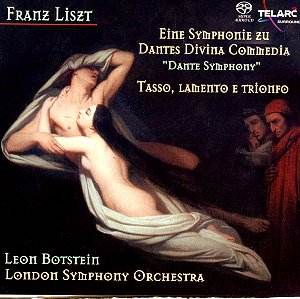
Botstein’s performance
of the Symphony is by comparison
curiously subdued, the most distantly
miked of all, with good orchestral detail,
but conservative dynamic range. The
very first Telarc recording, a direct-to-disk
LP, featured compressed dynamics. Apparently
this is a demon not yet completely exorcised
from the Telarc aesthetic. The double-basses
have almost no growl, even on the SACD
tracks, and this is not compensated
for by a slight improvement in transparency
and lower distortion in the cymbals
and trumpets. The violins have at appropriate
times a nice sense of expectancy, and
— legends or no — the boys’ chorus and
soloist are the best. The CD tracks
are better than on some Telarc Hybrid
SACDs and decode nicely in your Dolby
Digital surround sound decoder.
In contrast, Botstein’s
Tasso is richly and dynamically
performed and recorded, perhaps partly
because the work itself is more conventionally
tuneful. Tasso, Lamento e Trionfo,
Symphonic Poem #2, was conceived as
an overture to Goethe’s play "Torquato
Tasso". Liszt was also inspired by Byron’s
"Lament of Tasso". As the title suggests,
the work is a depiction of the deepest
of despair and depression followed by
the wildest paranoiac ecstasy of total
victory, and it makes a good "third
movement" to the Symphony.
This must have been Eduard Hanslick’s
favourite Liszt since it comes closest
to making his case. Here the problem
is not expressiveness, but reserve,
keeping some sense of proportion, particularly
in the over-the-top finale which set
a new standard of orchestral bombast.
Masur [DDD] fails the test and falls
into crude banality. Árpád
Joó’s innocent sincerity carries
him through brilliantly, and he receives
excellent (cd) recording. There is a
CD [ADD] version by George Solti that
is also exceptional.
*including a nice section
in the strings that Jerry Goldsmith
used so effectively in the "Star
Trek: the Motion Picture" film
score.
Paul Shoemaker



 London
Oratory School Schola, Michael McCarthy, director
London
Oratory School Schola, Michael McCarthy, director
 TELARC
SACD 60613 [64.36]
TELARC
SACD 60613 [64.36]