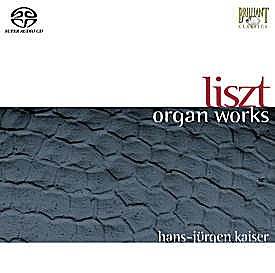
Here we have yet another
release devoted to organ works, this
time from the Brilliant Classics label
on one of their Super Audio discs. Most
of the Brilliant Classics releases that
I have heard comprised previously released
material however this Liszt recital
recorded in 1997 appears for the first
time.
I found the accompanying
booklet notes to be mainly incomprehensible
with plenty of the label’s usual proof
reading errors. This left me questioning
the accuracy of the information that
I did understand. From what I can gather
from the booklet notes all three Liszt
works have links with instruments made
by renowned organ builder Friedrich
Ladegast who also constructed the organ
at Schwerin used on this recording.
If the notes are accurate the Ladegast
Schwerin organ was built circa 1870
and has four manuals and pedal with
84 stops. It is a powerful instrument
with a glorious timbre that can vary
from sweet and sensitive to luxurious
and powerful.
World famous Hungarian
born composer and piano virtuoso Franz
Liszt worked in many genres although
mainly associated with the solo piano,
and with large-scale orchestral and
choral works. However Liszt did write
several works for the organ, an instrument
that he frequently played. It has been
said that Liszt was interested in playing
the organ but that his expertise on
the instrument was restricted owing
to his ineffective use of the pedals,
however other writers have remarked
on Liszt’s mastery of the organ. Nevertheless
Liszt’s relationship with organist and
organ authority Johann Gottlob Topfer
and his pupils stimulated a particular
interest in the instrument. It is a
commonly held view that Liszt’s organ
works tend to reveal pianistic tendencies.
This has been identified as a weakness
although his ‘symphonic’ style of composition
was developed by composers of the French
School such as Franck, Widor et al.
The first work on this
release is the mighty Prelude and
Fugue on the name of B.A.C.H. which
Liszt composed in 1855 and later revised
in 1870. The work is based on a motif
from the letters of Bach’s name in German
notation and has become an established
mainstay of the organ repertoire. Soloist
Hans-Jürgen Kaiser gives an expansive
and most committed performance of this
enduring music which is intensely geared
towards organ colour.
The Variations on
"Weinen, Klagen, Sorgen, Zagen"
is widely regarded as a warhorse
of organ repertoire. The work is constructed
from the bass lines of a section from
a J.S. Bach cantata of the same name
and from part of Bach’s B minor Mass.
Originally composed for piano Liszt
later transcribed the work for organ
in 1863. Hans-Jürgen Kaiser is
a most persuasive interpreter displaying
all the required authority and command.
The monumental Fantasia
and Fugue on 'Ad nos, ad Salutarem,
undam' (To us, to the water of salvation)
which Liszt composed in 1850 uses
some thematic material from Meyerbeer’s
Opera: Le Prophète. The
soloist’s reading is highly dramatic,
relentlessly surging forwards in a magisterial
performance. In particular, Kaiser’s
playing of the twenty-five minute long
Fantasia section demonstrates
the supreme artistry of both organist
and organ builder and is nothing less
than awesome.
The sound quality of
this Brilliant Classics SACD release
is wonderful with a wide dynamic range.
This is a luxurious and ardent tribute
to a great composer. The playing from
Hans-Jürgen Kaiser has a special
authority and the disc is worthy of
celebration.
Michael Cookson



 Hans-Jürgen Kaiser (organ)
  BRILLIANT
CLASSICS 92208 [77:46]
BRILLIANT
CLASSICS 92208 [77:46]