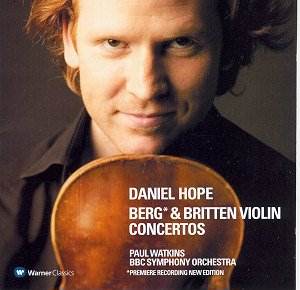
Daniel Hope’s previous
recordings on Nimbus have gathered a
fair amount of critical praise (http://www.musicweb-international.com/classrev/2001/June01/Hope.htm;
http://www.musicweb-international.com/classrev/2000/mar00/shostakovich.htm;
http://www.musicweb-international.com/classrev/jun99/schnittke.htm),
so his shift to Warner Classics should
be watched with great interest. He could
hardly have wanted a more interesting
or indeed important coupling than the
present one.
Important, musicologically,
for the Jarman edition of the Berg Violin
Concerto. The work, as is well-known,
is effectively a requiem for Manon Gropius,
who died at the age of eighteen and
who inspired the work’s dedication,
‘Dem Gedenken eines Engels’ (‘to the
memory of an angel’).
Jarman’s edition cleans
up errors in the full score that, he
claims in his informative accompanying
notes, Berg would have corrected. For
example, the solo line at the beginning
of Part II where ‘Berg copied the rhythm
wrongly and accidentally omitted two
ledger lines and an octave sign’. This
is the biggest difference one will hear
– as, perhaps, with the recent Kaplan
edition of Mahler 2, the differences
are often more felt than consciously
noted as one listens. It was Hope that
premièred this new edition (at
the RNCM in Manchester, in July 1995
– the score was published the following
year by Universal Edition, Vienna).
Hope’s performance certainly speaks
of an intimate knowledge of this complex
yet infinitely rewarding score and moments
like the chorale in Part II have an
expressive depth normally reserved for
players who have accumulated more years
of experience. Hope seems to realise
that there is a dark power that seethes
under the score until the peace of the
chorale finally becomes known (even
them it is not an ‘easy’ peace). Take,
for example, an arching, typically romantic
figure for solo violin at 7’22, a three-note
figure that heads towards the heavens
before coming back in on itself. Many
other players see this as a gesture
back in time to the High Romantics and
milk it for all it is worth – Hope rather
plays it with no let-up while maintaining
a more Expressionist intensity. Hope’s
technique is fully the equal of the
taxing solo part (the cadenza of Part
II is gripping).
Of all the concertos
in the violin repertoire, this is one
that requires most co-operation (an
unanimity of vision) between soloist
and conductor. Here Hope and Watkins
do indeed seem to work as one, an approach
that reaches its apex as the chorale
emerges entirely naturally, the unforced
result of their combined vision. Detail
is excellent and always has a point
– the horn’s statement of the folk-tune
at around 10’30 into Part I is more
highlighted than usual, making the trumpet’s
statement immediately thereafter seem
entirely logical. Warner’s recording
helps, as there is little or no muddying
of textures, my only quibble being that
the level at the very opening of the
work is set so low as to be virtually
inaudible.
Rhythm in this piece
is a vital element. Hope and Watkins
realise that this is a multi-layered
statement. On one level, they refuse
to luxuriate when lesser interpreters
might - try the opening of the Allegretto,
where the orchestral off-beats are slightly
more ‘nudged’ than usual – the music
refuses to be comfortable, to relax.
On the larger rhythmic scale, the Hauptrhythmus
takes on all the emotive weight of a
doom-laden Leitmotif (comparisons with
Mahler’s Sixth Symphony are not inappropriate).
The care taken by these
interpreters is clear at the close of
the work, where they create a sense
of arrival at the solo violin’s final
high note. Here Hope is glassy and penetrating
against gorgeous brass chords – this
is not a comfortable end by any means,
no matter what the chorale might try
to say.
Competition is, of
course, fierce in this work. Louis Krasner,
who commissioned the piece, recorded
it famously with Webern conducting –
another version with Fritz Busch at
the helm has just surfaced as part if
the Royal
Stockholm Philharmonic Orchestra’s eight-disc
set (my review to follow). Mutter
and Perlman in modern times have both
left memorable accounts. But Hope should
be heard even if those versions are
already on the shelves – and he would
make an excellent choice as the sole
version to own, too.
There are many points
of contact between Berg and Britten,
most obviously perhaps in the marriage
of an expressive surface with a firm,
and often complex, background organization
(compare, say, the precompositional
pitch-organisation of Lulu with
the quasi-serial manipulations of Turn
of the Screw, for example). So the
coupling of these two concertos is entirely
apt.
Of course Maxim Vengerov
recently recorded the Britten with Rostropovich
conducting in an exemplary
EMI recording (coupled with the
Walton Viola Concerto). Hope has a lot
to live up to, and again he acquits
himself well. It seems Watkins is at
home here, too, for the sleazy, slinky
dance-like elements of the first movement
make for mesmeric listening. The elusive,
bitter-sweet nature of this music is
excellently caught. A pity an editing
error intrudes (2 minutes in exactly
there is a clipped woodwind entry -
see footnote).
There is great rhythmic attack in the
second movement (Hope really digs in
here) and the orchestra also seems to
be enjoying itself (although it must
be admitted that Rostropovich seems
to get closer to the heart of the music).
Hope’s cadenza includes some terrific
high harmonics (the tone is remarkably
true and pure).
The Passacaglia finale
is the great challenge of this work.
The spacious approach taken here means
that one is undeniably aware that great
things are afoot (emphasised by the
way the theme creeps in). The famous
‘bird-song’ effect is well captured
by the recording (the whole area around
the eight-minute mark). The very ending
is interesting – the violin’s attempted
disquiet against the orchestra’s striving
towards repose works well.
Again, the accompanying
booklet notes are from a recognised
scholar in the field and are faultless
– this time the author in question in
Donald Mitchell.
Recommended with enthusiasm.
Hope’s youthful fervour coupled with
an enquiring mind and a clear affinity
for the music of these two composers
is an involving mix.
Colin Clarke
Comment from
John West
As producer and editor
of this recording, I read Colin Clarke's
review with considerable interest. His
enthusiasm for all aspects of the CD
are most welcome. However, I was alerted
to go back to my score of the sessions
when he says that there is an audible
edit at 02'00". I must inform Mr
Clarke and all your many readers that
there is NO edit at 02'00" or indeed
anywhere near that point. Although modern
recordings do require a great deal of
editing for the ultimate perfection
required of CD listening, in this instance
your reviewer is mistaken. Perhaps the
up-beat triplet quaver in the clarinets
is what he is hearing? It is most unlikely
that with the soloist, conductor and
producer all listening to the final
master many times, a mistake like this
could be missed and I am glad to be
able to "set the record straight"!



 Daniel Hope (violin)