Jean Cocteau’s one-act
play La Voix humaine was first
staged in 1932 by Berthe Bovy at the
Comédie Française. This
is actually a long monologue by a woman
whose lover has left her and whom she
telephones for the last time for three
quarters of an hour. The play in itself
is a real dramatic tour de force
calling for a first-class comédienne
to make sense of the often colloquial,
albeit a bit dated language used by
Cocteau. The task is made the more difficult
by the absence of a protagonist on stage.
So, challenges are plentiful here. What
should be said, then, of the near-impossible
task of setting it to music? Hervé
Dugardin director of Recordi Paris,
suggested that Poulenc should set La
Voix humaine. This was not the first
time that Poulenc collaborated with
Cocteau, although Poulenc’s few settings
of words by Cocteau are early works
(Cocardes – 1919, Le
Gendarme incompris – 1920, with
Cocteau and Raymond Radiguet, and a
short, uncharacteristic song Toréador
– 1918), as was the collective work
Les Mariés de la Tour Eiffel
by Cocteau and the Groupe des Six.
Of course, when he composed La
Voix humaine, Poulenc had already
composed a great amount of songs and
of vocal music (including his comedy
Les Mamelles de Tirésias
and his grand opera Le Dialogue
des Carmélites), and
had consistently and constantly refined
his approach to French prosody, that
is unequalled so far, and that can at
best be compared to Britten’s response
to English prosody. Setting La Voix
humaine, however, was still a formidable
challenge, and it may be safely said
that Poulenc magnificently rose to it.
(Cocteau later told Poulenc that he
had definitively fixed the way to say
his words in La Voix humaine,
once and for all). The vocal
part, mostly set as arioso with
brief melodic flights, is remarkably
written for the voice and is superbly
supported by a subtle, transparent and
constantly varied orchestral writing
that is quintessentially Poulenc throughout,
and that never drowns the voice, thus
allowing for each word to be clearly
heard. Singing La Voix humaine,
too, is another formidable challenge
for the singer who has to navigate through
a whole range of emotions while maintaining
the natural flow of both words and music.
The first recording
of La Voix humaine was
made many years ago by Denise Duval
with Georges Prêtre and the Orchestre
National de l’Opéra-Comique (on
EMI). Denise Duval gave the first performances
of the work and was close to Poulenc’s
heart, at least in artistic terms. (She
also sang and recorded Les Mamelles
de Tirésias also for
EMI but with André Cluytens this
time.) So, her performance remains the
model of any performance of La
Voix humaine; and, fortunately
enough, her recorded performance (first
published in 1959) is still available
in CD format.
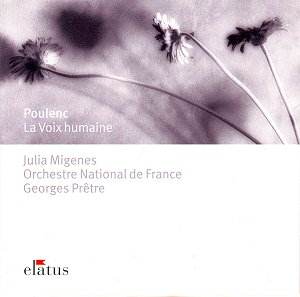
Now, what about the
present performance? To tell you the
truth, I was at first a bit diffident,
particularly when considering Migenes’
later career. Now, as far as I can judge,
Julia Migenes superbly rises to the
occasion. She is well served by her
excellent French pronunciation and her
acting skills, and is confidently supported
by that arch-Poulenc conductor, Georges
Prêtre for whom the music holds
no secrets. I had not heard La
Voix humaine for a long time,
and I was delighted to hear it again
in an entirely convincing reading such
as this one.
Hubert Culot



 Julia Migenes (soprano)