Surely anyone who
has played Beethoven’s Piano Sonata
in E, Op. 14 No. 1 (and many have, given
its status for years - who knows, maybe
it’s still there - on the Associated
Board’s Grade 8 exam) will be aware
of the frequency of four-part writing,
so it should come as no surprise that
it transcribes easily for string quartet.
What is really lovely is to hear it
in a clean, warmly, even welcomingly,
recorded account such as this one. Of
all four players of the New Music String
Quartet, maybe for a change the violist
is the best known. Walter Trampler (1915-1997)
was previously a violin member of the
Boston Symphony Orchestra. He also recorded
some Berio on viola - from which I first
knew him: with the composer directing
and the Juilliard Ensemble on RCA LSC3168.
He also commissioned new works. Claus
Adam was later a member of the Juilliard
Quartet. The New Music String Quartet
disbanded in 1955.
Cleanliness of texture
is a characteristic that runs through
Op. 14 No. 1. This is a considered reading
- notice the care with which the players
articulate the repeated crotchets of
the second subject, for example, or
the even interlocking semiquaver thirds
that are tossed from instrument to instrument.
Interestingly the piece seems to take
on more depth of utterance in the string
quartet medium and it was possibly this
that the players were trying to emphasise
by taking what feels like a rather slow
tempo for the middle movement. Here
it sounds portentous. Of course the
large, several-octave slur for first
violin that introduces the Trio works
better than on the piano because of
better connectivity between the notes.
Beethoven re-writes
the left-hand of the third movement,
replacing the arpeggiated triplets with
syncopation. A syncopated effect does
occur in the piano original, though
it is rather different in that he right-hand
is syncopated, while the left maintains
the original triplets.
The warmth of The New
Music String Quartet’s sound comes easily
across the years. As does one element
of period practice, that of slight portamento
(probably best described as a ‘slither’)
that the first violin inserts around
14’06. Incidentally, that timing refers
to fourteen minutes into the quartet
as a whole – for some reason, Bartók
Records do not track individual movements,
so there are only two tracks on the
disc.
The third Razumovsky
is a superb reading, one to stand along
with the very best. The New Music Quartet
conjures up a miraculous sense of stillness
in the first movement’s ‘Introduzione’,
contrasting it with perky playing in
the first movement proper, the Allegro
vivace (no tempo indications are given
in the documentation either, by the
way). Throughout there is a simply superb
sense of free communication between
the instruments, as if they are living
and breathing this music rather than
merely playing it. For the second movement
(Andante con moto quasi allegretto)
perhaps there could have been a little
more resonance on the cello pizzicati,
but for the rest this is a delight,
especially the imitative passages. Shadings
in the Menuetto are superb. Yet the
surprise comes with the finale. It is
marked Allegro molto, and The New Music
String Quartet certainly take the molto
bit at face value. In doing so, yet
simultaneously maintaining clarity,
the tension is markedly high but not
frenzied. Superb.
This disc is well worth
searching out - Bartók Records’
web address is given above.
Colin Clarke



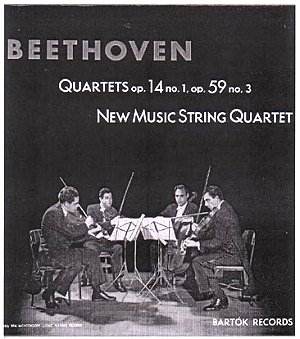
 The New Music String Quartet (Broadus Erle, Matthew
Raimondi, violins; Walter Trampler, viola; Claus
Adam, cello).
The New Music String Quartet (Broadus Erle, Matthew
Raimondi, violins; Walter Trampler, viola; Claus
Adam, cello).