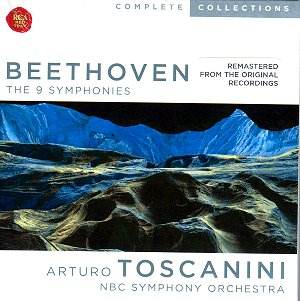
The record industry
is in recycle mode again. These definitive
performances have been in and out of
the catalogue intermittently since the
1950s; more in than out, I am pleased
to say. Each repackaging makes the cycle
more convenient moving from single discs
at full price, single discs at mid price,
twofers at mid-price, to the current
format, a boxed set at bargain price.
Each time they are
re-issued, we are told that the miracles
of modern technology have been applied
to them, making a giant step forward
in sound quality. Fortunately, although
the booklet informs us that the recordings
have been re-mastered yet again (2003),
there is no marketing blurb informing
us of the dramatic improvements once
again. This is very good, as to these
ears, there is very little difference
in sound quality between this issue
and the twofers, which were released
about five years ago. These made an
improvement albeit fairly slight on
their predecessors with a taming of
the upper frequencies and a definite
warming of the sound. If you have these
versions, there is little need to invest
in the current set, unless you are looking
to save space on your shelves, as the
present box, containing card sleeves
is a definite advantage in this area.
In addition, there is a very informative
multilingual booklet which enhances
this issue.
These performances
are extremely interesting to those of
us who have experienced the sometimes
bogus claims to authenticity of the
period performance brigade. Tempi in
this set, are often as fast as many
of the competing versions, and Toscanini
is well known for his strict adherence
to the composer’s instructions. Although
academic research has opened our senses
to Beethoven’s tempo markings, many
of these are almost met in the present
very fine performances.
Toscanini’s was insistent
on his orchestras playing accurately
and together. What is clear from listening
to these performances is that standards
of orchestral playing in the 1950s have
certainly been improved upon in the
intervening years. Modern cycles can
be and often are better played than
these, but are there any other factors
which should direct your intention towards
the current set – most emphatically
yes!
As was the fashion
in the 1950s, no first movement repeats
are played. The commitment from conductor
and orchestra alike is total. This shines
through in these incandescent performances.
One recalls the Toscanini quote "Is
not Napoleon. Is not Eroica. Is Allegro
con brio." These are pure performances
defined clearly by the scores and nothing
else. Gone are the interpretative features
of other contemporary great conductors
(Furtwängler, Mengelberg and Weingartner,
to mention just three), each of whom
recorded complete Beethoven Symphony
cycles at about the same time.
Comparing these cycles
one is struck by how deeply felt they
are and that they are like chalk and
cheese. Mengelberg, and to a lesser
extent Furtwängler, impose a thick
layer of interpretative detail on top
of the scores with fluctuations in tempo
etc which add to or subtract from the
performances depending upon your likes
and dislikes. Weingartner is perhaps
closer to Toscanini than the other two,
but he does not appear to galvanise
his players to the same extent.
No. 1 starts strongly
and continues in this vein, with rapid
tempi being utilised throughout. The
second movement is straightforward with
no nonsense playing from the orchestra.
The scherzo explodes onto the scene
with the orchestra playing for all it
is worth. The finale hurries along with
aplomb, and makes an extremely favourable
impression.
The Second, is played
in a similar vein to its predecessor,
with the scherzo and finale as energetic
as I am sure Beethoven intended. This
is edge-of-the-seat playing with a trace
of distortion evident, but much less
than on earlier releases.
The Eroica, with the
Allegro con brio first movement just
that, is a model of how Beethoven’s
first major symphonic utterance should
be played. Once again, there is a little
distortion at the central climax of
the movement, but not sounding nearly
as uncomfortable as before. The virtuosity
of the NBC players is clearly evident
even though there are one or two slipshod
moments. The scherzo and finale, with
suitably bucolic horns thrill as few
other performances.
The Eroica is coupled
with No. 4, which is played absolutely
straight without any of the rhythmic
distortions of the first movement introduction
as performed by many other less able
conductors.
We then move on to
a violent performance of the Fifth,
coupled with the Pastoral. This gives
you an idea of how rapidly these performances
are played. Again there is a little
distortion, particularly near the end
of the fifth, and in the storm of the
Pastoral. This slight overload is not
surprising given the amplitude of the
sound which the engineers were trying
to capture that day.
Disc four couples the
7th and 8th Symphonies.
The Seventh bowls along with emphasis
on the speed, rather than the dance.
I wonder if Wagner’s description of
this symphony as "the apotheosis
of the dance" would have been given
to the work if he had heard this performance.
The last disc in the
box gives us the Choral, which starts
off with each tremolando note being
clearly audible (compare this with Furtwangler,
who conjured up an impression of wonder
by, contrary to the dictates of the
score, running these notes together
to satisfy his interpretative requirements).
The last movement includes the wonderful
Robert Shaw Chorale, one of the finest
choirs in the world in its day. Often
used by Toscanini in his choral and
operatic recordings, one can easily
hear why this should be so. All parts
are clearly evident and the balance
between the different voices is managed
superbly well. In addition the soloists
are all first rate. At the conclusion
of the symphony, one feels that all
concerned have indeed scaled the highest
heights, and must have satisfied Beethoven’s
vision.
Very highly recommended
in its new format, unless the highest
of fi is a strong requirement.
John Phillips



 Eileen Farrell (soprano), Nan Merriman, (alto)
Jan Peerce, (tenor) and Norman Scott (bass) Robert
Shaw Chorale
Eileen Farrell (soprano), Nan Merriman, (alto)
Jan Peerce, (tenor) and Norman Scott (bass) Robert
Shaw Chorale