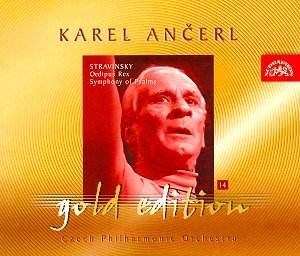
Karel
Ančerl’s time with the Czech Philharmonic
Orchestra was a supremely important
period in the history of this orchestra.
He took up the post of Artistic Director
in October 1950. In 1968 he emigrated
after the events of the Prague Spring
rarely to return.
These accounts of the
two major early Stravinsky ballets (he
did not record The Firebird)
act as testament to the close rapport
Ančerl enjoyed with his orchestra.
Jaroslav Holeček’s booklet notes
sum it up perfectly: ‘His artistic
performances were a synthesis of perfectly
calculated conception and minuscule
work with details’. The level of orchestral
minutiae you will hear on these accounts
can hardly be equalled, let alone superseded
elsewhere, yet Ančerl’s
accounts display a rhythmic grasp that
vies with the composer’s own recordings.
Supraphon’s presentation
is excellent, with the individual dances
in both ballets separately tracked for
convenience. One minor quibble re the
actual product – more space should have
been allowed between the two ballets
(i.e. between tracks 15 and 16). A mere
six seconds (in effect, a Luftpause)
comes between the quiet close of Petrushka
and the reedy, wailing bassoon that
initiates The Rite.
This remastering of
the 1962 Petrushka is little
short of miraculous. The level of audible
detail is perfectly exemplified by the
opening (Track 1). Furthermore, the
atmosphere is positively buzzing. If
Ančerl’s
speeds are not the fastest, articulation
is uniformly precise (as, indeed, Stravinsky
himself insisted upon when he conducted
his own works).
Interpretatively,
Ančerl seems happy not only to
link Petrushka to the
Rite of Spring in its rhythmic
expression, but also back to Firebird
(try the intensely pictorial, silvery
gestures around 5’55 in Track 1). Further,
this is an intensely colourful Petrushka:
listen to the darkness of the opening
of the Third Scene (‘The Moor’s Room’,
Track 4); or the chattering of the Nursemaids
(track 7); or the cartoon-like fight
of Petrushka with the Moor (track 12).
Despite fully realising
the elementalism of The Rite of Spring,
Ančerl
never forgets that this is music born
of the dance. The famous bassoon solo
that opens the work, here other-worldly
in effect, is made all the more unsettling
by the shifting, earthy clarinets underneath
it. Perhaps the sheer speed of ‘Augurs
of Spring’ will come as a surprise
(and the horn sforzandi
do not have the sheer hammered effect
of Abbado with the LSO – DG 453 085-2),
but here it is Ančerl’s long-range
thought that comes into play. Stravinsky’s
layering techniques later on are made
clearly audible and, as textures
pile onto one another, the recording
miraculously holds its own (similarly
in the controlled chaos of ‘Jeu du rapt’).
Stravinsky’s folk-like
themes take on an somewhat supernatural
quality by being presented in a curiously
objective
way. ‘Curiously’ because they stand
out in among Ančerl’s bold, primary-colour,
raw portrayal of much of the score.
In fact, perhaps his real achievement
here is that the score retains its ability
to shock: passages like ‘Rondes printaničres’
and (especially) the concluding ‘Danse
sacrale’ (track 29) sound remarkable
contemporary. This ‘Sacrificial Dance’,
in addition, has a manic quality that
is most exciting – it really does sound
as if the music exhausts itself and
has to pick itself up again several
times. No surprise, then, that the very
closing gesture is so forceful and dismissive.
A remarkable document
that should be heard without delay.
Colin Clarke



 Czech Philharmonic Orchestra/Karel Ančerl.