Berlioz’s Requiem,
his great ceremonial to the fallen,
is typical of the composer in its quirkiness
and originality. It has been seen by
many music lovers as a hi-fi spectacular,
which is quite unfair, as seven out
of the ten movements are relatively
serene and introspective. Nevertheless,
its large forces do pose a number of
problems for the conductor and recording
team.
This Atlanta recording
was in fact the first to be released
on CD, and being from a source such
as Telarc, was eagerly waited. Ironically,
it was met with a somewhat muted response,
mainly because of the recording. It
is not ideal, but I found it far more
enjoyable than I expected and easily
the match of its main rival, Previn
and the LPO forces on a budget EMI Double
Forte. Shaw’s lack of bombast and showiness
may be too restrained for some, and
he may well, in the last analysis, be
less overtly dramatic (or perhaps theatrical)
than Previn. But there is much to admire
in Shaw’s sustained beauty of line and
tightness of control. This is most evident
in the slow sections, where his beautifully
balanced choral forces sing with tonal
weight and sensitivity. The closing
Agnus Dei is a good example of
this, where the sound of a very large
choir singing with hushed intensity
is thrilling. It makes the build-up
to the central climax all the more powerful.
In fact, I found the
‘big’ moments to be equally convincing.
The famous Tuba mirum, where
Berlioz unleashes his four brass bands
‘at the round earth’s imagin’d corners’,
is one of music’s most spine-tingling,
apocalyptic moments, and Shaw does not
disappoint. Yes, he shows control again,
but he maintains a strict rhythmic pulse
when the awkward triplets start to overlap,
thus avoiding the untidiness of some
versions, including Previn. Shaw also
gives the troubled 9/8 syncopations
of the Lacrymosa a stronger,
more disturbing emphasis than some,
so that his slightly slower pulse pays
dividends in finding the expressive
counterpoint underneath. The notorious
flute and trombone chords of the Hostias
work admirably (this is a real test
of pitch for the choir), and Shaw’s
tenor soloist does all that’s required
of him in the Sanctus. It all
makes for a very satisfying reading,
perhaps too ‘safe’ or cultured for some,
but good for repeated listenings, and
with a far more disciplined choir than
Previn. The sound is a little muddier
in some climaxes than the Previn ( and
set in a drier acoustic), but the overall
balance is better, and it is certainly
without the surface hiss of the EMI,
which is disturbingly high for a digital
recording.
The fillers are also
of interest. I greatly enjoyed the Mefistofele
Prologue (actually a substantial
half-hour chunk) with John Cheek’s strong,
characterful bass adding to the pleasure.
The Verdi Te Deum is one of the
composer’s last and finest utterances,
usually heard as one of the so-called
Four Last Pieces, but equally
effective on its own. Shaw’s performance
cannot quite match the electrifying
intensity and rock-steady intonation
of Gardiner’s Monteverdi Choir version
on Philips (a filler to his Verdi Requiem),
but Shaw’s is an honest, straightforward
account that makes a good bonus to the
main fare.
This Telarc re-release
could well be of interest to those seeking
a mid-price Berlioz Requiem (with
more interesting fillers than other
versions). There are good notes and
full texts that, together with the disciplined
performance and wide-ranging sonics,
should put it on your short list.
Tony Haywood



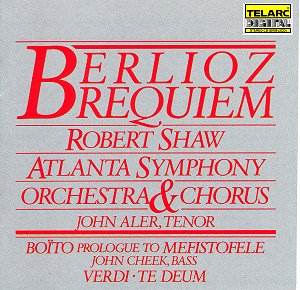
 Atlanta Symphony Orchestra and Chorus/Robert
Shaw
Atlanta Symphony Orchestra and Chorus/Robert
Shaw