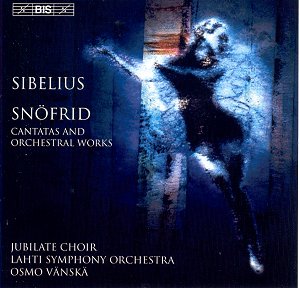
This is volume 54 in
Bis’s complete Sibelius Edition. It
mixes three orchestral pieces (one of
them, the Overture, not previously recorded)
with three choral pieces (again one
of them receiving its first commercial
recording). Those collecting the complete
edition will already have snapped this
up. What about the rest of us?
For the devoted Sibelian
the disc is a necessary acquisition
for the Overture and the Coronation
Cantata.
Oma Maa or
Our Native Land, Op. 92 has been
recorded before. It was issued as coupling
with Berglund’s second Kullervo on
HMV digital EX270336-3 (two LPs) and
on cassette EX270336-5. It was written
in 1918 between the Fifth and Sixth
Symphonies. Its immediately accessible
burnished choral style appealed to then
contemporary nationalistic currents.
Then there is Paavo Järvi’s 2002
version on Virgin Classics 7243
5 45589 2 4 which also includes
Snöfrid.
Järvi's Oma
Maa is quicker than Vänskä's
Bis version. He takes 11:55; Vänskä
13:26; Berglund (Helsinki Academic Choral
Society) 12:13. This nostalgic piece
blossoms warmly and slowly. It is impassioned,
noble, idealistic and includes echoes
of the Third Symphony. Unlike Snöfrid,
rough-hewn legendary gestures are
not part of the picture. Like parts
of Snöfrid a certain idyllic
ecstasy, typically carried by the choir,
is in evidence. Vänskä's Oma
Maa takes its time to burgeon and
this suits the work. If you are impatient
of this sort of material then you will
prefer the Järvi. Järvi also
has the benefit of a girls' choir of
impeccably honeyed purity. Vänskä's
women's choir sounds more mature - golden
rather than silvered. I had hoped to
compare the Berglund version but when
I got to CD4 in the EMI Classics
set (7243 5 74485 2 9) I found, not
the declared Oma Maa and Tulen
Synty, but Finlandia,
Tapiola and Oceanides.
Am I the only one to discover this?
Järvi's Snöfrid
runs to 11:23 against Vänskä's
14:15. It is an earlyish work setting
words by Viktor Rydberg - a poet whose
words Sibelius also set as songs - see
my recent review
of the complete Sibelius songs (Krause,
Söderström, Ashkenazy). Its
galloping early pages recall the language
of the Second Symphony. It is an unusual
piece with two turbulently majestic
and sometimes idyllic (11:43) choral
sections framing an episode in which
a female narrator speaks as the heroine
Snöfrid. The orchestral fabric
behind the closely-recorded voice is
minimal (a soft dark breathing pulse
from the brass) similar in approach
to much of the instrumental underpinning
in Luonnotar. Stina Ekblad, in
her native language, sounds more mature
than Järvi's Sofia Joons. Estonian
Joons, on the other hand, is more girlish
- more the fearless maiden of the waves.
On balance I would favour the more expansive
Vänskä whose brass players
rasp and growl with just that bit more
‘grunt’. Both recordings give a warmly
vibrant account of this rare piece.
The Overture in
A minor is strange with a gently
rolling trumpet fanfares followed by
some chuckling woodwind and a good-hearted
atmosphere typical of ‘Third Symphony
meets Karelia’. The slowly turning
fanfares, darkened and shadowed, bring
the work to an end. This was conducted
by the composer at the Helsinki Orchestral
Society concert on 8 March 1902; the
same concert at which he conducted the
premiere of the Second Symphony.
The Cantata for
the Coronation of Nicholas II is
a dutifully produced work. Neither the
writer Paavo Cajanader nor Sibelius
had any time for the Russian Imperial
family and its iron grip on Finland.
Eighteen years later in the wake of
the October Revolution and Finland’s
liberation by the Whites Oma Maa
with its impassioned Finnish nationalist
sentiments was a closer expression of
Sibelius's true feelings. Nevertheless
Sibelius turned in an attractive work
even if it does not shake the rafters
of originality. There is plenty of smoothly
reverent writing with fugal techniques
in evidence and writing that favours
Wagner.
Rakastava (also
known as The Lover under which
title it was recorded by Rozhdestvensky
for Melodiya in the 1970s) in its version
for strings is given an amber-toned
and rough-grained reading. This is not
the last word in refined string playing
but the poignant nostalgia and the work’s
ethereal polyphony (the words of Erik
Tawastjerna) are beautifully caught.
Hearing this work one is struck by its
kinship with the Sixth Symphony although
even that work does not delight in wan
melancholia as much as this. The solo
voices of Kuusisto (leader of the Lahti
Symphony Orchestra) and Pälli coil
outwards in modestly aspiring tendrils
of melody (tr. 7). At the close the
ground seems to be prepared for the
Fourth Symphony.
The Andante Festivo
sings out in opulence without
the tremulous twilight of Rakastava.
The theme has the serene and soulful
magnificence of Finlandia and
of the Russian Imperial Hymn.
Interesting that this was the work Sibelius
chose to polish up for the transatlantic
broadcast he made on 1 January 1939
for the New York World's Fair. The very
same Fair also drew premieres of Bax's
Seventh Symphony and Bliss's Piano Concerto
both conducted by that fine Sibelian,
Adrian Boult. This piece is a warm bath
of music purged of tragedy; devoid of
violence. When Sibelius acceded to Olin
Downes’ invitation to conduct a piece
for the event he broke a period of ten
years during which he had not conducted
a single concert. The broadcast was
recorded and the Andante Festivo
has been issued by Ondine.
Like the Virgin version
this disc is well documented with full
notes by Andrew Barnett (no relation).
Texts are given in the original Swedish
and Finnish with side-by-side translations
into English.
Overall this is a very
attractive collection made up entirely
of rarities. While the true esoterica
(Overture and Cantata) are not earth-shattering
events they are welcome novelties and
we must hope for more ... and soon.
Rob Barnett



 Lahti Symphony Orchestra/Osmo Vänskä