Comparison recordings of Pacific
231:
Hermann Scherchen, RPO [mono ADD] Westminster
DGG 289 471-2
Leonard Bernstein, NYPO [ADD] Sony MHK
62352
Michel Plasson, Toulouse SO DGG 435
438-2
Charles Dutoit, Bavarian Radio SO Erato
ECD 88171
Comparison recordings of Symphony
#3:
Herbert von Karajan, BPO [ADD] DG 423
242-2
Charles Dutoit, Bavarian Radio SO Erato
ECD 88045
Having the same birthday
as J.S. Bach, who stood at the watershed
between the Renaissance and modern music,
Honegger, born in France of Swiss parents,
stood between the German and the French
aesthetic. He found a particularly successful
fusion of them in his mature style.
His works abound in fugues, canons,
chorales and passacaglias and just as
often we encounter atmospheric, impressionistic
sections of which Debussy would have
been proud. Honegger was not afraid
to write beautiful music, nor
to depict ugliness in music. Not since
Liszt had orchestral music like this
been heard. Honegger could have emigrated
to Switzerland and lived out WWII in
relative comfort, but he remained in
France to help his mistress and their
child cope with the Occupation, thus
certainly shortening his own life.
People who are unfamiliar
with Honegger’s music are likely to
like the Third Symphony right
off. Dedicated to Charles Munch, who
unfortunately never recorded it, it
begins with a chaotic movement depicting
the horror of war in more or less traditional
but very economical orchestral style.
The adagio "De profundis
clamavi" is a solemn canonic dance
of at times exquisite beauty, but with
echoes and intrusions of fearful ugliness.
The third movement begins with an unfortunately
accurate prediction of the world to
come, the march of the "...robots
against civilised man*..." Honegger
skilfully depicts banality with music
that is everything but banal. When we
can’t take any more of this, everything
crashes to the ground and the adagio
music quietly rises from the ruins to
give some renewal of hope for the future.
By the end of the war, Honegger was
ill and depressed and during the last
ten years of his life never recovered
his youthful ebullience.
The Pastorale
is in a form Honegger used also with
Chant de Joie—A : B : A+B—where
a first section is followed by a section
on a differing theme in contrasting
tempo, and then the two are combined
in double counterpoint for the third
section.
As with Mozart, only
those who love this music play it at
all** and those who love it generally
play it pretty well. The Scherchen recordings
are great hi-fi classics from the early
1950s, and his is still my favourite
performance of Pacific 231 [which
the composer should probably have entitled
"Pacific 4.6.2," but never
mind], and until recently was also the
best sound available. True Honegger
collectors have the composer’s personal
favourite recording, by Willis Page
and the Orchestral Society of Boston,
one of the earliest stereo recordings
of anything ever made. Dutoit, his engineers,
and his players deal splendidly with
the work’s complexities and give us
a top-drawer performance and recording.
Bernstein produced one his most inspired
performances, although unfortunately
his excellent Pastorale has not
yet been issued on CD. The Plasson performance
is conservative and the recording very
transparent, with a very timid bass
drum.
Pacific 231
holds a special place in my affections.
At the time many years ago when I was
just getting to know classical music
and was generally bewildered as many
are by the vast quantity of it and all
the diverging styles and forms, Pacific
231 was the first piece of modern
music I heard and instantly assimilated,
liking it right off and feeling I "understood"
it. It’s generally a free-form set of
canonical variations for large orchestra
on several recurring motifs,
none of which is really a theme until
near the end when some of them come
together to make a counterpoint. In
the hands of a perceptive and witty
conductor (Scherchen) it is almost hilarious
how the seemingly accidental pile-up
of orchestral sounds every now and then
makes a noise exactly like a locomotive.
In a much quoted and misunderstood remark
Honegger once said that locomotives
fascinated him the way other men are
fascinated by women. The score is unusual
in that all tempo changes are carefully
notated and a conductor need only keep
track of the time signature changes
and beat constant time for it all to
come out right, but there is enough
more for the conductor to do keeping
everyone on cue for the astonishing
number of rhythmically independent instrumental
lines.
The work predates Villa-Lobos’s
Little Train of the Caipira,***
Ravel’s Bolero, Prokofiev’s Second
Symphony, and Alexander Mossolov’s
Iron Foundry. It may have, as
an antecedent, the charade scene from
Offenbach’s La Belle Hélène.
As with many other composers, Honegger
eventually became disgusted with people’s
vulgar attitude towards the program
— expecting every note to refer in some
way to machinery — and eventually repudiated
it, later writing his Mouvement Symphonique
#3 without any stated program, dedicating
the work to Wilhelm Furtwängler.
If Charles Munch never
recorded the Third Symphony,
his student Charles Dutoit made the
first digital version of the whole set.
His Liturgique smoothes over
rough spots and emphasises the calmer
moments although his timings are less
that Karajan who works for dramatic
contrasts and builds furious tension
when called for. But Takuo Yuasa and
his players achieve more drama, more
sweetness, and greater tension and clearly
sweep the field.
Takuo Yuasa’s performances
easily equal all previous versions (except
perhaps Scherchen’s Pacific 231),
and his is also the finest performance
of Rugby I’ve ever heard, better
even than the Bernstein’s. This music
has never sounded so good as on this
disk, obviously a high resolution master,
with a giant bass drum right up front.
If you already have satisfactory recordings
of this repertoire, you may want to
wait for the surround-sound DVD-Audio
which should be a top-bracket hi-fi
demonstration disk. If you can’t wait,
this is one of the finest sounding CDs
I’ve ever heard — at any price.
* Note the influence
on this music from Frederick Cohen’s
Green Table ballet music.
** Glenn Gould, an
exception to most rules, reportedly
despised Mozart and played the music
in order to ridicule it.
*** The Tocata
movement subtitled O Trenzinho do
Caipira from Bachiana Brasilieira
#2, based on a tune which is all
but identical to Peggy Lee’s "We
are Siamese" from Disney’s Lady
and the Tramp. But let’s try to
stay at least within sight of our subject.
Paul Shoemaker
see also review
by Terry Barfoot



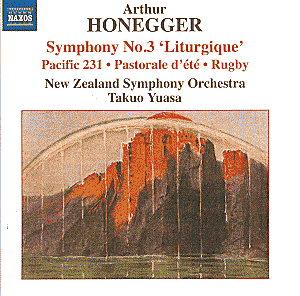
 New Zealand Symphony Orchestra/Takuo Yuasa