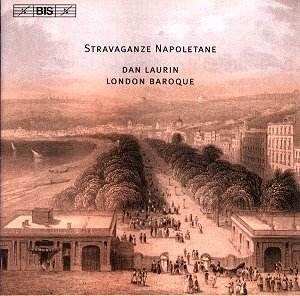
The focus is Naples,
then a Spanish province, and the date
for the most part the first quarter
of the eighteenth century. Four of the
works for recorder and strings derive
from a 1725 manuscript that testifies
to the abundance of talent in the city
– and most of the composers concerned
had strong links to the conservatories
there. Though instrumental music barely
registered in the way that the great
choral works did, increasingly composers
sought greater complexity in their chamber
works. The ones presented here are by
composers who have begun to absorb such
ideas of modernity or who were established
masters of the form – Corelli, Scarlatti
– or who were clearly influenced by
the new Italian school, such as Ravenscroft
who had studied with Corelli in Rome.
Though the form is
(in the main) the established four-movement
sonata there are great differences between
the textual approaches of the composers.
Mancini adopts graceful simplicity in
the opening Largo of his Sonata XIII
in G minor and his Fugue is uncommonly
beautiful – the use of the Fuga is common
to many of these works and establishes
gravitas through the individual use
of counterpoint. Noteworthy as well
are the questing repetitions in the
Largo of his E minor Sonata, adding
an almost conversational depth to the
writing. Corelli’s Fugue is not original
but he expounds on it with exceptional
verve and imagination. Domenico Sarri,
a most underrated composer, shows in
his A minor sonata just how well he
characterised his instrumental music
– this one mines a special interiority
as much as the high spirits of the second
movement Allegro. Inevitably Alesandro
Scarlatti, who arrived in Naples in
1683, impresses with his A minor work,
cast in five very short movements; the
Largo is affecting, the Fuga harmonically
sophisticated. Francesco Barbella is
one of the less well known composers
investigated here but his is a sonata
teeming with vestiges of modernity –
full of a fine sense of tension and
unease. Domenico Gallo’s sonata will
pull you up short – his opening movement
is the music Stravinsky used in Pulcinella,
ascribed to Pergolesi. It seems far
more likely that Gallo wrote it and
it’s a shame that so little is known
of the composer, other than music by
him survives in Naples and Bologna.
London Baroque does him proud with elegance
and lift to their rhythms. Finally there
is Ravenscroft who could spin an elegantly
expressive, tightly structured Grave
with the best of them.
The notes set the scene
with scholarly lightness and the performances
are most sensitive – the hero of the
disc is recorder player Dan Laurin who
employs an alto recorder in various
keys and also plays a voice flute in
D for the second Mancini sonata.
Jonathan Woolf



 Dan
Laurin, recorder
Dan
Laurin, recorder