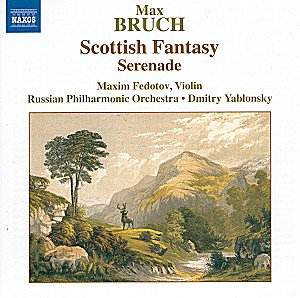
Over twenty years ago
the violinist Salvatore Accardo did
Bruch a great favour by recording all
the composer’s concerted works (nine
of them) for violin and orchestra. These
recordings are still available on the
Philips label. My 1988 biography of
the composer - the first written about
him, even in his native Germany, and
due to for a reprint in paperback in
summer 2005 - has seen a marked increase
in the exploration of the composer’s
one hundred published works. This was
followed by a successful effort to wean
the public off its commonly held belief
that Bruch was a one-work composer,
of the first violin concerto in G minor
Op.26 and little else. For several years
that work topped Classic FM’s Easter
Parade called the Hall of Fame, so much
so that they stopped calling me for
my comments each year. There was, and
remains, little more to say of that
great piece and its miraculous Adagio.
True, Kol Nidrei, a too-short
work for cello and orchestra and thus
tricky to programme, and, back with
to the violin repertory, the Scottish
Fantasy are by no means unknown.
However of the other six works for violin,
we hear relatively little. So it’s a
welcome, if slightly safe-playing approach
for Naxos to couple the Serenade
with the Fantasy.
There are a couple
of misconceptions when it comes to Bruch.
He was neither Jewish (despite Kol
Nidrei and the Three Hebrew Melodies
for a cappella chorus), nor
a traveller who collected folksongs
on which he based his music. Folksong
was very important to him, particularly
those of northern lands such as Scandinavia
and Scotland, but he never visited the
countries in question. Despite living
in Liverpool for three years (1880-1883),
he never travelled to Scotland, though
at one point, during his tenure in Liverpool,
there was serious discussion of him
taking charge of a proposed new Music
Academy in Edinburgh, but the plan fell
through due to lack of funds. Mendelssohn,
greatly admired by Bruch, famously visited
the country and was inspired to write
an overture and symphony, but for his
sources Bruch relied mainly on James
Johnson’s collection of folksongs called
The Scots Musical Museum. Here
four are used, Auld Rob Morris,
The Dusty Miller, I’m doon
for lack of Johnnie and Scots
wha hae. The Fantasy was
written over the winter of 1879-1880
while Bruch was living in Berlin (1878-1880).
Bruch credited Sir Walter Scott with
its inspiration, such as the Introduction
which he said depicted ‘an old bard
who contemplates a ruined castle and
laments the glorious times of old’.
The four-movement Serenade
is virtually a fourth violin concerto.
It is certainly longer than its three
predecessors, and, like all Bruch’s
creations for the solo violin, he was
well advised on string technique by
professional colleagues. From the mid-1860s
until the First World War these had
included Ferdinand David, Otto von Königslow,
Joseph Joachim, Pablo de Sarasate and
Willy Hess. Significantly, Bruch’s music
barely changes in its style over the
same forty-year period; it remains tuneful,
crafted, melodically strong, but harmonically
and structurally unadventurous, and
hardly ever free from the influences
of either Mendelssohn or Schumann. Bruch’s
obsession with folk music continued
(free use of a Nordic melody used in
the first movement and occasionally
reminiscent of Auld Rob Morris in
the last) with the Serenade, written
at a hilltop house in the Rhineland
during August 1899 for Sarasate. Joachim
edited the solo part and gave its first
semi-public performance on 19 December
that year at the Berlin Hochschule.
Its official premiere followed on 15
May 1901 in Paris with the Belgian violinist
Joseph Débroux under Camille
Chevillard conducting the Lamoureux
Orchestra. It had a fair success, including
Boston in 1903 with Marie Nichols as
soloist and Hess vacating his leader’s
chair to conduct.
Fedotov’s playing is
both passionately fiery and sweet in
tone; the Fantasy is hugely demanding
in terms of technical virtuosity. Its
double-stopping has its own notoriety
within the violin fraternity. He plays
it with consummate ease, despite a rather
breathless tempo taken by Yablonsky
for the central Allegro; listen out
for the exquisite duet between flute
and soloist about four minutes into
this third track. Orchestral detail
is rather fogged by too much resonance,
though the horns have a good day, while
the harpist, virtually a second soloist
in the work, should have been given
more of the prominence accorded in the
Finale. Bruch tends to over-orchestrate,
so clarity and transparency of detail
become vital ingredients, and conductors
tend to lose themselves too often in
the intense romanticism of his music.
Fedotov, on the other hand, clearly
enjoys the more ruminative passages
in the Finale. The Serenade gets a convincing
performance, the slightly trivial second-movement
March saved from any banality by energetic
forward drive and wistfully shaped rubato
in its contrasting slightly slower sections.
Although the zenith of his success was
achieved early, way back in 1867 in
the Adagio of his G minor concerto,
Bruch continues to excel at his slow
movements, and the one here is as beautiful
as any. The Finale somewhat overstays
its welcome, questioning the wisdom
of a fourth movement in the first place,
but that is why the work is a Serenade
and not a Concerto. For those wishing
to acquaint themselves with beautiful
music, familiar and unfamiliar, this
disc is more than value for money.
Christopher Fifield



 Maxim Fedotov (violin)