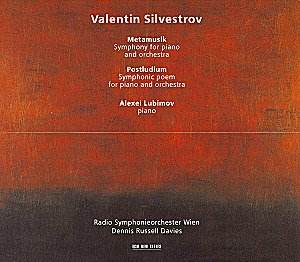
Silvestrov has long
been obsessed by the idea of postlude.
"Everything we wish to say is an
echo, an allusion, a postlude to something
that has already been said at some time".
These words, presumably by the composer,
printed in Tatjana Frumkis’s essay printed
in the accompanying booklet, sum it
all up perfectly well. Indeed, Silvestrov
composed three chamber works sharing
that title, and this set of Postludes
may be performed either as a whole or
separately: Postludium DSCH
for soprano, violin, cello and piano
(1981), Postlude for solo
violin (1981) and Postlude
for cello and piano (1982). Silvestrov
composed a Violin Sonata titled Post
Scriptum in 1990-1991 which
also relates to the same concept.
Postludium
("Symphonic poem for piano and
orchestra") completed in 1984 partakes
of the same idea. Postludium
and the somewhat later Metamusik
share many similarities but the most
striking difference is that Metamusik
is twice as long as Postludium.
Structurally, the two pieces have much
in common: both are for piano and orchestra,
both open with a powerful ‘Big Bang’
and both include slower sections glancing
back at Romantic music, albeit through
allusions rather than mere quotations.
One might even be tempted to consider
Postludium as a try-out
for the later, larger work. The earlier
work, in spite of its relative brevity,
is magnificently accomplished, fully
standing on its own musical merits.
It is a compact, tightly knit and –
on the whole – perfectly balanced piece
of music. As already mentioned, it opens
with an arresting orchestral gesture
and the ensuing music is imbued with
doom-laden urgency. The music is more
overtly dramatic and straight-to-the-point
than in Metamusik which
explores its material on a much longer
time span. The music quietly dissolves
in a tender, dream-like coda. No wonder
that this piece has been recorded on
several occasions. I can think of –
at least – three other recordings of
it : one was – and may still be – available
on a rare Russian disc which I remember
having seen in a record shop in Brussels,
whereas two fairly recent recordings
are still available (on Sony as a ‘fill-up’
to the large-scale Fifth Symphony and
on Megadisc MDC 7837).
Metamusik,
too, opens with a mighty wave of sounds
washing everything aside. This is followed
by a cadenza introducing a more troubled,
menacing section punctuated by massive
chords and angry interjections from
the orchestra. This sombre, ominous
mood is sustained at quite a length
in ebbing waves. The tense mood of the
music then relaxes in a musing episode
in which the piano spins soft, bell-like
figurations and arpeggios. At about
10’20’’ (track 1), the music looks back
in a Rachmaninov-like meditation, which
– curiously enough – superficially recalls
Richard Rodney Bennett’s romantic film
scores. This is followed by a long questing
episode more or less mirroring the opening
bars of the work. At about twenty minutes
in, the Romantic music is resumed with
a deeper sense of loss (or regret?)
signalling the beginning of what is
actually the work’s long-drawn coda
concluding in an ethereal mood. Metamusik
is a major work, although not an easy
one; and certainly one that does not
easily yield all its secrets. Silvestrov’s
music is not difficult to listen to;
the difficulty is rather to see through
or between the notes, as Alexei Lubimov
rightly remarks in his short essay printed
in the booklet.
Silvestrov is an important
composer whose music has been fairly
well served so far, as far as commercial
recordings are concerned, although some
of the symphonies are still unrecorded
at the time of writing. He has also
found a number of wonderful performers
wholly dedicated to his music (Lubimov
also has recorded Silvestrov’s Piano
Sonatas and Cello Sonata – the latter
with Ivan Monighetti – for Erato several
years ago). All concerned here play
with convincing commitment. These superb
performances, recorded under the composer’s
supervision, are self-commending. Another
magnificent release from ECM. I now
wish that ECM could go on recording
more of Silvestrov’s music. A recording
of the Third Symphony Eschatophonie
is now long overdue.
Hubert Culot



 Radio-Symphonieorchester Wien/Dennis Russell Davies