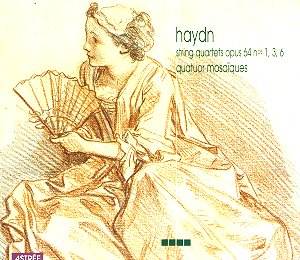
This recording of
the Op.64 Haydn quartets ought to be
dedicated to anyone who has ever doubted
the quality and integrity of period
instruments. Going on the evidence presented
in this delicate Astrée package
there is little wonder that Quatuor
Mosaïques have achieved unanimous
critical acclaim and numerous awards.
And this stands as a compliment of the
highest order from someone who was brought
up on and swears by the Amadeus and
Griller quartet interpretations of the
Classical period repertoire.
Haydn’s mature Op.64 set of six string
quartets was composed in 1790, the same
year that saw the release of the composer
from his Kapellmeister duties when Hungarian
patron Prince Esterházy died.
Dedicated to the violinist and businessman
Johann Tost, three out of the six quartets
(Nos.1, 5 and 6) were premièred
in London at impresario Johann Peter
Salomon’s concert season; but not before
the composer had made a few alterations
to accommodate a more theatrical British
palate! It is this dramatic strain that
proves such a strength in the quartet
No. 6. Here we find bold unison statements,
graceful melodies, violin acrobatics
and cerebral contrapuntal passages.
These are the building blocks of the
expressive opening Allegro. The
range and depth of this music could
not have been better communicated than
by Quatuor Mosaïques who at all
times articulate with clarity and character.
Particularly satisfying passages are
the fugal entries [2:18] and the imitative
dialogue; each in perfect proportion.
The Andante is just as strong
for its impeccable control and sense
of wisdom. With the cello entry, a sobering
resonance meditates through the texture;
the musical warmth and solidarity across
the ensemble is brilliant. Within this
tranquil framework an independently-minded
first violin breaks into song over a
broken chord accompaniment. The shift
of scene is superbly handled by a sensitive
collaboration of musicians.
A stately Menuetto is flamboyantly
contrasted by the microscopically-detailed
Presto finale. However the intricacies
of the latter are handled with the same
decorum that graces the former. This
meticulous attention carves out any
deviations with concrete definition;
notice the pauses [2:38; 3:09; 3:12;
3:17] that stand out with potent feeling
and significance.
Quartet No. 3 adopts an altogether different
tone. Less concentrated than No.6, the
relatively light-hearted opening Adagio
is nevertheless elegantly propositioned.
At one point [3:44] a dark corner of
impetuous scalic imitation threatens
to subvert the tranquillity but loses
out to its calm exterior. The shifting
portraits are handled with impeccable
ease and unrelenting energy so that
the musicians often compel the listener
to buy into an almost visual conception
of the music.
Two minuets stand at the centre of this
courtly quartet. The second, Menuetto
allegretto, leads with a dashing
first violin tune that carries its obedient
colleagues down a path of humorous and
fragmented phrases. The Quator Mosaïques
relish a nicely contrasted middle section
that indulges in smoother lines and
motivating syncopations. With the same
professionalism the ever-punctilious
instrumentalists narrate an exceptionally
well-crafted fast Finale that
is punctuated by pillars of surprising
harmonic manipulations (0:42;1:52; 2:43;
3:47).
The final piece, Quartet No.1, is the
simplest of them all and begins with
a portly, low-pitched Allegro Moderato.
Quator Mosaïques capture the composure
with dignified gestures and faultless
technique. Concluding with the tightly
packed Presto finale – dense
in both sound and texture – consolidates
a sequence of performances that sustain
a remarkable collaboration of musicianship
and technical agility.
The remaining quartets of Op. 64 (Nos.
2, 4 and 5) have been issued separately
on Astrée E8875.
Aline Nassif



 Quatuor Mosaïques: Erich Höbarth
(vn 1); Andrea Bischof (vn 2); Anita Mitterer
(vla); Christophe Coin (cello).
Quatuor Mosaïques: Erich Höbarth
(vn 1); Andrea Bischof (vn 2); Anita Mitterer
(vla); Christophe Coin (cello).