This recording of The
Seven Last Words of the Saviour on the
Cross is contained on the eleventh
and final volume from BIS and Brautigam
in their survey of the complete solo
keyboard works of Haydn.
Haydn was commissioned
by the Canon of Cadiz Cathedral in Spain
to compose instrumental music on The
Seven Last Words of the Saviour on the
Cross. It was intended for the work
to be performed during Lent as an aid
to meditation during Holy Week. The
seven slow movements (Adagios)
are sometimes referred to as ‘sonatas’
or ‘meditations’ and are intended to
reflect the final utterances of Jesus
on Mount Calvary.
The first meditation
commences with the words: "Father,
forgive them, for they know not what
they do", with the final section
ending with the words, "Into my
hands, O Lord, I commend my spirit!"
The complete work is framed by a solemn
introduction and concludes with a fast
movement describing an earthquake. Haydn
found composing the seven Adagios
no easy task and stated: "The task
of writing seven Adagios, one
after the other, each lasting about
ten minutes, without wearying the listeners,
was by no means easy and I soon found
that I could not restrict myself to
the required timing."
Haydn originally composed
The Seven Last Words for full
orchestra in 1786. A year later he scored
an alternative version the for string
quartet, which is said to be the most
popular adaptation and around the same
time a piano reduction of the work came
into existence. In 1795 as Haydn was
travelling through Passau on the Austro-German
border he heard a performance of an
arrangement of the work made by a choirmaster
Joseph Freiberth. He had added choral
parts to Haydn’s original orchestral
score. In response Haydn set about composing
his own choral version using a text
by Baron Gottfried van Sweden. Haydn
set the words for four soloists and
chorus, adapting the original orchestral
score and adding parts for the clarinet,
contrabassoon and trombones. He also
inserted a solemn Introduction for wind
between the fourth and fifth movements.
The keyboard version,
played on this release, was not made
by Haydn but by an unknown arranger
thought to be a music publisher, in
1787. Haydn had an involvement: he edited
the proofs which he praised as being,
"very good and made with remarkable
diligence".
Dutch-born soloist
Ronald Brautigam has been enhancing
his reputation as one of the world’s
leading exponents of the fortepiano.
Brautigam’s chosen instrument is a modern
copy made by Paul McNulty in Amsterdam
in 1992 after Anton Gabriel Walter,
circa 1795. I would never describe the
McNulty fortepiano as being a particularly
colourful instrument however the sound
is warm and strong yet without the fuller
sonority of a concert grand piano.
Brautigam, a period
instrument specialist, clearly has a
real affinity for these Haydn keyboard
works and delivers a direct and appealing
interpretation. He undoubtedly gives
a sensitively expressed account of these
contemplative and reverent sacred works.
With clean articulation and a fine characterisation
his performance is certainly a fine
one without ever quite being distinguished.
The recorded sound is vivid and extremely
lifelike.
Michael Cookson



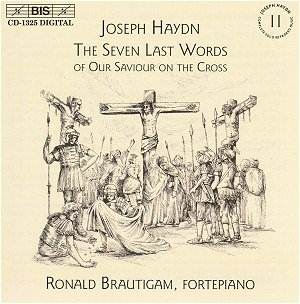
 Ronald Brautigam (fortepiano)