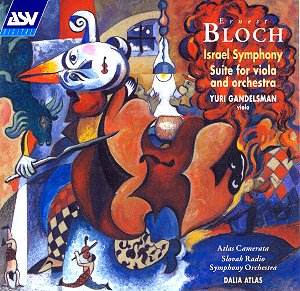
The Israel Symphony
represents the heart of Bloch’s
projected Jewish Cycle, an ambitious
scheme that never quite came to fruition.
The Symphony was to have been cast in
three big parts and was begun in 1912.
But the increasingly depressing news
of the War led to Bloch’s abandoning
the vast edifice and it was recast in
the three surviving movements that we
have here, lasting about half an hour
in total. The short opening movement
(Lent et solennel) is an attempted evocation
of the mobile Temple in the wilderness.
For all the hieratic brass and the stern
nobility there is also a fresh air transparency
that reminds one, however improbably,
of a kind of pre-Copland. And in the
second movement, in which Bloch took
the Day of Atonement, Yom Kippur, as
his theme, we find more evidence of
influence and counter-influence. Though
it opens in media res in turbulence
and tumult it moves glancingly close
to Mahler before moving away. The great
string wash at 7.20 here, elevated and
striving, has an almost cinematic-operatic
sweep to it that reminds one strongly
of, if not Mahler, then at least those
influenced by him – before Bloch reasserts
the striving and the strain of the early
part of this movement. Novel instrumental
colour is used – though Elgar beat Bloch
with the shofar by a long way – and
in the beautiful finale the light and
verdant orchestration is a delight.
The solo singers – there are five –
are directed to stand among the instrumentalists
or at the back of the platform. The
intention clearly was one of integration
and the texts they sing – Bloch’s own,
derived from Psalms 142 and 143 – take
on a personalised expression even though
they are, in a recording, unavoidably
present in a way that concert performances
could soften. This is a real improvement
on the Abravanel/Vanguard disc both
in recording balance and incisiveness
of performance.
Coupled with it is
the Suite for Viola in its incarnation
for Viola and Orchestra. The Suite for
Viola and Piano was first performed
in 1919 by Louis Bailly and Harold Bauer
and the orchestration followed later,
as indeed did a version for Cello and
Piano. There are losses and gains here.
I value the interplay of solo instruments
in the original version, especially
when played by such as Primrose and
Kitzinger or Wallfisch and Wallfisch.
But there is some remarkable orchestral
colour and exotic instrumentation in
this version that is well worth hearing.
The evocative arching support, the suggestive
winds and coiling strings are all pregnant
with meaning both expressed and occluded
and the soloist Yuri Gandelsman proves
a masterful guide. The Atlas Camerata
is especially fine at evoking the acrid
intensity of the slow movement as indeed
it is in the swirling and demanding
Allegro ironico.
Notes are fine and
performances, as indicated, excellent
– I haven’t mentioned by name the Slovak
Radio Orchestra but they are on top
form. Dalia Atlas directs with real
idiomatic command. Maybe the studio
acoustic in the Symphony is a touch
too big, but it does expand well to
contain some of the climaxes. But this
is all strongly and understandingly
done and enthusiastically recommended.
Jonathan Woolf



 Slovak Radio Orchestra/Dalia Atlas