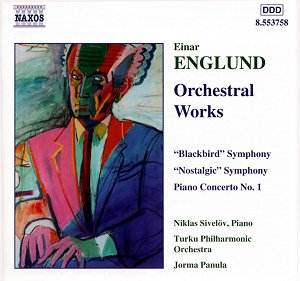
Einar Englund is one
of those post-Sibelian Finnish composers
I find interesting, but not interesting
enough to make me spring for a full-priced
CD. Enter Naxos. The low-budget Naxos
release of Englund's Symphony No. 2,
"Blackbird," paired with the Piano Concerto
No. 1 and the Symphony No. 4, "Nostalgic",
costs less than half what you'd pay
for these works on a full-priced CD.
An added bonus: the
Turku Philharmonic Orchestra is led
by the deft hand of Jorma Panula on
these recordings, who also conducted
the premiere of the No. 4 when it first
appeared in 1976. Presumably this is
music he knows very well.
Symphony No. 2: I first
heard the "Blackbird" Symphony on a
borrowed Ondine recording that at once
captivated me. What is unforgettable
about this music is the questioning
voice of the flute that haunts this
symphony from the beginning of the first
movement, Allegro moderato.
One can't help but
think the blackbird motif has a good
deal to do with the World War II, since
this symphony was written in 1948. Englund's
Symphony No. 1, 'War,' is from the previous
year, but I wonder if the No. 2 is not
simply another way of dealing with war
through the questioning voice of nature.
As the symphony unfolds,
the other wind instruments pick up some
of the burden of the flute and the flute
begins to strut at the edge of our hearing
like a blackbird on a reed, or perhaps
a schoolboy whistling - but a schoolboy
of 1948, who has seen or heard terrible
things.
It's interesting how
Englund manages to weigh down the usually
sprightly voice of the flute with such
a mournful weight of questioning. (I
think of the oboe as more ideally suited
to this sort of quizzical, pondering
work, as in Ralph Vaughan Williams'
wonderful Oboe Concerto.)
The notes by Ralf Hermans
say that music critic Heikki Aaltoila
summed up the "Blackbird" Symphony as
"a sarcastic statement by a rebellious
soul on the brutality of Man and our
distorted civilisation, compared with
the purity of Nature." That seems exactly
right.
Piano Concerto No.
1: The touchstones in hearing Englund's
music, for listeners who haven't heard
it before, are Stravinsky, Shostakovich
and Bartók. The Bartók
influence is strong in this piano concerto,
played here by soloist Niklas Sivelov.
Not only does it have a Bartók
feel to it, it has a nice tip of the
hat to folklore that Bartók would
appreciate: Hermans says its themes
are derived from the "yoik," a vocal
technique of the Sami people of Lapland.
(Englund apparently drew on the same
inspiration in writing the music for
a film called "The White Reindeer.")
Symphony No. 4, "Nostalgic."
This symphony is from 1976, when Englund
was 60 years old. As the name suggests,
it's the work of a composer who is beginning
to wrestle with the ideas of time, memory,
and perhaps mortality. Hermans notes
that Englund was moved to write a symphony
"to the memory of a great composer"
after Stravinsky and Shostakovich died
in the 1970s. This four-movement work
is contains two wonderfully apt center
movements, but I find myself wondering
how well the Prelude and the Epilogue
knit the whole thing together.
For me, it is the two
center movements that make this symphony
well worth the hearing. The second movement
is marked "Tempus fugit," and does indeed
convey - in a hectic 4:34 - the sense
of moments fleeing away, irrevocably.
Englund, a Swedish-speaking Finn, was
apparently remembering childhood days
on the Baltic island of Gotland in passages
of this symphony. Nevertheless, the
geography of this work seems more internal
- it is not about an island in the Baltic
Sea so much as it is about time lost,
and remembering.
The third movement,
"Nostalgia," is where Englund writes
his most heartbreakingly beautiful music
of this work. It contains a reference
to Sibelius' Tapiola. Englund
apparently had met Sibelius and spent
at least a brief time with him at Ainola.
The grim last movement apparently carries
out the composer's intent. Englund wrote
that the music subsides, "with nostalgia
and melancholy, into a silence black
as night."
Nevertheless, there
is lovely music in this symphony worth
the hearing before the dark end.
Lance Nixon



 Niklas Sivelov (piano) (Piano Concerto No.
1)
Niklas Sivelov (piano) (Piano Concerto No.
1)