Comparison recording
John Eliot Gardiner, English Baroque Soloists DG Archive 429 779-2
Being that I am neither a Christian nor a Beethoven
fanatic, this work at the intersection of those two interests
has mostly eluded my attention until now. Whenever I have come
across reference to this work in my reading, it has been made
clear that this is not generally considered to be one of Beethoven’s
insuperable masterpieces; that the work has “problems.”
Beethoven’s personal religious beliefs
are not and were not clearly known, perhaps even by himself. He
is known to have had a then recently translated Egyptian religious
text under the glass on his desk while writing the “Ode
to Joy” movement of the Ninth Symphony. Indeed one of the
criticisms frequently levelled against the Missa Solemnis is that
Beethoven seems to have perceived the drama of the text with little
sense of reverence or familiarity, and written it as a symphony
with voices, although like almost every other European in that
age he must have been baptized a Christian at birth. He dispensed
with the 37 words of the articles in the credo text in 22 bars
at allegro non troppo then wrote a five minute fugue on the “life
of the world to come”. One could assume that Beethoven just
rebelled against whatever there was — religion, politics,
social custom, what-have-you. Like me his religious experience
may have consisted of peak experiences of clear sight which came
unpredictably and inexplicably and were not related to any orthodox
creed or practice.
Although Beethoven did pursue a special study
of Church modes and scales during its composition, there is almost
no trace of Renaissance Gregorian feel to this work. It is operatic
in its aesthetic, and that is not the only similarity between
it and the Verdi Requiem of fifty years later. Liszt and Beethoven
lived at a time when society was held in the firm grip of entrenched
privilege and power, and they heard liberation from this tyranny
in the sound of martial music and battle, the overthrowing of
the ancien régime by force. That may explain why the words
“agnus Dei” are accompanied by an offstage military
band, something which sounds very odd to our modern aesthetic.
Barenboim is one of the finest musicians of this
time, being a first-rate instrumentalist and conductor and an
eloquent spokesman for music. Although hardly limited in any way,
his skill is generally focused on German music and his Beethoven
performances and recordings especially are among the finest there
are. As witness his recent recording of the Choral Fantasia, Barenboim
can make second-rate Beethoven sound as close to first-rate as
humanly possible, so I approached this disk with my skepticism
on my sleeve, expecting to be convinced, perhaps overwhelmed.
Certainly by the time we got to the fugue which concludes the
gloria section, I was enjoying myself greatly.
John Eliot Gardiner, certainly another of the
great conductors of our time, has a particular determination to
produce music with a feeling of enthusiasm and spontaneity. One
has the feeling that after weeks of strenuous rehearsals, he will
announce to the musicians that now it’s time to put the
spontaneity back in. At best this works just great. But at times,
such as in his Christmas Oratorio recording on DG, the result
can be a kind of cloying pertness with everyone trying just a
little too hard to care. In his recording of this Beethoven work,
the result is excellent music-making, and his recording is generally
considered the best version available. Klemperer fans naturally
think his is the best version, but I do not care at all for Klemperer’s
Beethoven; even this recording. His vocalists are more forward.
His overall timing is actually slightly less than Barenboim (the
recording fits on one disk) not so much because Barenboim’s
tempi are slower, but because Barenboim occasionally makes use
of dramatic pauses between phrases where Klemperer just keeps
slooooowly turning the crank. Gardiner comes in nearly fifteen
minutes under Barenboim, with his tempi on all sections running
significantly faster, although when Barenboim and his forces get
going with the wind up, it would seem pretty difficult to go much
faster. But Gardiner’s performers do go faster, and if those
moments of high excitement are what you want, you will prefer
the Gardiner performance. Barenboim never appears dawdling, and
Gardiner never feels rushed. On the other hand, the Barenboim
performance has a slightly more coherent feel, and a slightly
more realistic concert hall perspective, so if these are important
to you, you will prefer the Barenboim. But flipping a coin may
in the end be just as effective.
Paul Shoemaker



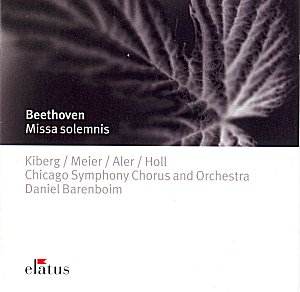
 Tina Kiberg, sop; Waltraud Meier, mezzo; John Aler, ten; Robert Holl, bass.
Chicago Symphony Orchestra and Chorus/Daniel BarenboimRecorded Orchestra
Hall, Chicago, Illinois, USA, May 1993 Notes in English, Français,
Deutsch. Latin text, no translations. [No SPARS code, but presumed DDD]
Previously released on Erato 4509 91731
Tina Kiberg, sop; Waltraud Meier, mezzo; John Aler, ten; Robert Holl, bass.
Chicago Symphony Orchestra and Chorus/Daniel BarenboimRecorded Orchestra
Hall, Chicago, Illinois, USA, May 1993 Notes in English, Français,
Deutsch. Latin text, no translations. [No SPARS code, but presumed DDD]
Previously released on Erato 4509 91731