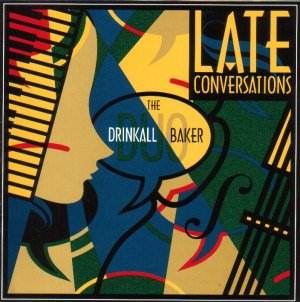
Why these ‘conversations’, between
cello and piano, should be ‘late’ I’m not sure,
but the disc is definitely worth listening to as it has much to
say. All the artists, composers and performers are associated
with Brigham Young University, Idaho. According to its website,
the university’s honor code: ‘emphasizes being honest,
living a chaste and virtuous life, abstaining from alcohol and
tobacco, using clean language and following other values encompassed
in the doctrines of the Church.’ (http://home.byu.edu/webapp/home/index,
accessed May 2004)
Of course it’s personal taste but that’s
not my sort of code. If its professor of cello (Drinkall) and
its ‘head of the accompanying area’ (Baker) were obliged
to play music that fulfils the code then I suspect this may have
been a dull disc. As it is, only the opening work disappoints.
The conservatism inherent in the code is evident
in Cundick’s sonata that could have been written a hundred
years ago. There are echoes of French Impressionism, particularly
in the Arabian sounding theme that starts the piece. It sounds
good and that should be sufficient excuse for its existence. However,
I can’t rid myself of the thought that composing in earlier
idioms is worthless unless they are revisited with a modern eye;
such as Stravinsky’s neo-classicism.
It could be age. As I grapple with the fact that
I must now be middle-aged, I find myself concerned that my time’s
running out despite the fact that there’s so much music,
and so many performances, that I want to listen to. In my more
neurotic moments I’ve considered playing two pieces simultaneously
to pack in as much as possible (I shall seek treatment). However,
as we are blessed with having more music at our personal disposal
than ever before, we should choose our listening carefully. There’s
too much good stuff to hear without wasting time. Hence, if I
wish to hear early 20th century cello-piano music in the European
tradition then I’ll be reaching for favoured and new performances
of Debussy, Ravel and others. I shan’t be reaching for Cundick
because he’s not as good as they and that’s not a
criticism. If there is a limited repertory for instruments then
that in itself is justification for writing music in ‘old’
idioms but that’s not the case for this combination.
Happily, the other three composers are aware
of what happened after World War I and their music is much more
invigorating. Sargent’s music could be a score for an avant-garde
animation, such as Viking Eggeling’s Diagonal Symphony.
Each movement is a different type of conversation; the lively
ones are too abrasive to be the stuff of ‘late conversations’,
particularly those I suspect that are supposed to take place at
Brigham Young.
Hicks’ Induction Coil offers a great variety
of sound, stretching both instruments to their limits. I particularly
liked the moment when both cellist and pianist are directed to
strum. Steven Johnson’s notes are excellent and he quotes
the composer: [Hicks] title, then, “connotes (a) a coiled
coupling of two circuits in which interruptions in the direct
current of one circuit produce a high-potential alternating current
in the other and (b) a kind of hypnotic induction carried out
on a cobra.”
Well, if it is possible to compose the above
then Hicks has done it.
Nibley claims his sonata is designed for easy
listening in a ‘modern-romantic, eclectic, tonal and mildly
dissonant’ style. Whilst it’s certainly approachable,
the ‘easy’ tag is slightly misleading particularly
if you’re listening to it late at night. The last movement
is especially good and shows off the marvellous virtuoso playing
of both Drinkall and Baker; the recording’s good too.
Of course it could be that all these composers
are writing music in the light of the ‘honor code’
and to be abstemious might be far more interesting than it seems
to me.
Nick Lacey
.



 Drinkall Baker Duo ((Roger
Drinkall, cello; Dian Baker, cello) No details of recording dates or venues
1996
Drinkall Baker Duo ((Roger
Drinkall, cello; Dian Baker, cello) No details of recording dates or venues
1996