I have to admit to
a certain fondness for a pianophile
website run by a man whose opinions
are as trenchant as his prose is brusque.
He combines the assiduous triviality
of Mr Pooter with the historical sweep
of 1066 And All That. My two
favourite entries are Spartan indeed;
Solomon is usually boring – except
his Tchaikovsky, which isn’t and
his Yves Nat entry, which asks plaintively
Yves Nat - why do some people like
his Schumann?
I wouldn’t presume
to answer that question with any Olympian
authority but at least the current discography
gives us the opportunity to get acquainted
with Nat pre and post War because, as
with his compatriot Cortot, he re-recorded
his repertoire under more favourable
conditions. Thus Andante have included
his earlier Kinderszenen in their Schumann
box, along with the Fantasiestücke,
and Dante (no longer in print) issued
an all Schumann 1930s disc about a decade
ago. EMI has issued a 4 CD set devoted
to him. Archipel splits the difference;
we have the boxy 1933 Concerto recording
and the post-War quartet of works that
make up the remainder of the programme.
Let’s rephrase the question; what do
I like about Nat’s Schumann.
First, the Concerto. It’s not a favourite
recording of mine. The recording, as
I suggested, is cramped and even for
1933 dimly recorded. French recording
studios at the time had a tendency to
be somewhat unresonant but even so the
performance strikes me as somewhat brash.
It’s always a point of considerable
importance to hear French wind and reed
playing of this period – and that’s
no less the case here – but Nat rather
tosses off passagework and values the
virtuoso above the poetic, and it’s
no surprise that the 1937 Myra Hess
recording rather eclipsed this one in
esteem.
The smaller pieces
strike a consistently finer note. The
Toccata is especially rewarding.
He’s not flattered by the 1954 recording
which is curiously flat and I’m sure
doesn’t fully reflect his range of dynamics
but Nat’s musicianship emerges unscathed.
This is not Schumann playing in the
Horowitz or Arrau mould. There’s nothing
brazen or hyper-virtuosic about the
performance, and so for example there
are none of the former’s vertiginous
bass relief etchings (nor, to be scrupulous,
does Nat explore the inner voicings
as Horowitz did – either in 1934 or
1962). Nat’s tempo is relatively slow
but the musical control of architecture
is strong, the line very well sustained.
His Papillions is highly poetic
– vibrant and rhythmically acute and
the Arabesque makes another point of
comparison with highly personalised
Schumann playing. Horowitz (1962) is
saturated in daring intimacies and metric
displacement, stretching the narrative
line to breaking point (and for the
ascetic minded, beyond) whereas Nat
is fluent, clear eyed, exploring those
moments of emotive reprieve with sagacious
control.
His Kinderszenen didn’t
change greatly over the years from the
recorded evidence. His 1954 recording
makes an intriguing comparison with
Cortot’s 1947 traversal. Nat is a great
deal smoother and more obviously romanticised,
gentler, taking the child’s view of
childhood, or, rather, an adult’s idealised
view of childhood; Cortot recollects
seemingly through tougher adult experience.
It’s noticeable that Nat is consistently
faster except for those scenes that,
like Träumerei, call for
gentle reflection. Nat’s touch is delicate
and elfin, he lacks Cortot’s disruptive
bass accents and colouristic intensity,
the interplay of the hands (Von fremden
Ländern und Menschen), the
capricious rubati and voicings (Kuriose
Geschichte). Emotively Cortot pleads
more in Bittendes Kind whereas
Nat is rather better behaved. Neither
man was known for avoiding technical
pileups, especially in the 1940s and
50s when they were beset with physical
problems (Nat in fact died in 1956;
he was born in 1890). There’s some evidence
of this in Wichtige Begebenheit
where he splashes about for a bar or
so but throughout his supple playing
and simplicity of utterance bring rewards,
even if he is not as revelatory as Cortot
who is positively proto-Brahmsian in
Fast zu Ernst. Throughout Nat
is more even, more obviously romantic,
maybe more whimsical (judged against
Cortot’s dramatic incision). Listened
to independently of Cortot Nat’s is
a pliant, fluent and warmly sympathetic
reading, though I must say that Cortot
galvanizes me more.
The original 1954 discs
weren’t brilliantly engineered, lacking
definition and dynamic breadth; Archipel
seem to have subjected them to noise
reduction, which has had a neutral impact
at best. Why do some people like Yves
Nat’s Schumann? Some of the answers
are here, if you choose to seek them
out.
Jonathan Woolf



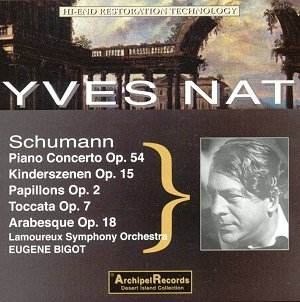
 Yves Nat (piano)