Todd Goodman was born
in Pennsylvania in 1977, received his
Bachelor of Music degree in composition
at the University of Colorado at Boulder,
and has studied at Duquesne University
in Pittsburgh, and the Aspen Music Festival
in Aspen, Colorado. He has received
commissions from a wide variety of players
and ensembles across the United States,
and performances in Canada, Mexico,
Europe and Asia as well as the USA.
Mr Goodman received the Gold Farbe award
from the University of Colorado film
department for his scores to two short
films Hypnotic Reverie and Light
Autumn, the Anderson Award for composition,
and the Milan Desi Derri prize for his
Concerto for Alto Saxophone and Winds.
As the Altoona Symphony Orchestra’s
composer-in-residence since 2002, seven
works have been commissioned from him
during his three season tenure - including
this, his Symphony No 1, Fields of
Crimson.
Just how effective
any piece of music is depends very largely
on your expectations: and how ‘good’
it is is determined by (as they say)
‘where you’re coming from’. I have a
friend who regards himself as a discerning
collector, but rubbishes Beethoven,
and yet thinks Dolly Parton’s wonderful!
So where to start with Fields of
Crimson?
This music is best
regarded as a documentary in sound,
rather than as a symphony - not even
as a symphony in the American tradition.
The composer’s theme is the American
Civil War, specifically the "battle
of Gettysburg, and the anxiousness and
anguish of one family". Although
it last less than half an hour, it covers
a great deal of ground: the introductory
movement is a quiet depiction of dawn,
the noisy sounds of battle are recreated,
there are bugle calls and marches galore,
while reflective meditations (with a
spoken narrative, written by Justin
Cober - either involving or intrusive,
depending on your ‘starting point’)
link the three central movements.
Extracts from reviews
(in the main not authored by
musicians?) posted on Mr Goodman’s website
confirm my feeling that Fields of
Crimson is likely to mean most to
students of (or anyone fascinated by)
the Civil War or American history and
heritage; to pacifists; or people who
need an evocative programme in order
to facilitate or maximise their listening
experience; and those who tend to enjoy
music most when (as with film, for example)
it’s part of a wider artistic concept.
For such listeners, this music may indeed
mean much. On the other hand, musicians
and CD collectors who expect to be challenged
or stimulated by new music (by its individuality,
or its language, structure and ideas)
are likely to be disappointed if not
- to be honest - profoundly irritated.
I’m afraid I found
in this music very little which wasn’t
commonplace, homespun and everyday.
I wonder if Mr Goodman, in talking of
the need for "audience connection",
conceived this piece as a kind of musical
annotation of a particularly significant
chapter in American history - an audio
aid, as it were; a musical means to
an extra-musical end, rather than as
music per se - or was he unwittingly
offering an excuse (as others have done
before him) for writing simple tonal
music? The music is littered with rhythmic
and harmonic clichés and off-the-shelf
orchestration, springs very few surprises
and - for the most part - avoids any
kind of counterpoint or complexity.
Now I accept that the
term ‘symphony’ (since as long ago as
Stravinsky, Webern and Hindemith, in
fact!) no longer promises organic growth,
nor even a taut structure: but the development
(such as it is) and sequence of musical
material in Fields of Crimson
is determined entirely by historical
events, and the narrative. Mr Goodman
(quite rightly, perhaps) would doubtless
insist this was his intention, suggesting
further that this is a kind of
‘history in sound’ - uniquely, you might
argue - rather than truly symphonic
music. But, given the lightweight nature
of the musical material, I cannot help
feeling deceived by the (pretentious?)
use of the word ‘symphony’ - even more
than its subtitle Fields of Crimson,
which does at least point honestly to
the heavyweight nature of its subject
matter.
Students of contemporary
American music should be warned: this
is no competitor or sequel to Adams
or Corigliano, let alone Carter! Copland
keeps coming to mind. And, in those
moments where the music rises above
the mundane, it sometimes recalls the
Ives of 100 years ago - (in particular
its synthesis of different musical stereotypes,
and its interminable military overtones)
and that’s about as ‘modern’ and as
thought-provoking as the music (in the
sense of art-music) gets!
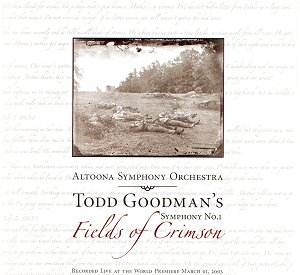
The CD is beautifully
produced, with very appropriate and
imaginative artwork. But the recording
is live (the work's first performance,
in fact, on 1st March 2003) and betrays
that fact with much audience noise,
quite a lot of ragged ensemble, and
distracting unsubtleties in individual
playing.
If the subject matter
interests you, this is worth investigating.
If you’re a sophisticated and demanding
listener, and a keen observer of the
leading edge of contemporary American
music, this is well worth avoiding.
Like I say, it really does depend -
literally - on your ‘point of view’.
Peter Lawson



 Carolyn Donaldson (narrator)