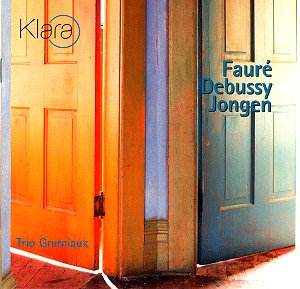
This is stunningly
beautiful playing. The members of Trio
Grumiaux serve up tonal breadth, fullness,
and ardour, all tempered by a cultivated
elegance harking back to their eponymous
model. Luc Dewez bathes the numerous
’cello melodies in rich, dusky tone.
Violinist Philippe Koch matches him
in feeling and technique, his tone perhaps
lacking a touch of silver: at [4:38]
in the first of the Jongen pieces, the
sustained high violin note is vibrant
and accurately tuned, but doesn't quite
soar. At the Bösendorfer piano,
Luc Devos is adept at the sort of fluid
arpeggiation abundant in these scores,
sounding particularly liquid in the
Debussy.
Veteran collectors
will know the Belgian composer Joseph
Jongen primarily for his organ works
- his Symphonie concertante was
a Virgil Fox showpiece early in the
LP era - so his Two Pieces will
be a novelty. After a mysterious introduction,
with the piano marking a single pentatonic
line over string harmonics, the opening
Élégie nocturnale
moves into a more conventional, questing
lyricism over intensely chromatic harmonies.
In a nice episode towards the close,
the piano voices a sequence of unstable
chords over pizzicatos from the string
instruments in alternation. The strings
launch the ensuing Allegro appassionato
with buzzy double-stopped chords in
an intense, tautly driving rhythm, before
breaking into flowing, contrapuntally
arranged cantabiles over piano
arpeggios. Koch turns his tonal reticence
to advantage at [1:32], where the violin
sings with touching restraint.
Fauré's Trio,
written when the composer was seventy-six,
is, of course, a mature masterpiece.
At the start, and occasionally later
on, pianist Devos turns oddly stolid,
leaving us overly conscious of the individual
chords rather than the rippling effect.
Otherwise, nothing but praise: the players
build each of the three songful movements
in a single, inexorable arc, maintaining
harmonic tension and an undulating line
through the successions of modulations.
Interestingly, in the unusual violin-and-’cello
unison lines, Koch and Dewez keep their
vibratos active. This tends to call
attention to the inevitable pitch discrepancies,
but still strikes me as preferable to
the denatured sound which is the usual
alternative.
Debussy's early four-movement
Trio, once believed lost, was rediscovered
in the early 1980s. Cast in straightforward
harmonies similar to those in the composer's
early piano works, not only is it clearly
the work of a young composer, but, after
the Fauré, it sounds like that
of a chronologically earlier one as
well! Guido Defever's booklet note cites
Franck as a stylistic model, but the
music's sunny temperament and disarming
simplicity more readily suggest Schumann,
whom Defever also mentions. In the first
movement, the second subject's yearning
aspirations even provide a hint of Tchaikovsky
- is it a coincidence that in the summer
of 1880, Debussy travelled in Western
Europe with Madame von Meck, Tchaikovsky's
patroness? The Finale offers
a nice touch: the music simmers down
to an apparent quiet ending, at which
point buoyant, scurrying activity suddenly
carries the music to a more unequivocally
affirmative conclusion. The players,
once again, build and relax naturally
through the phrases, without overdoing
the Romantic passion.
Vivid, immediate sonics
enhance these marvellous performances:
a slight volume cut will mitigate the
close perspectives, along with a touch
of plumminess in the piano reproduction.
Stephen Francis
Vasta



 Trio Grumiaux