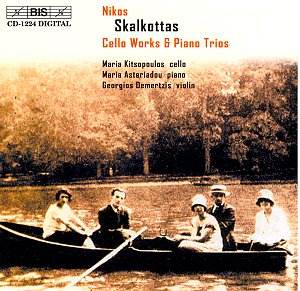
This is the tenth Skalkottas
CD produced by Bis since 1997. Very
often these have been performed by Greek
musicians and recorded by Greek production
teams. Half of these discs have been
of his chamber music. Each has been
recorded and performed to the highest
possible standards. The music is incredibly
clever, complex, life-enhancing, joyous,
shocking and tough by turns.
I remember being in
Greece twenty years ago and finding
no LPs of Skalkottas’s music and hardly
anyone who had heard of him. Then in
the late 1980s the BBC broadcast a series
of programmes offering a selection of
his orchestral and chamber works. It
is from that season that Bis gained
the initiative for this continued series.
I do urge all collectors and listeners
to get hold of at least one of these
Skalkottas discs and this is as good
a place as any to start. These recordings
are particularly well timed as later
this year (2004) the centenary of Skalkottas’s
birth will be marked. Who knows, in
the U.K., we may even have some Skalkottas
at the Proms.
Each CD has been marked
by some of the most copiously annotated
booklets in my entire collection. Now
I don’t mind, but these can sometimes
be rather technical. Although this one,
by Kostis Demertzis, is one of the more
friendly examples, the small font and
detailed analysis might prove a little
daunting for some. However the writers
are ultimately trying to be helpful.
It’s worth spending some time reading
what Mr Demertzis has to say before
hearing anything. The music will (I
believe) tackle and hold your attention.
What is it about this
composer which is so fascinating? For
me the uniqueness of the music is to
be found in Skalkottas’s marrying of
Greek rhythms and serial technique;
elements that often prove unusually
complementary. No matter what technique
he is using his voice is so personal
that you need only a few bars to recognize
him.
If you just want only
the Greek inspired ‘ethnic’ music then
you would be better going for the more
diatonic sets of ‘Greek Dances’ (on
Bis CD
1333/4) or the beautiful ‘Maiden
and Death’ Ballet suite (Bis CD1014).
If you hanker for something more adventurous,
the serious dodecaphonic works on this
disc might well suffice. I say serious
but these are, at the same time, brilliantly
crafted, original and highly concentrated
compositions. They also display great
rhythmic energy and excitement and quite
often fun (as in the ‘Eight Variations’).
Longing is also within Skalkottas’s
vocabulary. Listen, for example, to
the long, lyrical melody in the ‘Largo’
for cello and piano. What is so interesting
also is that Skalkottas was capable
of working at two contrasting works
at the same time: say a ‘Greek Dance’
and a twelve-tone ‘Piano Trio’. You
could argue that what he was trying
to do was to make Schoenberg’s theory,
listener-friendly. One speculates, sadly,
what might he have achieved had he have
lived a more normal life-span rather
than only the tragic forty-five allotted
to him.
Let’s just take two
of these works as exemplars; first the
‘Tender Melody’. The title and the length,
at two and a half minutes, would indicate
a piece of quick composition and suggest
ease of listening. However Skalkottas
uses a compositional game which you
might well not notice. As Alban Berg
said, the technique is the composer’s
business however, for listeners who
are interested, the extensive notes
go into some detail. You may well not
realise, aurally, that this very beautiful
piece uses a highly sophisticated form
of serial technique. The cello part
consists "of the constant repetition
of the row". The succeeding phrases
"begin on a different note of the
row, the first on the first note F#,
the second on the second note E, the
third on the third note D" etc.
Eventually the full row is heard again
at the end, so that "the tender
melody consists of twelve sections"
… and to add to its interest. "the
piano chords form various rows without
any obvious connection to the cello’s
row".
I recall, in the late
1960s, an LP of Skalkottas’s chamber
works, which I borrowed from the library
and recorded from it the astonishing
‘Eight Variations’. Does it use a real
Greek folk tune? During its thirteen
minutes and amid its chromatic wanderings
and diatonic melody the Variations track
through lyricism,(var.3), march-like
spasms (var.2), scherzandi (var.4),
dances, (var.7), impetuosity (var 8),
crying and desperation (var 5). These
are sometimes for piano alone, sometimes
for violin and cello and then, for emphasis,
all three. All of life seems encapsulated
in this music.
The recording is clear,
immediate and close but (and I especially
like this) the performers’ breathing
is not audible! The performances are
magnificent, bringing out all aspects
of this emotionally complex music to
its fullest extent. Highly recommended
Gary Higginson



 Maria Kitsopoulos, cello; Maria Asteiadou, piano;
Georgios Demertzis, violin
Maria Kitsopoulos, cello; Maria Asteiadou, piano;
Georgios Demertzis, violin