Comparisons:
Papillons/Arabeske – Freire/Decca
Davidsbündlertänze – Backhaus/Enterprise,
Schein/Ivory Classics
Fantasiestücke – Rubinstein ‘1949’/RCA,
Argerich/EMI
Waldszenen – Arrau/Philips, Richter/DG
Kreisleriana – Gieseking/Classica D’Oro,
Schliessmann/Bayer
Contrast has been a
cornerstone of music for centuries and
likely reached its apex during the 19th
century romantic era. Robert Schumann
even created two opposite alter-egos
to use as the foundation for his contrasting
themes in many of the works he composed
in the 1830s. At one extreme is the
dreamer Eusebius who constantly ponders
the meaning of life. At the other end
is the man of action Florestan.
Schumann’s creation
of these two figures reflects the behaviors
that he was not able to exhibit himself.
Yet, each figure is a fractured personality.
Eusebius has no ability to take action,
and Florestan never considers anything
but the immediate mission at hand. Naturally,
if the two figures merged, we would
have a complete person capable of functioning
in the world. However, Schumann rarely
has them merging, preferring that their
interactions create conflict and tension.
When looking at the piano music Schumann
wrote in the 1830s, the Florestan/Eusebius
themes usually take center stage except
in works such as Kinderszenen where
the contrast is between child and adult.
The majority of the
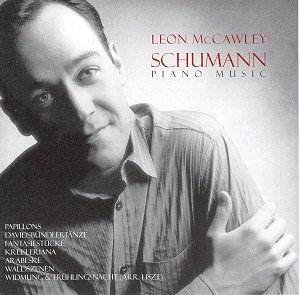
music on the new Avie 2-cd set of Schumann’s
solo piano music comes from the late
1830’s when Schumann was in mental anguish
at not being able to spend time with
his beloved Clara Wieck due to her father’s
protective stand and dislike of Schumann.
This anguish and the Florestan-Eusebius
contrasts led to Schumann’s most inspired
and compelling musical thoughts.
When listening to versions
of works such as the Davidsbündlertänze,
Kreisleriana, Fantasiestücke and
Papillons, pianists are judged on how
well they convey Florestan and Eusebius.
Also very important, is conveying the
mix of the two figures that often jointly
occupy the same movement of a work and
even the same section/theme.
Looking at the young
and savvy Leon McCawley’s performances
in the above light generally yields
advantageous results. McCawley is most
effective in the Florestan music; he
gives the warrior a strong and fierce
presence with plenty of excitement thrown
in. McCawley isn’t quite in Walter Giesking’s
league in giving us a fierce and wildly
intense Florestan, but he beats out
most of the competition.
McCawley is also idiomatic
in the Eusebius music, although I do
have a few reservations. He tends to
use quick tempos that sometimes have
the effect of reducing the poignancy
of Schumann’s refrains. Also, underinflection
and short note values tend to exacerbate
the reduced emotional depth. The playing
is still gorgeous, but other pianists
including Ann Schein and Arthur Rubinstein
clearly dig deeper into the nostalgic
and cerebral elements of the Eusebius
personality.
The interaction of
Florestan and Eusebius is McCawley’s
weakest area. The contrasts Schumann
creates between the two figures are
often displayed through Eusebius taking
the upper voices and Florestan the lower
and middle ones. Unfortunately, McCawley
tends to carry a rather lame bass line
with little growl or churning. A perfect
example is the last movement of Davidsbundlertanze
where the primary theme offers wonderful
opportunity for the bass strokes to
have a hammer-like effect that McCawley
entirely avoids.
There is an aspect
of McCawley’s performances that lifts
them above the average. I don’t recall
other versions of these works that provide
such clean lines and textures. In this
regard, McCawley reminds me of the noted
pianist/conductor Olli Mustonen except
that Mustonen is much sharper and unique;
McCawley is firmly planted in the mainstream
of interpretation.
The recorded sound
is fine although there is a little too
much air and high notes can sound glassy.
The main consideration is that the sound
characteristics do not interfere with
McCawley’s immaculate lines.
In conclusion, the
new Leon McCawley set of Schumann piano
works has much to offer. The performances
bespeak an insightful awareness of Schumann’s
alter-egos, and I feel that most listeners
would be very pleased with the set.
However, we already have a wealth of
transcendent performances on record,
and McCawley never reaches this hallowed
position. I give the Avie set a mild
recommendation except for those who
want their Schumann textures ‘clean
as a whistle’. Also, those who are smitten
with Olli Mustonen might well find McCawley
an attractive partner.
Don Satz



 Leon McCawley, piano