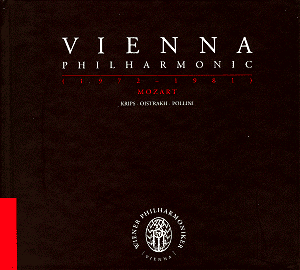
Joys aplenty with this
magnificent VPO Mozart set from Andante.
The sheer rarity value of Maurizio Pollini
caught live directing the Vienna Philharmonic
might indeed be worth the full price
of the set, especially when this is
Pollini at his sovereign best; but these
are by no means the only musical riches
here.
Before further ado
I should admit, perhaps, the reasons
for my excitement regarding the piano
concertos. The first time I heard Pollini
was in Manchester’s Free Trade Hall,
where he directed a touring English
Chamber Orchestra in performances of
Mozart’s Piano Concertos Nos. 14 and
17 (and conducting the 34th
Symphony). It was a defining moment
in my musical life – to hear these performances
from the same period, the early eighties,
was to merely confirm my memories.
There is not a hint
of Pollini the literal interpreter here.
Instead he goes straight to the heart
of this magnificent music. He refuses
to treat the twelfth concerto as ‘minor
Mozart’ – there is no trace of the ‘less-than’
here. The playing of the VPO is stylish
and delicate, caught beautifully by
the Austrian Radio recording (which
also preserves Pollini’s crystalline
sound perfectly). Pollini’s technique
is exemplary. His staccati are
never pecked at; the cadenza is an example
of supreme pianism. The Pollini/VPO
combination manages to achieve true
intimacy in the Andante, contrasting
with the fresh and multi-faceted finale.
The Concerto No. 14
in E flat receives similar advocacy.
Here the piano’s entrance is thrown
into bold relief by an eminently well-mannered
orchestral exposition. By bringing out
the drama more than is usually heard,
the resultant energy level rises. The
contrastive concentration in the second
movement is almost palpable. The tempo
is slow (hardly the Andantino asked
for) yet this is an utterly elegant
statement. The D minor Concerto enters
new emotional worlds, and Pollini is
fully alive to the music’s dark undercurrents.
(The microphones, by the way, pick up
an authentic Pollini grunt at 7’36,
if you listen carefully.) The tenderness
of the slow movement is highlighted
by the VPO’s playing, but it is in the
finale that everything gels. Pollini’s
voicing verges on the genius, and the
whole is reminiscent of early Barenboim
with the ECO (on EMI) in its grim determination,
despite their differences as pianists.
David Oistrakh died
in October 1974, not too long after
this recording of the Sinfonia concertante
for violin and viola was made and so
this remains the Oistrakhs’ last account
of it together. The interplay between
the soloists is remarkable, David’s
nimble viola being something of a miracle
(has the cadenza ever been better caught?).
The slow movement is a confident, relaxed
outpouring; the finale unhurried and
yet, despite this seeming contravention
of the ‘Presto’ command, it seems exactly
at the right tempo.
It is David Oistrakh
who conducts the ‘Jupiter’ symphony,
from the same source. Andante’s essay
seems to omit reference to this, yet
the performance has much to commend
it (despite a slightly workaday impression
of some of the first movement). In particular
the rapt slow movement and the exultant,
festive finale stand out.
The performance of
the Requiem is notable for preserving
Josef Krips’ last public appearance
before his retirement. There is a backbone
of granitic strength that runs through
this Requiem, which breathes
what we might today call ‘old-style’
Mozart (in addition, Krips used modern
clarinets rather than more mysterious,
veiled-of-tone bassett horns). Some
movements may seem decidedly under-tempo
(‘Quam olim Abrahae’, CD3 track 10,
3’25, decidedly drags its feet, for
example, plodding away to no great effect,
and the ‘Agnus Dei’ seems to run out
of steam) yet there remains much that
is moving.
It is interesting how
there are pluses and minuses here –
how the ‘Sanctus’ emerges like a blaze
of bright light after the turgidity
of ‘Quam olim Abrahae’, and how against
a very uncontrolled, unsteady solo trombone
in the ‘Tuba mirum’, Walter Berry’s
imposing bass emerges. Dermota’s entrance
appears somewhat under-powered, though.
Soloists can effectively
be split into two, the new generation
ladies against the older gentlemen (Dermota
was 63 at the time). Popp is on the
tremulous side at first, yet she is
resplendent later (2’14 and onwards,
track 4).
The sound can congest,
a definite down point in a work such
as this. But overall there is much to
move the senses here (try the ‘Lachrymosa’).
It is difficult to imagine anyone laying
out the cash for this set purely for
the Requiem, but it nevertheless
remains a valuable historic document
and worthy of inclusion.
Anyway, there is no
doubt whatsoever that the first two
discs contain treasures to return to
regularly.
Colin Clarke



 bIgor
Oistrakh (violin); dLucia Popp (soprano);
dMargarita Lilowa (mezzo); dAnton
Dermota (tenor); dWalter Berry (bass);
dSingverein der Gesellschaft der Musikfreunde
in Wien; Vienna Philharmonic Orchestra/ aMaurizio
Pollini (piano/director), David Oistrakh (bviola/director;
cconductor), dJosef Krips.
bIgor
Oistrakh (violin); dLucia Popp (soprano);
dMargarita Lilowa (mezzo); dAnton
Dermota (tenor); dWalter Berry (bass);
dSingverein der Gesellschaft der Musikfreunde
in Wien; Vienna Philharmonic Orchestra/ aMaurizio
Pollini (piano/director), David Oistrakh (bviola/director;
cconductor), dJosef Krips.