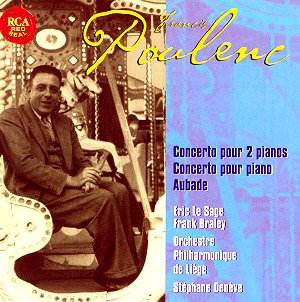
If you think of Poulenc
principally as a purveyor of sophistication
and boulevardier wit, the violent
opening of the Concerto for Two Pianos
- crackling chords ushering in a demonic
moto perpetuo - will come as
a shock. In the quieter second subject,
the rich chords which in other Poulenc
scores create a jazz flavor here produce
an anxious undercurrent, which paradoxically
intensifies as the music gets softer.
The final, bounding section of the movement
recalls Shostakovich, with elegance
tempering the spikiness. The central
Larghetto movement begins with
an almost childlike simplicity - Jean-Jacques
Velly, in the booklet, suggests a homage
to Poulenc's favorite composer, Mozart
- but, before two minutes have passed,
shifting harmonies once again evoke
a troubled air. Only the Finale
- once past its ominous beginning -
offers the composer's familiar bubbly
good humor.
The lush, softer-edged
sounds introducing the (one-)Piano
Concerto are more typical of the
composer. After presenting a bright,
chipper interlude at 2:13 for contrast,
Poulenc melts it into and out of the
softer sonorities which began the movement
- a nice display of compositional prestidigitation.
A broad horn call at 3:10 injects a
Straussian note into the agitated development
of the initially tranquil Andante
con moto, while the final Rondeau,
with its quotes of "Swanee River" (which
apparently disturbed some in the premiere
audience), skitters about entertainingly.
The Aubade is
less a virtuoso concerto than a concertante
chamber work, simultaneously conceived
as a ballet. As befits Poulenc's original
classical scenario, centering on the
chastity of Diana, the moon goddess
- the composer disowned the expanded
plot concocted by George Balanchine
for the 1930 premiere - the music frequently
sings with a correspondingly chaste
line, occasionally, as in La toilette
de Diane, breaking into a sprightly,
frolicsome mood.
Eric Le Sage performs
creditably and deftly in Aubade
and the solo concerto; his tone quality
is decently weighted, not flinty, though
I would have liked a wider variety of
layered colors. Frank Braley joins him
for the duo concerto, which they bring
off with stunning unanimity. (The purpose
of the writing is not, of course, merely
to amplify the already formidable volume
of a single concert grand, but to expand
its possibilities for rapid passagework
and leaping figurations, all of which
makes rather frightening demands on
the players' coordination.)
The Liège Philharmonic
winds are excellent - I particularly
enjoyed the plangent clarinet, cool,
clear flute, and gleaming oboe in Aubade
- but the strings are mushy and soft-centered,
whether playing as soloists (the uncertainly
tuned duetting cellos of the Récitatif
in Aubade, track 13) or sectionally
(the tentative muted chorale in the
piano concerto, track 4, 6:59). RCA,
typically, favors a bright sonic image
which, unfortunately, turns harsh and
edgy in the Piano Concerto (presumably
each work required a different mike
setup). But even there, as the brass
chorale at 6:06 illustrates, the winds
emerge with a nice sense of depth.
Despite the orchestral
and sonic flaws, as a convenient package
of Poulenc's concertante piano
works, this disc is recommendable.
Stephen Francis
Vasta



 Frank Braley*, Eric Le Sage (pianos)