Caldara’s sacred vocal
works are the ones by which we know
him best – the Missa Dolorosa, the Stabat
Mater, La Passione and the Magnificat
are some that have received fine recordings
recently – but this disc shows us another
side to him. Caldara was certainly not
the first and assuredly not the last
to be influenced by Corelli’s Sonatas
and in his Op.2 the influence is palpable
though never enough quite to submerge
Caldara’s own highly individual compositional
personality. As with his model’s works,
which were published in 1685 when Caldara
was about fifteen, he ends the set with
a single movement Chaconne and throughout
the set, of which we have Nos. 4, 6,
8 and the Chaconne (No.12) the expected
dance movements are evoked.
There are numerous
points of interest. These include a
fine attacca style cultivated by the
members of the Four Nations Ensemble
in the second movement Corrente in No.6
in A – a movement that shows an insinuating
Corellian lyricism at its heart. He
was especially fine at the Corrente,
as No.4 shows, with its neatly stylish
vivacity. The little No.8 in F (most
last five minutes or so) sports a sensitive,
suspenseful and lively Allemanda whilst
the Chaconne may also remind one of
Monteverdi. With this Op.2 set comes
his very different Op.3, a set of twelve
cantatas – we have three of them here.
If Corelli was the influence in the
instrumental sonatas then Alessandro
Scarlatti is the influence here – those
who followed the Scarlatti Cantatas
series on Conifer and DHM will be aware
of the cool formality of many of the
settings. Again Caldara adheres closely
to his model in taking themes of Arcadian
love, reminiscent of Virgilian Eclogues,
and fusing Recitative and aria and distilling
the essence into a concise and formal
structure. The results are appealing
and convincing and have the advantage
of mezzo-soprano Jennifer Lane, whose
clarity of diction, fine trill and warm
intensity across the range illuminate
Il Silentio – and in particular its
opening aria, Se al tuo penar.
Though some of Caldara’s contemporaries
frowned on recitative in works of this
kind – and Caldara’s employment of it
is correspondingly restrained – Lane
shows delicacy and agility in her use
of it. The opening aria of La Fama reminds
one strongly of Alessandro Scarlatti’s
La Violette but in general the settings
are discreet and elevated. The biggest
of the cantatas is Vicino a un rivoletto,
which probably dates from Caldara’s
time in Rome (c.1707-08). It is an accompanied
setting, with obbligato violin and cello
as well as the continuo. Unusually one
string instrument accompanies each of
the two long arias; the violin aptly
high-lying and windswept in its more
frivolous setting, the cello expressive
and love-lorn, and approaching moments
of sheer desolation. There is some powerfully
imaginative writing here and the performances
are equal to the writing.
Caldara may have been
a follower rather than a formal innovator
in these works but there is still much
to enjoy. If the Sonatas show a degree
of constraint, the cantatas trace a
journey, through their formal precision,
well beyond the merely representational.
It’s a journey well worth undertaking.
Jonathan Woolf



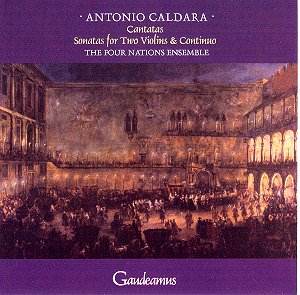
 The Four Nations Ensemble (Jennifer Lane (mezzo-soprano),
Ryan Brown and Claire Jolivet (violins), Loretta
O’Sullivan (cello) and Andrew Appel (harpsichord
and director))
The Four Nations Ensemble (Jennifer Lane (mezzo-soprano),
Ryan Brown and Claire Jolivet (violins), Loretta
O’Sullivan (cello) and Andrew Appel (harpsichord
and director))