Imposed discovery is probably the greatest benefit
to being a music critic. Were it not for the numerous discs that
come across my desk that I am obligated by my agreement with this
web site to listen to and review, I dare say that there would
still be a great deal of music with which I would never have taken
the personal time to become acquainted. The music of Nikolai Myaskovsky
is one such case, and for the record, I have found yet another
treasure trove of splendid music. I encourage you the reader to
explore it alongside me.
A prolific composer, Myaskovsky was born near
Warsaw of Russian military parentage in 1881. A relative latecomer
to compositional study, he entered the St. Petersburg conservatory
at the age of twenty-five, where he was the student of Liadov
and Rimsky-Korsakov. Amongst his fellow students was a young Sergei
Prokofiev, ten years Myaskovsky’s junior. He graduated in 1911,
but the auspicious beginning to his musical career was interrupted
when he was forced to join the military during the First World
War. The trauma he suffered during that conflict was to affect
him for the rest of his life.
Never an ultra-modernist, his compositional style
lies somewhere between the late Russian romantics and that of
his fellow student, Prokofiev. The Symphony number 24 was written
in memory of Vladimir Derzanovsky, a prominent musicologist and
publisher, and a close friend. Like most of his Soviet colleagues,
he had been evacuated during the Second World War, and news of
his friend’s death reached him some time after the fact. When
he was allowed in 1943 to return to Moscow, he began sketching
the symphony, only to learn of the death of Rachmaninoff, another
of his major influences, shortly after composition had begun.
There is a certain sense of melancholy about
the work, however, it is far from a dirge. Rather, it seems more
a solemn affirmation of the lives of his departed friends. Complete
with a goodly battery of percussion and instruments, and a number
of solid brass fanfares, this work is serious, but not depressing.
It has a sweep and grandeur about it, but these elements are held
perfectly in check by the taut structure of the movements. Never
saying more than is necessary, Myaskovsky adheres mostly to traditional
formal structures.
The playing is of the first order, although there
might be the occasional over-blowing by the brass and winds with
which a purist may quibble. On the whole though, maestro Yablonsky
delivers well-honed performances with just the right combination
of abandon and restraint. The Twenty-Fifth Symphony is a good
deal more melodic and atmospheric, and dare I use such a trite
term, pretty. Opening with a set of variations on a typically
Russian theme as opposed to the more traditional sonata form,
this work was seen by the Soviet authorities as an "epic
portrayal of the Fatherland." (That is quoting the program
notes, but am I not mistaken that the Russians refer to their
home as the motherland?)
In summation, I find it a crime that the music
of this fine composer continues to lie around in relative obscurity.
It deserves a more prominent place in the concert hall, and I
encourage the audience of listeners here to expand their horizons
by learning of Myaskovsky’s music.
Sound quality is of the first order, and the
program notes are informative and well written. Recommended very
highly.
Kevin Sutton
see also reviews by Rob
Barnett and Jonathan
Woolf
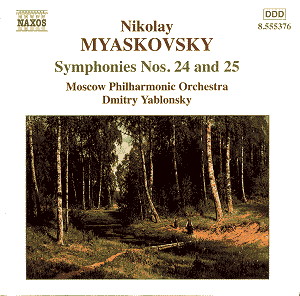
 Moscow Philharmonic
Orchestra/Dmitri Yablonsky
Moscow Philharmonic
Orchestra/Dmitri Yablonsky