These two symphonies were composed during Myaskovsky’s
last decade. The 24th was a product of his wartime
evacuation and was begun in March 1943, completed by the end of
August and premiered by Mravinsky in Moscow in December of that
year. In three movements of almost equivalent length, it’s a work
of appealing character written in Myaskovsky’s characteristic
vein of noble seriousness. The horn call to arms of the opening
Allegro deciso is followed by brass power, dynamic bass pizzicati
and the unveiling of a consolingly eloquent lyricism in the orchestra.
The gravity is accompanied by an ominous percussion part that
hints at the unsettledness of all that we are privy to before
the return of the brass but not forebodingly now … more in a contemplative
way. Myaskovsky is often criticised for obvious thematic development
and for pat overuse of cyclical elements in his writing but as
has been seen before it depends how acute the ear of the conductor.
A plodder will recycle; a thinker will subtly inflect and change
the character of the music or will allow Myaskovsky’s voice true
space. Yablonsky, thankfully, falls into the latter category.
The Molto sostenuto is quite brisk in his hands – melodically
he drives things forward. In the identical coupling on Melodiya
back in the early 1990s Svetlanov took something of a leisurely
view of the movement, allowing it to expand, but Yablonsky does
allow the gravity of the lyricism to emerge and underscores the
simplicity with which the movement ends, the reconciliatory strings
predominant. Myaskovsky wrote wonderfully evocatively for woodwind
and there’s ample evidence in the finale. The verdancy here prefigures
some dogged writing later on – it’s most instructive to listen
to the oppositional writing here - declamatory and hectic and
then lyrically generous. Indeed the ending itself is withdrawn,
secretive, and ambiguous. A symphony that demands investigation.
The 25th, the D flat major, followed
three years later, Myaskovsky having written the work in 1946.
One of his staunchest champions – and still one of his most acutely
penetrative executant interpreters - Alexander Gauk premiered
it in the Great Hall of the Moscow Conservatoire in March 1947.
The opening adagio is graced by a long-breathed melody of wistfulness,
flecked by a favoured clarinet. Throughout he cultivates a cellistic
sonority – it’s tempting to call this autumnal but it doesn’t
really have that quality. The central moderato is very brief,
a slither of a piece only four minutes long but the weight falls
on the Allegro impetuoso finale. This opens in a vigorous, rather
bluff way that soon relaxes into a very special eloquence. Admirers
won’t need telling from me how acutely understanding Myaskovsky
is of the inevitable-seeming unfolding of a benevolent and affectionately
lyrical line. The dramatic bursts that interrupt this threaten
fugato development as they often do in Myaskovsky. As with the
earlier work declamatory outburst and rhythmic drive contrast
in an oscillatory way with moments of reflective intimacy. Yablonsky
is good at extracting a genuine weight of Miaskovskian bass sonority
and at developing equally a sense of philosophic seriousness and
resolution.
Indeed he secures an excellent sense of weight
and balance throughout. This is vibrant and sensitive playing
and does Myaskovsky proud. The recent mini proliferation of Myaskovsky
on disc will gladden many a heart and here’s another reason to
be content. No complaints at all about the disc? None.
Jonathan Woolf
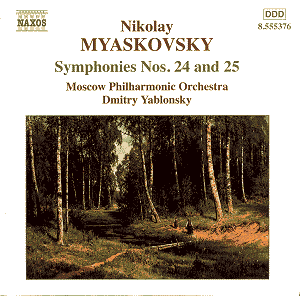
 Moscow Philharmonic Orchestra/Dmitry
Yablonsky
Moscow Philharmonic Orchestra/Dmitry
Yablonsky