Mozart is sometimes
berated as being the ear candy of conservative
classical radio stations. However one
need only listen to this splendid music
to appreciate the genius of the man
anew. These are works of uncommon beauty
and elegance, and yet they also contain
an enormous emotional range. There is
a soulfulness about them that is of
uncommon appeal.
Mozart composed his
oboe quartet K. 370 for the young Mannheim
oboist Friedrich Ramm who was appointed
to the court orchestra there when a
mere fourteen years old. The delicacy
and fluidity of Ramm’s playing is what
led the composer to in effect write
a chamber concerto for the youthful
virtuoso. Sewn throughout with sunny
singable melodies, it is a work of buoyant
optimism and charm. This is a tight
and spirited performance with some amazingly
fleet passagework by oboist Joris van
den Hauwe. The performance is marred
slightly by some questionable intonation
from the strings, but on the whole,
it is a rendition that has more delights
than detriments.
The unfinished C major
Adagio is performed here in what is
only an estimation of the composer’s
original instrumentation intentions.
Only twenty-eight bars of the lower
parts were completed. Mozart did not
indicate specific instruments other
than the English horn part, which he
completed. This is a sweetly solemn,
church-like work that hints melodically
of the famous motet Ave verum corpus.
It is played here with a rich burnished
tone from the English horn, and the
editorial decision to use violins and
cello as the underlying ensemble works
quite well.
The quintet in C minor,
K 406a is a reworking of a reworking.
Originally a wind serenade (K. 388),
Mozart arranged the piece for string
quintet, a genre made popular by Michael
Haydn, to fill out a set of three such
works that included the quintets K.
515-516. Here the present ensemble has
given the first violin part over to
the oboe, with some rather vague claim
in the program notes that the choice
is justified by the oboe’s tone being
closest to that of the human voice.
(Whatever that may mean?!) It is nonetheless
a convincing and pleasant combination
of instruments, and on the whole well
executed, although the string intonation
problems creep in again at some rather
inopportune moments.
Late in his life, Mozart
came to know the Glass armonica (sic),
an instrument developed by Benjamin
Franklin, played by moistened fingers
upon tuned bowls of glass. Given the
instrument’s limited dynamic range,
Mozart kept the work relatively brief,
but still managed to craft some splendid
music. For what is ostensibly a novelty
work, the Adagio and Rondo is surprisingly
dramatic, and Mozart very cleverly adapts
to the limitations of the instrument
by using it more in dialogue with the
ensemble rather than as an equal partner.
This is a lovely performance indeed,
and Dennis James is quite able to make
his instrument sing with great expression.
All in all, this is
a pleasant disc of somewhat unusual
chamber music, and is a worthwhile addition
to one’s collection. I found that the
oboe was brought a bit too far to the
fore, giving it more of a soloistic
quality than perhaps that called for
by the composer, but this is a minor
complaint. Program notes are a bit rambling
and are not particularly enlightening.
Recommended with a couple of minor caveats.
Kevin Sutton
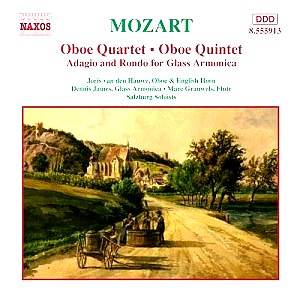
 Joris van den Hauwe, oboe and English horn, Dennis
James, Glass armonica, Marc Grauwels, flute, The
Salzburg Soloists, Luz Leskowitz, leader
Joris van den Hauwe, oboe and English horn, Dennis
James, Glass armonica, Marc Grauwels, flute, The
Salzburg Soloists, Luz Leskowitz, leader